

Key Takeaways
-
There is no single universal peptide blood panel; the right tests depend on the specific peptide, your goals, and your health history, and a licensed clinician should explain each test.
-
A practical baseline panel for most people includes a CBC, comprehensive metabolic panel, fasting glucose or HbA1c, and a lipid panel, giving a 'before' picture to compare against later.
-
Growth hormone axis peptides may call for age-adjusted IGF-1 plus glucose markers, since tesamorelin's FDA label warns of glucose intolerance or diabetes and recommends monitoring glucose.
-
Blood tests cannot confirm that a compounded peptide is pure, correctly dosed, or effective, because the FDA does not review compounded drugs for safety, effectiveness, or quality before marketing.
-
There is no evidence-based retesting schedule for all peptides; follow the drug's prescribing information and your clinician's judgment, and repeat labs sooner if symptoms or side effects change.
-
Don't stop medications or peptides before a blood draw without asking your provider first, and share your full list of medicines and supplements, since they can affect results and fasting requirements vary by test.
If you’ve been reading about peptide therapy, you’ve probably hit the same question everyone does: what blood panel is needed for peptides? It’s a smart thing to ask. Labs are how a good clinician learns about your body before choosing any plan. They are also how you keep an eye on things once you start.
Here’s the honest answer. There is no single, universal peptide blood panel. The right tests depend on the specific peptide or medicine, the reason you want it, and your own health history. Some people need a short list. Others need a longer one. A licensed clinician should explain why each test is on the list.
In this friendly guide, we compare two approaches: a basic baseline panel and a targeted, peptide-specific panel. You’ll see what each one covers, who needs what, and how to decide. Whether you’re a data-loving biohacker, a busy professional, or simply someone who wants to feel better with age, this will help you walk into your first visit feeling prepared and confident.
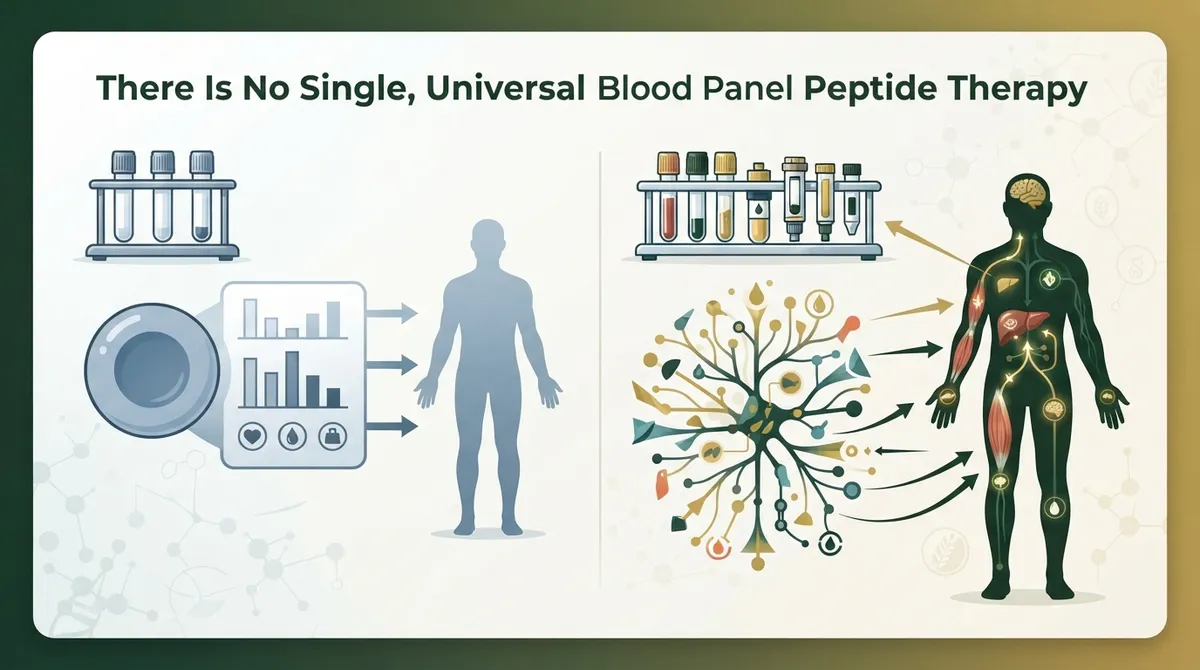
The Short Answer: There Is No One-Size-Fits-All Panel
Peptides are a broad group. Some are FDA-approved medicines with detailed prescribing information. Others are promoted for wellness, and the human research behind them is limited. Because of that, your labs should match the actual plan, not a generic checklist.
A practical way to think about it is in two layers:
- Layer one: a general baseline that checks your overall health.
- Layer two: targeted tests that match the specific peptide, goal, and your history.
A broad panel is not automatically needed for every peptide. But a thoughtful baseline is a smart starting point for most people. If you’d like a deeper walk-through of this topic, our guide on lab work for peptide therapy: what to test and why is a good companion read.

Basic Baseline Panel: The Foundation
Think of the baseline panel as a health snapshot. It doesn’t tell you which peptide is right. It tells your provider whether your body is ready and whether anything needs attention first.
What a Baseline Panel Usually Includes
Most clinicians start with these four categories:
- Complete blood count (CBC): checks red cells, white cells, and platelets. It can hint at anemia, infection, or other blood issues.
- Comprehensive metabolic panel (CMP): looks at kidney function, liver function, electrolytes, and blood sugar.
- Fasting glucose or HbA1c: shows how well your body handles sugar. HbA1c reflects your average blood sugar over roughly the past two to three months, according to the CDC and NIDDK.
- Lipid panel: measures cholesterol and triglycerides to gauge cardiovascular risk.
These tests are common, widely available, and not expensive. They also give you a “before” picture to compare against later.
What the Baseline Can and Can’t Do
A baseline panel is great for spotting red flags. For example, if your kidney or liver numbers look off, your provider may pause and investigate before moving forward. If your blood sugar is running high, that matters for certain peptides.
But a baseline is not a substitute for a peptide-specific evaluation. It also can’t tell you whether a product is pure, properly dosed, or effective. We’ll come back to that point, because it’s important.
Targeted Panel: Matching Labs to Your Peptide
Now for layer two. Once your clinician knows which type of peptide you’re considering, they may add tests that fit that choice.
Growth Hormone Axis Peptides
Some peptides, such as growth hormone secretagogues, work through the growth hormone pathway. For these, clinicians may check age-adjusted IGF-1 along with glucose markers like fasting glucose or HbA1c. Lipids may matter too.
Here’s a helpful example. The FDA-approved prescribing information for tesamorelin (Egrifta SV) warns that it may cause glucose intolerance or diabetes. It recommends checking glucose status before and during treatment. The monitoring schedule is individualized to the patient.
One caution: IGF-1 results must be read in context. A single IGF-1 number is not enough to diagnose growth hormone deficiency. It’s one piece of a bigger puzzle. To learn more about how this class works, see our overview of growth hormone peptides: what they are and how they work.
GLP-1 Medicines
GLP-1 medicines are FDA-approved for certain conditions, so monitoring should follow the product label and your condition. Routine lipase testing in people without symptoms is not a universal requirement. Your provider will decide what makes sense for you. Curious about the basics? Here’s how to understand GLP-1 peptide therapy in 2026.
Conditional Add-On Tests
Other tests are added only when there’s a reason. Examples include:
- Thyroid tests if you have fatigue, weight changes, or a thyroid history.
- Hormone tests if symptoms or goals point that way.
- Pregnancy testing when the medicine calls for it.
- Other markers based on your history and the clinical question.
Your clinician should explain why each test is being ordered. If a clinic can’t tell you, that’s worth noticing.
Side-by-Side: Baseline vs. Targeted Panels
Here’s a quick comparison to make the difference easy to see.
| Feature | Basic Baseline Panel | Targeted Panel |
|---|---|---|
| Purpose | General health snapshot | Match labs to a specific peptide or goal |
| Typical tests | CBC, CMP, glucose or HbA1c, lipids | IGF-1, thyroid, hormones, or others as needed |
| Who needs it | Most people starting care | People using specific peptide classes or with relevant history |
| Strength | Spots red flags early | Personalizes monitoring |
| Limitation | Not peptide-specific | Only useful when ordered for a clear reason |
The takeaway: most people benefit from the baseline, and the targeted layer gets added when it’s justified.
Which Tests Matter for Which Goal?
Another way to look at it is by goal. This table shows how labs often line up with common reasons people explore peptides. It is a general guide, not medical advice.
| Common Goal | Labs a Clinician May Consider |
|---|---|
| Energy and recovery | CBC, CMP, glucose or HbA1c, thyroid if symptoms fit |
| Growth hormone axis support | Age-adjusted IGF-1, glucose markers, lipids |
| Weight management with GLP-1 | Baseline panel, plus tests based on your condition and the label |
| Hormone-related symptoms | Baseline panel, plus relevant hormone tests |
| Injury or tissue recovery | Baseline panel, plus history-driven tests |
For biohackers, this is where data really shines. Tracking your numbers over time tells you far more than a single snapshot. If that’s your style, read our piece on how to use biomarker testing to guide peptide therapy.
What Blood Work Cannot Do
This part matters, so let’s be clear and kind about it. Blood tests are helpful, but they have limits.
Labs cannot confirm that a peptide product is pure, accurate in dose, or effective. The FDA states that compounded drugs are not FDA-approved and are not reviewed by the FDA for safety, effectiveness, or quality before they are marketed. Lab monitoring cannot fill that gap.
Many peptides promoted for wellness or research use also have limited human safety and efficacy data. Blood tests can’t remove risks from uncertain dosing, product quality, drug interactions, or unknown side effects.
So what should you do? Work with a licensed provider, ask where products come from, and understand the difference between approved and compounded options. Our article on FDA-approved vs. compounded peptides breaks this down in plain language. You can also review general background on what are peptides to get comfortable with the basics.
How Often Should Labs Be Repeated?
This is one of the most common questions, and the honest answer is: it depends. There’s no evidence-based schedule that applies to every peptide.
Some commercial sources suggest rechecking at 4 to 8 weeks or every 3 to 6 months. Those numbers show up a lot, but they are not a universal clinical guideline. The best rule is to follow the drug’s prescribing information and your clinician’s judgment.
Here’s a simple way to approach timing:
- Get a baseline before you start. This is your “before” picture.
- Ask your provider when to recheck. It should fit your specific plan and risks.
- Repeat sooner if symptoms change. New side effects are a good reason to call.
- Keep your records together. Trends over time are more useful than any single result.
If you want to see how follow-up fits into a full plan, check out 5 blood panel for peptide therapy tests to know in 2026 and 5 blood work analysis steps before peptides.
Practical Tips for Your Blood Draw
A little prep helps your results mean more. Keep these friendly tips in mind:
- Ask about fasting. Some tests, like fasting glucose and lipids, may require it. Your provider will tell you.
- Share everything you take. Medications, supplements, and any current peptides can affect results.
- Don’t stop medicines on your own. Ask your clinician first if you’re unsure whether to pause anything before a draw.
- Hydrate and rest. A calm, well-hydrated morning makes the draw easier.
- Bring your history. Past labs, family history, and symptoms all help your provider choose the right tests.
Busy professional? Good news. Many people complete labs at a local draw site on their own schedule, then review results over a virtual visit. That’s the beauty of telehealth care.
How Allura Longevity Handles Labs
At Allura Longevity, labs are the first step, not an afterthought. Clients begin with a $50 virtual consultation and then complete blood work through LabCorp. From there, a licensed provider designs a customized six-month plan based on your results and goals. Care includes ongoing monitoring and adjustments, led by Ashley, a board-certified Family Nurse Practitioner.
Treatment plans are delivered right to your home, and telehealth is available in Florida, Georgia, Texas, Connecticut, Indiana, Maryland, New York, and California. Whether you’re exploring peptides for women or peptides for men, the approach is the same: test first, personalize second, monitor along the way.
Want to see how the process works from the very start? Our guide on how to start peptide therapy safely and see real results covers it step by step. For a broader look at monitoring and safety, see the National Library of Medicine for peer-reviewed background on peptide-based therapeutics.
So, Which Panel Wins?
Neither wins on its own. The best approach combines both. Start with a solid baseline, add targeted tests when there’s a clear reason, and let a licensed clinician guide the choices. That keeps you safe, avoids unnecessary testing, and helps your plan stay personal.
If you’re ready to take the next step, we’d love to help. Request a consultation with Allura Longevity to talk through your goals and get the right labs for you. Spots for new clients are limited each month, so reach out soon. You can also call us at (813) 510-6277. Your future self will thank you for starting smart.
FAQs
Q: What blood tests should I get before starting peptide therapy?
A: Most clinicians start with a baseline that includes a CBC, a comprehensive metabolic panel, fasting glucose or HbA1c, and a lipid panel. From there, your provider may add targeted tests, like age-adjusted IGF-1 for growth hormone axis peptides, based on your plan and history. The exact list should be chosen by a licensed clinician.
Q: Do I need IGF-1 testing before taking growth hormone-releasing peptides?
A: Often, yes. Clinicians may check age-adjusted IGF-1 along with glucose markers for growth hormone axis treatments. Just remember that IGF-1 results need clinical context and shouldn’t be used alone to diagnose growth hormone deficiency.
Q: How often should blood work be repeated during peptide therapy?
A: There’s no universal schedule that fits every peptide. Your timing should follow the medicine’s prescribing information and your clinician’s judgment. Some sources mention checks every few weeks or months, but those are not a single clinical rule.
Q: Can blood tests prove a compounded peptide is safe?
A: No, and that’s an important point. The FDA does not review compounded drugs for safety, effectiveness, or quality before they are marketed. Lab work can track how your body responds, but it can’t confirm a product’s purity, dose, or effectiveness.
Q: Should I stop my medication before a peptide blood test?
A: Please don’t stop any medication or peptide on your own. Ask your provider first, since some tests need fasting and others don’t, and the right advice depends on what you take. Always share your full list of medicines and supplements before your draw.





