

Key Takeaways
-
BHRT and peptide therapy are different categories: BHRT uses hormones like estradiol, progesterone, and testosterone, while peptides are short amino acid chains that act as signaling molecules. Each needs its own evidence and safety review.
-
"Bioidentical" describes chemical structure only, not safety or effectiveness. Some FDA-approved estradiol and progesterone products are bioidentical, and approved products are usually the first choice when they meet your needs.
-
The Endocrine Society states that comprehensive trials proving the safety and efficacy of custom-compounded bioidentical hormones are lacking, and it advises against routine use when FDA-approved options exist.
-
Hormone testing during BHRT should be tied to a specific clinical reason, not used to chase a target number, since the Endocrine Society does not support routine serial testing to make compounded therapy safer.
-
For menopausal hormone therapy, risks are generally small when started before age 60 or within 10 years of menopause, but your personal health history and regimen determine your actual risk.
-
When evaluating a clinic, verify a licensed prescriber, ask about FDA-approved options first, confirm sourcing and follow-up plans, and be wary of guarantees or claims that custom always beats approved products.
If you’ve been searching for medically supervised BHRT peptides, you’ve probably noticed something confusing. Clinics use these terms together all the time, as if they mean the same thing. They don’t. And knowing the difference can help you ask better questions, spot red flags, and feel confident about the care you choose.
Here’s the short version. BHRT stands for bioidentical hormone replacement therapy. It uses hormones that are chemically identical to the ones your body makes, like estradiol, progesterone, and testosterone. Peptide therapy uses short chains of amino acids to send signals in the body. Hormones are not peptides, and peptides are not hormone replacement. A good clinic can offer both, but each one needs its own evidence, its own safety plan, and its own follow-up.
In this friendly guide, we’ll walk through what “medically supervised” should really look like in 2026, how BHRT and peptides differ, what the research says about compounded products, and how to size up a provider. Whether you’re a busy professional, a data-loving biohacker, or simply curious about aging well, you deserve clear answers. Let’s dig in.

What Does “Medically Supervised BHRT” Actually Mean?
“Medically supervised BHRT” means a licensed clinician guides your hormone treatment from start to finish. That includes your history, your risks, your prescription, and your follow-up. It is a care process, not a magic label.
Here’s an important point. Supervision alone does not make a treatment safe, effective, or FDA-approved. It simply means a trained professional is making decisions with you and watching how you respond. That is valuable, but it is not a guarantee.
Also, the word “bioidentical” only tells you about chemical structure. It does not mean a product is automatically safer or more effective. Some FDA-approved estradiol and progesterone products are bioidentical, and they have gone through regulatory review. That is a big deal, and we’ll come back to it.
What good supervision looks like
A well-run program usually includes these steps:
- A full health history. Your clinician asks about symptoms, past conditions, family history, and medications.
- A risk review. This includes things like blood clot history, breast health, heart health, and liver health.
- Labs tied to a reason. Testing should answer a real clinical question, not just collect numbers.
- A discussion of approved options first. You should hear about FDA-approved choices before anything custom.
- A clear prescription plan. Dose, delivery method, and goals are explained in plain language.
- Scheduled follow-up. Your provider checks response and side effects, then adjusts as needed.
If a clinic skips most of these steps, that’s worth a pause. Real supervision is hands-on and ongoing.
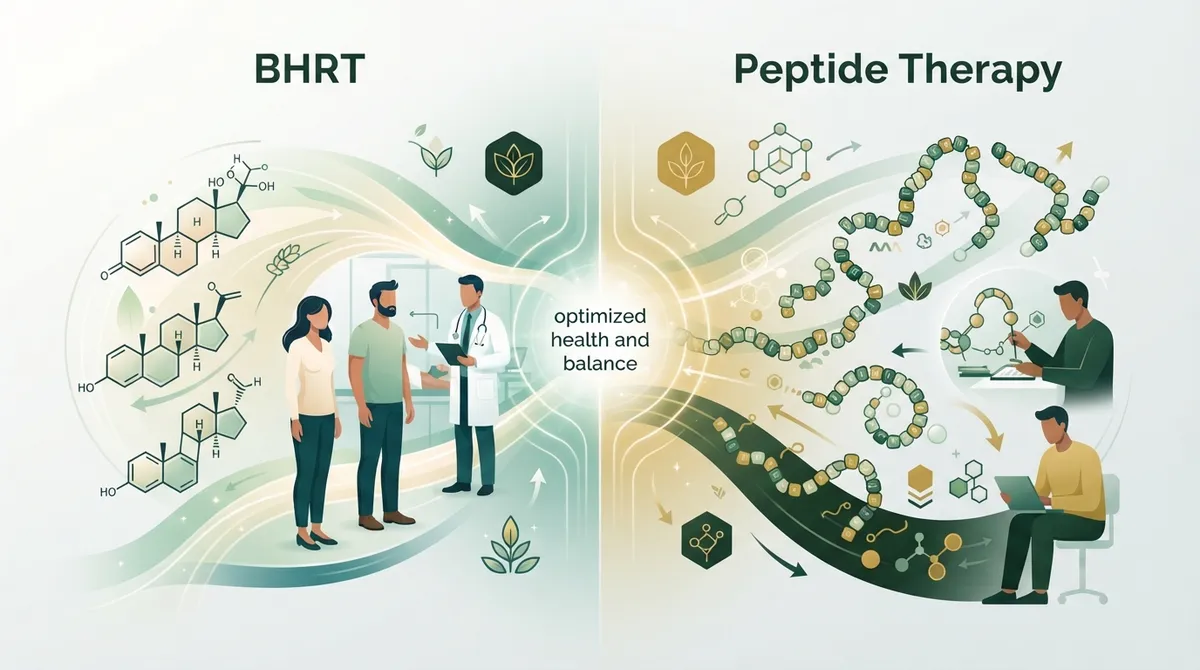
BHRT vs. Peptide Therapy: Are They the Same Thing?
No, they are two different categories. This is the biggest mix-up in the space, so let’s clear it up with a simple comparison.
| Feature | BHRT | Peptide Therapy |
|---|---|---|
| What it is | Hormones identical in structure to those your body makes | Short chains of amino acids that act as signaling molecules |
| Common examples | Estradiol, progesterone, testosterone | Sermorelin, ipamorelin, BPC-157, GLP-1 medicines |
| Main goal | Replace hormones that have declined | Support specific body signals, such as growth hormone release, recovery, or appetite |
| Regulation | Some products are FDA-approved; compounded versions are not | Varies widely by specific peptide |
| Evidence level | Strong for approved menopausal therapy; limited for custom compounded blends | Strong for a few approved drugs; emerging or limited for many others |
So when someone says “BHRT peptides,” they usually mean a clinic that offers both services. That can be a great setup, because a provider who understands both can look at the whole picture. Just remember that each treatment must be judged on its own merits.
If you’re still wondering which route fits you, our guide on how to choose between bioidentical hormones and peptides breaks it down further. And if you want a quick refresher on the basics, here are 8 facts that explain what are peptides in 2026. For a general overview from a trusted health site, you can also read about what are peptides.
Are Bioidentical Hormones FDA-Approved?
Some are, and some are not. This is where many people get tripped up.
FDA-approved bioidentical products exist. For example, there are approved estradiol and progesterone products in different forms. These went through review for safety and effectiveness, and their doses are consistent from batch to batch.
Custom-compounded BHRT is different. A compounding pharmacy mixes these products to order. They are not subject to the same FDA premarket review for safety and effectiveness as approved drugs.
| Question | FDA-Approved Bioidentical Products | Custom-Compounded BHRT |
|---|---|---|
| Premarket FDA review? | Yes | No |
| Dose consistency | Standardized | Can vary |
| Large safety and efficacy trials? | Yes, for approved products | Comprehensive trials are lacking |
| Best use | First choice when a suitable product exists | Specific clinical needs approved products cannot meet |
The takeaway is simple. “Bioidentical” is not the same as “FDA-approved,” and “custom” is not the same as “better.”
Is Compounded BHRT Safer or Better Than Approved Options?
This is a fair question, and the honest answer is that there is no proof it is. The Endocrine Society states that comprehensive trials establishing the safety and efficacy of custom-compounded bioidentical hormone therapy for symptom relief are lacking. It advises against routine use when FDA-approved products are available.
There are also quality concerns. The Endocrine Society’s scientific statement describes a lack of standardization and quality control in custom-compounded hormone production. Possible issues include:
- Underdosing, which can leave symptoms untreated
- Overdosing, which can raise the risk of side effects
- Contamination, which can cause infections or other problems
- Poor labeling, which makes it hard to know what you’re actually taking
None of this means compounding is always bad. It means it should be used with care and for a reason.
When might compounding make sense?
A clinician may consider a compounded product when a patient has a specific need that an approved product cannot meet. Common examples include:
- An allergy to an ingredient in an approved product
- A needed dose or form that is not commercially available
- A temporary shortage of an approved option
In these cases, compounding can be a reasonable tool. It just shouldn’t be sold as inherently safer or more personalized in a way that’s proven to improve outcomes. For a deeper look, see our guide on how to choose safe custom compounded hormone therapy.
Do You Need Constant Hormone Testing During BHRT?
Not necessarily, and this one surprises people, especially data-driven biohackers who love tracking everything. Many clinics promote frequent saliva or blood testing and then adjusting doses to hit a target number.
The Endocrine Society does not support the idea that routinely measuring and replacing hormones to a target, or using serial saliva or blood testing, makes compounded therapy safer or more effective for estrogen, progestin, and DHEA treatment. Testing should be tied to a clinical reason.
That said, smart testing still matters. Labs can help screen for underlying issues, check for safety concerns, and guide care when there is a real question to answer. For testosterone therapy in men, for example, monitoring is a standard part of safe care. The key idea is purpose. Every test should have a reason, and your provider should be able to explain it.
If you’re curious how labs fit into a peptide plan, we cover that in 5 blood work analysis steps before peptides in 2026.
What Risks Should You Talk About Before Starting?
Every treatment has trade-offs, and a trustworthy provider will walk through them with you. For menopausal hormone therapy, the Endocrine Society notes that risks are generally small when therapy begins in women younger than 60 or within 10 years of menopause. That is encouraging, but it is not a guarantee. Your own risk depends on your health history and the specific regimen.
Before starting BHRT, ask your clinician to discuss:
- Your personal and family history of blood clots, stroke, heart disease, and cancer
- How your age and time since menopause affect your risk
- Whether an FDA-approved product could meet your needs
- Possible side effects, such as breast tenderness, mood changes, or bleeding
- What symptoms should prompt you to call right away
Peptides have their own questions. Some, like GLP-1 medicines, have strong research behind them for certain uses. Others have much less human evidence. Ask what the evidence is for your specific peptide, and whether it is approved for your goal. Our article Is peptide therapy safe? What you really need to know is a helpful next read.
How Do Hormones and Peptides Work Together in a Clinic?
A clinic can legitimately offer both. Think of it like this: hormones are the big messengers your body runs on, while peptides are more like targeted signals that nudge certain systems. A provider may use one, the other, or both, depending on your goals and your labs.
For example, a woman in perimenopause might focus first on hot flashes and sleep, where approved hormone therapy has the strongest evidence. A man with fatigue and low testosterone may start with a workup and a discussion of testosterone options. Someone focused on recovery or metabolic health may explore peptide options on top of that.
The key is that each piece should be justified on its own. No bundle should be treated as a package deal just because it sounds modern. You can explore related reading on how hormone therapy works with peptides and peptides for women or peptides for men to see how personalization can look in practice.
How Can You Evaluate a Clinic That Offers BHRT and Peptides?
Choosing a clinic is a big decision, and you deserve to feel confident. Use this checklist as a starting point:
- Check the license. Make sure the prescriber is a licensed medical provider in your state.
- Ask about approved options. A good provider talks about FDA-approved products first, then explains why anything else is needed.
- Ask how products are sourced. Find out where medications are made and how quality is checked.
- Look for honest language. Be cautious of promises like “proven” or “guaranteed” or claims that custom always beats approved.
- Confirm the follow-up plan. You should know when you’ll check in and how doses may change.
- Request clear pricing. Costs should be upfront, with no surprise fees.
Telehealth can be a wonderful option here, especially for busy people. It lets you meet with a licensed provider, complete labs locally, and get treatment delivered home. If you’re weighing your options, read Local Clinic vs. Telehealth: Best Peptide Therapy Near You? You can also review how to get prescription peptides safely in 2026.
For extra background on peptide research, the National Library of Medicine is a reliable place to explore published studies.
What Does Medically Supervised Care Look Like at Allura Longevity?
At Allura Longevity, care is built around the basics we’ve covered: real evaluation, licensed oversight, and ongoing follow-up. It starts with a $50 virtual consultation. From there, you complete blood work through LabCorp, and your licensed provider reviews your results alongside your history and goals.
Your plan is then built for you, not pulled off a shelf. Clients receive a customized six-month treatment plan, with medications delivered right to their door. Along the way, your provider monitors your progress and adjusts your plan as needed. Care is led by Ashley, a board-certified Family Nurse Practitioner, and telehealth is available in Florida, Georgia, Texas, Connecticut, Indiana, Maryland, New York, and California.
Services focus on energy, sleep, mental clarity, immune support, skin rejuvenation, muscle recovery, metabolism, and sexual wellness, along with GLP-1 weight loss, BPC-157 for injury recovery, and testosterone replacement. And because every body is different, your treatment is matched to your needs and what the evidence supports.
Ready to Take the Next Step?
The best health decisions come from clear information and a team you trust. Medically supervised care means more than a prescription. It means thoughtful evaluation, honest conversations about evidence, and follow-up that keeps you safe and supported. Hormones and peptides are different tools, and the right plan starts with understanding which one, if either, fits you.
If you’re ready to explore personalized, licensed-provider care from the comfort of home, we’d love to meet you. New client spots are limited each month, so don’t wait too long. Request a consultation today, or call us at (813) 510-6277 to get started.
FAQs
Q: What does medically supervised BHRT mean?
A: It means a licensed clinician guides your hormone treatment, from reviewing your history and risks to prescribing and following up on how you respond. Supervision is a care process. It does not on its own prove a treatment is effective, safe, or FDA-approved.
Q: Are bioidentical hormones the same as peptide therapy?
A: Nope, they’re different. Bioidentical hormones like estradiol, progesterone, and testosterone are not peptides, while peptides are short chains of amino acids. A clinic can offer both, but each needs its own evidence and safety review.
Q: Is compounded BHRT safer than FDA-approved hormone therapy?
A: There’s no proof that it is. The Endocrine Society notes that comprehensive trials for compounded bioidentical hormones are lacking, and compounded products can vary in dose and quality. Approved products are usually the first choice when one fits your needs.
Q: Do hormone levels need to be tested regularly during BHRT?
A: Testing should be tied to a clear clinical reason, not done just to chase a target number. The Endocrine Society does not support routine serial testing as a way to make compounded therapy safer or more effective. Ask your provider why each test is being ordered.
Q: How should I evaluate a clinic that offers both BHRT and peptide therapy?
A: Look for licensed providers, a discussion of FDA-approved options first, clear sourcing, honest claims, and a real follow-up plan. If a clinic promises guaranteed results or says custom always beats approved, take that as a cue to ask more questions.





