
Key Takeaways
-
A truly personal BHRT plan starts with your goals, symptoms, medical history, and lab work, and dose, hormone type, and delivery route should be adjusted over time rather than fixed.
-
Personalization is well supported for hormone choice, dose, and route, but there is no standard 'BHRT peptide plan' backed by large trials, so each peptide must be judged on its own evidence.
-
The Endocrine Society states no comprehensive trial has established the safety or efficacy of compounded bioidentical hormone therapy, so ask why a specific compounded product was chosen for you.
-
Saliva testing is not supported as a reliable way to set hormone doses, while blood tests offer a snapshot that should be read alongside symptoms since hormone levels naturally fluctuate.
-
If you have a uterus and use systemic estrogen, a progestogen is generally needed to protect the uterine lining, a clear example of evidence-based personalization.
-
Red flags include no labs or history review, the same protocol for everyone, guaranteed anti-aging promises, and no scheduled follow-up or reassessment.
Ever wonder how personal a BHRT peptide plan really is? You are not alone. Many people hear words like “customized” and “tailored” and wonder what is behind them. Is it a true one-of-a-kind plan, or just a stock plan with your name on it?
Here is the honest answer. A good plan can be personal in real, meaningful ways. A clinician can shape your goals, dose, route, and follow-up around your symptoms, health history, and lab results. But “personal” does not mean “proven.” Major medical groups still ask for evidence, safety checks, and regular reviews. And there is no single, standard “BHRT peptide plan” backed by large trials. So each piece of a plan should be judged on its own.
In this guide, we walk through 14 ways a plan gets personal, what is solid science, and what is just marketing. Whether you are a health optimizer, a busy professional, or a data-loving biohacker, you will leave knowing what to ask and what to expect. Let’s dive in.

What Does “BHRT Peptide Plan” Actually Mean?
The phrase blends two different things, so let’s pull them apart.
BHRT stands for bioidentical hormone replacement therapy. It uses hormones that are chemically identical to the ones your body makes. Some bioidentical options are FDA-approved. Others are custom-mixed by compounding pharmacies, which is a different category with different rules.
Peptides are short chains of amino acids. Some have approved medical uses. Others are still being studied. If you want a quick refresher, see 8 Facts That Explain What Are Peptides in 2026 or this overview of what are peptides.
Putting them together is a choice, not a rule. Sources we reviewed support individualized menopausal hormone therapy. They do not show that adding peptides improves hormone therapy outcomes. That is why a smart plan treats each part separately.
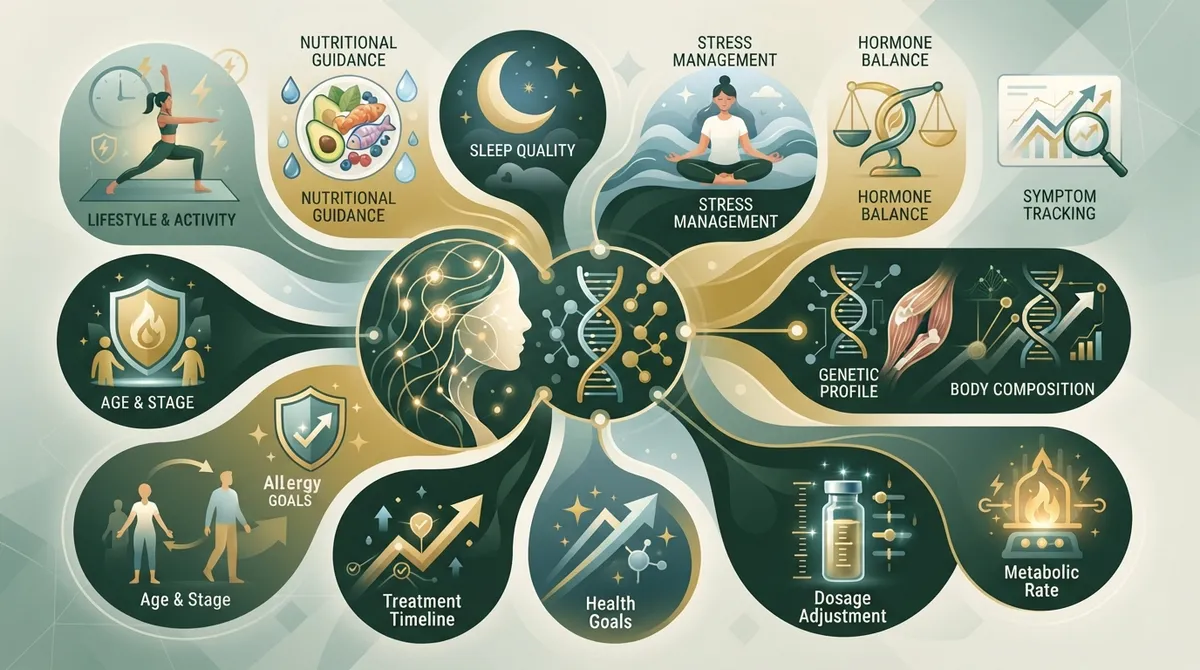
14 Ways a BHRT Peptide Plan Can Be Personal
1. It Starts With Your Goals
A personal plan begins with what you want. Better sleep? Steadier energy? Hot flash relief? Sharper focus? Your goals decide what is on the table, and just as important, what is not.
2. Your Symptoms Shape the Direction
Symptoms guide treatment. For example, systemic hormone therapy is the most effective option for hot flashes and genitourinary symptoms of menopause, according to the 2022 North American Menopause Society (NAMS) position statement. A plan should match your real symptoms, not a script.
3. Your Medical History Matters
Past health events change what is safe. A clinician should ask about blood clots, breast health, liver issues, heart health, and family history. A plan that skips this step is not personal. It is just generic.
4. Your Age and Timing Count
NAMS notes that for most healthy symptomatic women under 60 or within 10 years of menopause, the benefit-risk balance is generally favorable when there are no contraindications. Timing matters, so a personal plan considers where you are on your own timeline.
5. Your Lab Work Gives Real Data
Blood work is the backbone of a data-driven plan. At Allura Longevity, clients complete labs through LabCorp before a plan is built. Labs help flag things worth a closer look. They are a snapshot, though. Hormone levels naturally rise and fall, so one test is never the whole story.
6. The Hormone Type Is Chosen for You
Estrogen, progesterone, and testosterone each do different jobs. Which ones you need, if any, depends on your body and your goals. Our guide on which types of hormone therapy actually fit your body can help you think this through.
7. Your Dose Is Adjusted, Not Guessed
Dose is one of the most personal parts of a plan. Risks and benefits vary by hormone type, dose, duration, route, and timing. The goal is usually the lowest dose that works well for you, reviewed over time.
8. The Delivery Route Fits Your Life
Hormones can come as pills, patches, gels, creams, injections, or pellets. Each has pros and cons. Some people love a daily cream. Others prefer fewer steps. See topical hormone therapy versus oral for a closer look.
9. A Progestogen Is Added When Needed
If you have a uterus and use systemic estrogen, a progestogen is generally needed to protect the uterine lining. This is a clear example of personalization based on your anatomy, not on a trend. Learn more in 9 Facts on Progesterone Therapy for Women (2026).
10. Peptides Are Judged One at a Time
This is where honesty matters most. The word “peptide” does not prove a product is approved, safe, or right for you. Each peptide should be checked for its evidence, its approval status, and its fit for your health picture. Our post on FDA-approved vs. compounded peptides explains the difference.
11. Your Lifestyle Gets a Seat at the Table
Sleep, stress, food, movement, and alcohol all affect how you feel. A personal plan respects your real routine. Busy schedule? Telehealth and at-home delivery can make a plan far easier to follow.
12. Your Preferences Are Part of the Decision
Shared decision-making is the standard in major menopause guidance. That means you and your clinician decide together. Some people want injections. Others do not. Your comfort level is a valid input.
13. Follow-Up Is Built In
A plan is not set in stone. Periodic reassessment is a core recommendation in current guidance. Expect check-ins, symptom reviews, and possible changes. Our article on 6 steps to monitor hormone therapy safely shows what that looks like.
14. It Can Change as You Change
Your body at 45 is not your body at 55. A truly personal plan flexes with your life, your labs, and your goals. If a plan never changes, it is probably not that personal.
Where Personalization Is Backed by Evidence
Not every “custom” claim carries the same weight. Here is a simple way to sort the solid from the shaky.
| Personalization Step | Evidence Strength | What It Means for You |
|---|---|---|
| Matching treatment to symptoms and health history | Strong (major guidelines) | Expect a thorough intake and risk review |
| Choosing hormone type, dose, and route | Strong (NAMS 2022) | Risks and benefits vary by these choices |
| Adding a progestogen when you have a uterus | Strong | Protects the uterine lining |
| Periodic reassessment and dose review | Strong | Plans should be revisited over time |
| Compounded custom formulas being safer or better | Not established | Large safety and efficacy trials are lacking |
| Saliva testing to set hormone doses | Not supported | Treat this claim with caution |
| Adding peptides to improve hormone therapy results | Not established | Judge each peptide on its own evidence |
Red Flags That a Plan Is Not Really Personal
Some plans sound custom but are not. Watch for these signs:
- No labs or history review. If no one asks about your health background, that is a problem.
- The same protocol for everyone. A fixed bundle with a fancy name is not personalization.
- Promises of “optimization” or guaranteed anti-aging. Honest clinicians do not guarantee results.
- Heavy reliance on saliva testing. The Endocrine Society says evidence does not support saliva testing as a validated way to customize doses.
- Claims that compounded means safer. Compounded products are not held to the same FDA premarket review as approved drugs, and dose or purity can vary.
- No follow-up plan. Without reassessment, it is hard to know if the plan is working.
A Quick Look at the Compounding Question
Many people assume a custom-mixed formula must be better because it is made just for them. The research does not back that up. The Endocrine Society states that no comprehensive trial has established the safety or efficacy of compounded bioidentical hormone therapy for symptom relief.
That does not mean compounded products are always wrong. It means you deserve clear answers. Ask where a product comes from, how it is made, and why it was chosen for you. Our guide on how to choose safe custom compounded hormone therapy walks through smart questions, and 503A vs. 503B explains the pharmacy side.
How a Personalized Plan Typically Unfolds
While every person is different, a thoughtful plan often follows steps like these:
- Virtual consultation. You share your goals, symptoms, and health history with a licensed provider.
- Blood work. Labs give a clearer picture of where you stand.
- Risk and benefit review. Your clinician explains options, including what the evidence does and does not show.
- Plan design. Hormone and peptide choices, doses, and routes are matched to you.
- At-home delivery. Treatment arrives at your door, so it fits your schedule.
- Ongoing monitoring. Your provider checks in and adjusts the plan when needed.
That last step is where plans either shine or fade. For a deeper look, see How to Start Peptide Therapy Safely and See Real Results.
How Personal Is Personal? A Quick Comparison
| Feature | One-Size-Fits-All Plan | Truly Personalized Plan |
|---|---|---|
| Intake | Short form or none | Goals, symptoms, and full history |
| Lab work | Skipped or generic | Reviewed and used to guide choices |
| Dosing | Fixed | Adjusted over time |
| Peptide choice | Bundled by default | Chosen only if evidence and fit support it |
| Follow-up | Rare | Scheduled and ongoing |
| Claims | Big promises | Honest about limits |
Who Benefits Most From a Personalized Approach?
Different people come to this for different reasons, and a personal plan should respect each one.
- Health optimizers want steady energy, better sleep, and faster recovery, and they like seeing numbers move.
- Aging adults want to feel strong and vibrant while staying safe.
- Biohackers love data, tracking, and tweaking, which fits a plan with regular lab reviews.
- Busy professionals need care that fits a packed calendar, which is where telehealth shines.
- Wellness seekers already invest in prevention and want a medically guided next step.
Curious about options for your situation? Explore peptides for women or peptides for men.
Questions to Ask Before You Start
A great clinician welcomes questions. Bring this list to your first visit:
- What exactly is in my plan, and why was each part chosen for me?
- Is each hormone or peptide FDA-approved, compounded, or still being studied?
- What evidence supports using it for my goal?
- What are the risks for someone with my health history?
- Which labs will you review, and how often?
- How will we know if it is working, and what happens if it is not?
- How often will my plan be reviewed and adjusted?
For more ideas, check out 15 Peptide Consultation Questions to Ask in 2026.
Where Allura Longevity Fits In
Allura Longevity is a telehealth clinic built around personalized, medically supervised care. You begin with a $50 virtual consultation, complete blood work through LabCorp, and receive a customized six-month plan delivered to your home. Licensed providers, led by Ashley, a board-certified Family Nurse Practitioner, monitor your progress and adjust your plan along the way. Care is available in Florida, Georgia, Texas, Connecticut, Indiana, Maryland, New York, and California.
The goal is simple: a plan that fits you, explained in plain language, with honest talk about what is proven and what is still being studied. For background on the research side, you can browse the National Library of Medicine.
The Bottom Line
So, how personal is a BHRT peptide plan? It can be very personal where it counts: your goals, history, labs, dose, delivery route, and follow-up. It is less personal, and less proven, when the word “custom” is used to sell unproven formulas or peptide add-ons.
The best plan is one you understand. Ask questions, expect reassessment, and look for a provider who is honest about the evidence. If you are ready to see what a thoughtful, data-informed plan could look like for you, request a consultation with our licensed team. Spots for new clients are limited each month, and you can call (813) 510-6277 with any questions.
This article is for education only and is not medical advice. Always talk with a qualified clinician about your own health.
FAQs
Q: What does a personalized BHRT plan include?
A: A personalized plan usually starts with your goals, symptoms, and health history. From there, a clinician chooses hormone type, dose, delivery route, and follow-up that fit you. It should also be reviewed over time, not set once and forgotten.
Q: Is compounded bioidentical hormone therapy safer than FDA-approved options?
A: Not as far as the evidence shows. The Endocrine Society says no comprehensive trial has established the safety or efficacy of compounded BHRT, and compounded products are not held to the same FDA premarket review. Always ask your clinician why a specific product was chosen for you.
Q: Can saliva or hormone testing set the right BHRT dose?
A: Saliva testing has not been shown to be a reliable way to customize hormone doses. Blood tests can still be a helpful snapshot, but hormone levels naturally shift, so your symptoms and follow-up matter just as much as any single number.
Q: Do peptides belong in a BHRT plan?
A: It depends on the peptide and on you. The sources we reviewed do not show that adding peptides improves hormone therapy results, so each peptide should be judged on its own evidence, approval status, and safety for your health picture.
Q: How often should a BHRT plan be reviewed?
A: Major guidance recommends periodic reassessment, so plan on regular check-ins, especially early on. Your provider may adjust your dose or approach based on symptoms, labs, and how you are feeling.





