
Key Takeaways
-
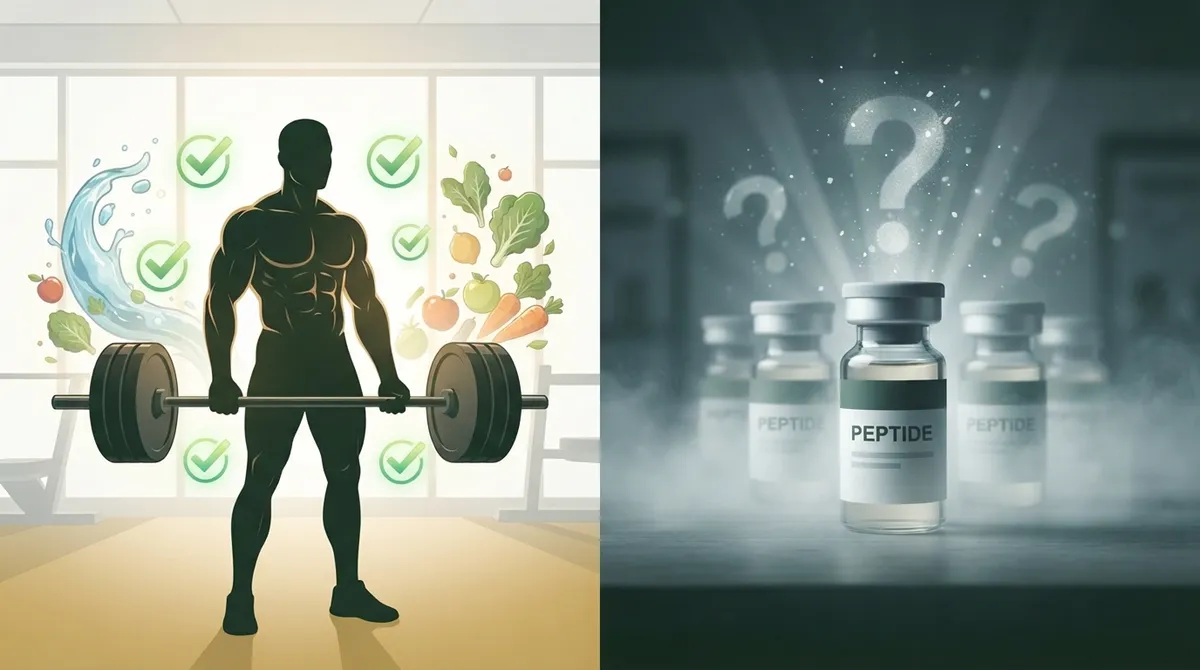
No peptide is FDA-approved for body recomposition in healthy people; 'peptides for body recomposition' is a marketing phrase, not a medical diagnosis or approved treatment.
-
Tesamorelin is the only peptide with strong evidence, but only for HIV-associated lipodystrophy (visceral fat reduction of 15.2% in trials), not for general healthy populations.
-
CJC-1295 and ipamorelin lack robust evidence for fat loss or muscle gain; raising hormone levels does not prove meaningful body-composition changes will occur.
-
Compounded peptides bypass FDA review for safety, effectiveness, and quality, making it essential to work with licensed providers rather than unverified online sellers.
-
Resistance training, adequate protein intake, calorie balance, quality sleep, and treating underlying health issues remain the most evidence-backed foundation for body recomposition.
-
A personalized, lab-guided plan with blood work and licensed clinician oversight provides safer results than generic peptide stacks and helps identify which options are FDA-approved, off-label, or compounded.
You have hit the gym, tightened up your diet, and slept like it is your job. Yet the mirror still is not showing the lean, strong look you want. So you search online and see a flood of posts that recommend peptides for body recomposition as a shortcut. It is easy to get excited. It is also easy to get misled.
Here is the friendly truth. “Peptides for body recomposition” is a marketing phrase, not a recognized medical diagnosis. Body recomposition simply means losing fat while keeping or building muscle. No peptide is broadly approved by the FDA for that goal in healthy people. That does not mean peptide therapy has no place in your health plan. It means you deserve clear facts, not hype.
In this guide, we walk through eight things worth knowing before you ask anyone to recommend peptides for body recomposition. We cover what the evidence says, where tesamorelin fits, what to think about with other peptides, and what actually moves the needle. Think of this as a chat with a well-informed friend who wants you to make a smart, safe choice.

1. Body Recomposition Is a Goal, Not a Medical Diagnosis
Body recomposition means changing the ratio of fat to lean mass. You might drop body fat while your muscle stays the same or grows. The scale may barely move, yet your clothes fit differently.
Here is why that matters. Doctors prescribe medicines for medical conditions, not for a look. So when a product is sold as a “recomp peptide,” that is a sales label. It is not an official use approved by regulators.
If you want a deeper primer on how these compounds work in general, our guide 8 Facts That Explain What Are Peptides in 2026 is a good place to start. You can also read the basics from what are peptides for a plain-language overview.

2. No Peptide Is FDA-Approved for General Recomposition
This is the single most important fact in the whole article. As of 2026, no peptide is broadly established or FDA-approved to help otherwise healthy people burn fat and build muscle at the same time.
Many websites imply otherwise. They use words like “sculpt,” “shred,” and “transform.” Those are not medical claims backed by regulators. A responsible provider will not promise you a particular physique outcome. Instead, they will talk about your labs, your health history, and your realistic goals.
That honesty is a green flag. If someone guarantees muscle gain and fat loss from a vial, take a breath and keep shopping around.
3. Tesamorelin Is the Notable Exception, but Only in a Narrow Case
Tesamorelin is a growth hormone-releasing hormone analogue. The FDA approved it in 2010 to reduce excess belly fat, called visceral fat, in adults with HIV-associated lipodystrophy. That is a specific condition. It is not general weight loss.
The research behind it is solid for that group. In a 26-week randomized trial of 412 people with HIV and abdominal fat gain, visceral fat dropped 15.2% with tesamorelin and rose 5.0% with placebo. Triglycerides also fell by 50 mg/dL with tesamorelin, while they rose by 9 mg/dL with placebo.
A 2024 study in people with HIV reported a median visceral-fat change of -25 cm² with tesamorelin versus +14 cm² in the comparison group. It also reported less liver fat. One meta-analysis of five randomized trials in HIV-associated lipodystrophy found a mean visceral-fat drop of 27.71 cm² and a lean mass gain of 1.42 kg. These numbers are population-specific, so they should be checked against the final paper before anyone cites them.
The key point: these results do not automatically apply to healthy people without that condition. For a closer look, see 14 Facts on Tesamorelin for Weight Loss (2026).
Quick Snapshot of the Tesamorelin Evidence
| Finding | Result | Who It Applies To |
|---|---|---|
| Visceral fat, 26 weeks | -15.2% (vs +5.0% placebo) | Adults with HIV and abdominal fat gain |
| Triglycerides, 26 weeks | -50 mg/dL (vs +9 mg/dL placebo) | Adults with HIV and abdominal fat gain |
| Visceral fat, 2024 study | Median -25 cm² (vs +14 cm²) | People with HIV |
| FDA approval | 2010, for HIV-associated lipodystrophy | Not for general weight loss |
4. CJC-1295 and Ipamorelin Have Limited Evidence for This Goal
You will see CJC-1295 and ipamorelin come up often in recomposition talk. They are growth hormone secretagogues, which means they nudge your body to release more of its own growth hormone.
Here is the catch. Showing that a product changes a hormone level is not the same as proving you will lose fat or gain muscle. Right now, there is no robust evidence that these products deliver safe, meaningful body-composition benefits for general use.
That does not make them “bad.” It means a clinician should be honest about what is known and unknown. If you are curious about the details, our posts on Ipamorelin Peptide Therapy: Benefits, Dosing & Safety and How to Use CJC-1295 Peptide Safely for Real Results break things down in plain English.
5. Compounded Peptides Come With Quality and Safety Questions
Many peptides sold for recomposition are compounded. Compounded drugs are not FDA-approved. The FDA does not review them for safety, effectiveness, or quality before they are marketed.
The FDA has also flagged safety concerns about certain bulk drug substances used in compounding, including CJC-1295 and ipamorelin. Rules in this area can change, so always check current FDA guidance before you decide. This is one reason it pays to work with a licensed provider rather than ordering from a random website.
Want to understand the difference? Read FDA-Approved vs. Compounded Peptides: What Wins? and How to Verify FDA Approval Before Peptide Therapy.
Approved vs. Compounded at a Glance
| Feature | FDA-Approved Drug | Compounded Product |
|---|---|---|
| FDA review for safety and effectiveness | Yes, before marketing | No |
| Quality oversight before sale | Reviewed as part of approval | Not reviewed by FDA before marketing |
| Approved uses | Specific, labeled conditions | None |
| Best for | Matching a labeled condition | Case-by-case clinical judgment |
6. Know the Risks and Who Should Skip Certain Peptides
Every treatment has trade-offs. Tesamorelin, for example, needs clinical oversight. Its prescribing information lists warnings that include:
- Elevated IGF-1 levels
- Glucose intolerance or diabetes
- Fluid retention
- Hypersensitivity reactions
It is also contraindicated in active malignancy, pregnancy, and disruption of the hypothalamic-pituitary axis. This is exactly why you should never self-prescribe. A licensed clinician can review your health history and decide if a therapy is even a safe option for you.
Curious about the bigger safety picture? We cover it in Is Peptide Therapy Safe? What You Really Need to Know.
7. The Basics Still Do the Heavy Lifting
Here is the part nobody sells in a vial, but it works. For real body recomposition, the foundations matter most:
- Resistance training: Lifting challenges your muscles and tells your body to keep or build them.
- Enough protein: Protein supports muscle repair, especially when you are trimming fat.
- Balanced nutrition: A modest calorie deficit with quality food helps you lose fat without crashing.
- Good sleep: Recovery and hormone balance both depend on it.
- Treating medical issues: Thyroid, blood sugar, and hormone problems can quietly block progress.
For eligible patients, FDA-approved anti-obesity medicines may also be an option. These are not the same as peptide products marketed for muscle gain, so do not treat them as interchangeable. If you want to learn more, check out 12 Body Composition Facts Peptide Users Need in 2026 and Can Peptide Therapy Really Help You Build Muscle?
Where Different Approaches Fit
| Approach | Evidence Level for Recomposition | Key Note |
|---|---|---|
| Resistance training plus protein | Strong | The foundation for nearly everyone |
| Tesamorelin | Strong, but only for HIV-associated lipodystrophy | Do not generalize to healthy people |
| CJC-1295 / ipamorelin | Limited | Hormone changes do not equal fat loss or muscle gain |
| FDA-approved anti-obesity medicines | Varies by drug | For eligible patients, under supervision |
8. A Personalized, Lab-Guided Plan Beats a Generic Stack
So how do you actually move forward? Start with data about you. Blood work shows how your hormones, metabolism, and key markers look today. From there, a licensed provider can help you decide what makes sense, what does not, and what to skip.
This is where telehealth shines, especially for busy professionals and biohackers who want solid information without sitting in a waiting room. At peptides for women and peptides for men, Allura Longevity offers personalized, medically supervised plans. Clients begin with a $50 virtual consultation, complete blood work through LabCorp, and receive a customized six-month plan with ongoing monitoring by licensed providers, led by Ashley, a board-certified Family Nurse Practitioner. Care is delivered to your home in Florida, Georgia, Texas, Connecticut, Indiana, Maryland, New York, and California.
Not sure where to begin? These reads can help you prepare: How to Start Peptide Therapy Safely and See Real Results and 15 Peptide Consultation Questions to Ask in 2026. For wider context from a public research source, the National Library of Medicine is a helpful place to explore.
What a Safe First Step Looks Like
If you are ready to take action, here is a simple path:
- Write down your goal in plain words, such as “lose body fat and keep my strength.”
- Get current blood work so your plan is based on your numbers.
- Talk with a licensed clinician about your health history and medications.
- Ask which options are FDA-approved, which are off-label, and which are compounded.
- Pair any therapy with training, protein, and sleep.
- Recheck labs and adjust over time.
Final Thoughts: Your Next Step Toward a Smarter Plan
When someone asks you to recommend peptides for body recomposition, the most honest answer is this: there is no magic vial. Tesamorelin has real evidence, but only for a specific condition. Others, like CJC-1295 and ipamorelin, have limited proof for this goal. The best results still come from smart training, solid nutrition, great sleep, and care that is tailored to you.
If you want a clear, judgment-free conversation about what fits your body and goals, request a consultation with Allura Longevity. Spots for new clients are limited each month, and you can reach the team at (813) 510-6277. You deserve a plan built on real data and real care.
FAQs
Q: Which peptides are FDA-approved for body recomposition?
A: None are approved for body recomposition in otherwise healthy people. Tesamorelin is FDA-approved, but only to reduce excess belly fat in adults with HIV-associated lipodystrophy. A licensed clinician can explain what that means for you.
Q: Does tesamorelin reduce belly fat in people without HIV?
A: The strong trial results come from people with HIV-associated abdominal fat gain, so they should not be assumed to apply to everyone. Using it outside its approved purpose would be off-label and needs careful medical oversight.
Q: Are CJC-1295 or ipamorelin proven to build muscle or burn fat?
A: Not yet. They may raise growth hormone levels, but that does not prove meaningful fat loss or muscle gain. Robust evidence for general body-composition benefits is still lacking.
Q: Are compounded peptides FDA-approved?
A: No. The FDA does not review compounded drugs for safety, effectiveness, or quality before they are marketed. That is why working with a licensed provider and verifying current FDA guidance really matters.
Q: What evidence-based options help with fat loss and muscle retention?
A: Resistance training, enough protein, balanced nutrition, good sleep, and treating underlying medical issues are the core tools. For eligible patients, FDA-approved anti-obesity medicines may also be an option under a clinician’s care.





