

Key Takeaways
-
Verify whether peptides are FDA-approved for their specific use or compounded without pre-market review, as telehealth is a delivery method that doesn't bypass FDA regulations or safety requirements.
-
Require blood work and a genuine medical evaluation with a licensed clinician before starting treatment; skip services that promise guaranteed results or skip lab testing.
-
Confirm your prescriber is licensed in your state, identify the dispensing pharmacy, and ask about the regulatory status of each product to avoid research-use-only products sold illegally for human use.
-
Expect ongoing monitoring and adjustments through follow-up visits; legitimate telehealth peptide services provide regular check-ins to track progress and modify treatment plans based on results.
-
Be aware that compounded peptides lack FDA pre-market safety and effectiveness review, and uncertain identity, purity, sterility, or storage issues can create real health risks.
-
Recognize common red flags including guaranteed results claims, hidden prescriber names, false FDA-approval claims, and services without follow-up plans or medical history review.
You have probably seen the ads. A quick online form, a few clicks, and a vial of peptides shows up at your door. It sounds almost too easy. So is peptide therapy telehealth the real deal, or just clever marketing?
The honest answer is: it depends on who is behind the screen. Done well, telehealth can make personalized care simple for busy people. Done poorly, it can expose you to products no one has properly checked. In 2026, knowing the difference matters more than ever.
This guide walks you through how peptide therapy telehealth works, what is FDA-approved and what is not, and what a trustworthy service looks like. Whether you are a health optimizer, a busy professional, or simply curious about aging well, you will leave with a clear checklist. Let’s dive in together.

What Is Peptide Therapy Telehealth?
Peptides are short chains of amino acids. Your body makes many of them naturally, and they act like tiny messengers. If you want a plain-English primer, this guide on what are peptides is a helpful start, and our own post, 8 Facts That Explain What Are Peptides in 2026, goes deeper.
Peptide therapy telehealth simply means getting that care remotely. You meet a licensed clinician by video or online visit. They review your health history and labs. If treatment makes sense, they prescribe it, and a pharmacy ships it to your home. Follow-up happens online too.
Here is the key point, and it is a big one. Telehealth is a delivery method. It is not a shortcut around the rules. A product does not become FDA-approved because a video call happened. Prescribing, licensing, and pharmacy laws still apply in every state.
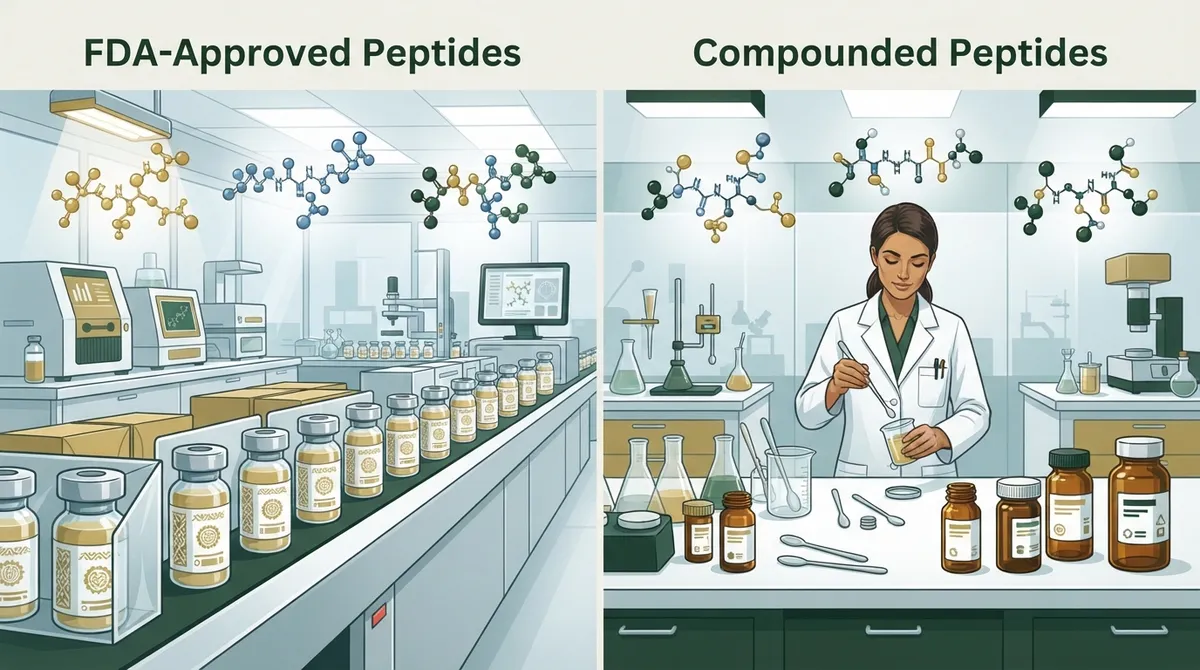
FDA-Approved Peptides vs. Compounded Peptides
The word “peptide” covers very different products. This is where many people get confused, so let’s slow down and sort it out.
Some peptide medicines are FDA-approved. Insulin is a classic example. So are certain GLP-1 drugs used for diabetes and weight management. These have clear uses, trial data, and safety oversight.
Other peptides are marketed for recovery, skin, sleep, or anti-aging. Many of these are not FDA-approved for those uses. Some are made by compounding pharmacies. According to the FDA, compounded drugs are not reviewed by the agency for safety, effectiveness, or quality before they are sold.
| Category | Example | FDA Review | What to Know |
|---|---|---|---|
| FDA-approved peptide medicine | Insulin, certain GLP-1 drugs | Yes, for specific uses | Established evidence for approved conditions |
| Compounded peptide | Custom-prepared products from a pharmacy | No pre-market review | Made for a specific patient with a prescription |
| Research-use-only peptide | Vials labeled “not for human use” | No | Should never be used by people |
For a deeper look, see FDA-Approved vs. Compounded Peptides: What Wins? and 503A vs. 503B: Which Peptide Compounding Wins?
Is Peptide Therapy Telehealth Legal?
Yes, telehealth itself is legal. Doctors and nurse practitioners can evaluate patients remotely and prescribe when the law allows. But several rules must all line up.
- Clinician licensure: The prescriber must be licensed in your state.
- A real patient-clinician relationship: There must be a genuine evaluation, not just a checkout page.
- Pharmacy rules: The dispensing pharmacy must follow state and federal law.
- Compounding limits: Compounding is meant for specific medical needs, not as a general swap for approved drugs.
Under federal law, 503A pharmacies generally compound for an identified patient with a prescription. 503B outsourcing facilities register with the FDA and follow extra requirements. Registration, though, is not the same as FDA approval of a facility or its products.
Also, the FDA’s rules on which bulk substances can be compounded change over time. So a peptide being easy to find online does not mean it is currently eligible for compounding. A good clinic checks current FDA information instead of guessing.
Curious about state coverage? See Which States Allow Telehealth Peptide Prescriptions? Allura Longevity is licensed in Florida, Georgia, Texas, Connecticut, Indiana, Maryland, New York, and California.
How a Peptide Telehealth Visit Works, Step by Step
A well-run program is more thorough than most people expect. Here is what the journey usually looks like.
- Book a consultation. You share your goals, symptoms, and medical history online.
- Complete lab work. Blood tests show your hormones, metabolic markers, and other key numbers.
- Meet your provider. A licensed clinician reviews your results and screens for risks or contraindications.
- Get a personalized plan. Your treatment is built around your labs and goals, not a one-size-fits-all menu.
- Receive your medication at home. A licensed pharmacy ships it, with clear instructions.
- Follow up and adjust. Your provider checks in, tracks progress, and tweaks the plan as needed.
Want a fuller walkthrough? Read What Really Happens During a Peptide Telehealth Visit? and How to Start Peptide Therapy Safely and See Real Results.
The Real Benefits of Going the Telehealth Route
Let’s be fair. Telehealth has real perks, especially if your calendar is packed.
- Convenience: No waiting rooms or commute. Visits fit around work and family.
- Access: You can reach specialized providers even if none are nearby.
- Data-driven care: Labs and tracking make it easy to personalize your plan, which biohackers love.
- Home delivery: Medication arrives at your door.
- Ongoing check-ins: Follow-ups are quick and easy to schedule.
If you are weighing options, Local Clinic vs. Telehealth: Best Peptide Therapy Near You? breaks it down nicely.
What Peptides Are Commonly Discussed?
Peptide therapy is a broad field. People ask about different peptides for different goals. The evidence and regulatory status vary a lot, so it is smart to check each one on its own.
| Goal | Commonly Discussed Options | Evidence Note |
|---|---|---|
| Weight management | GLP-1 medications | Approved products exist for specific uses |
| Injury recovery | BPC-157, TB-500 | Limited human data; not FDA-approved for these uses |
| Growth hormone support | Ipamorelin, CJC-1295, sermorelin | Evidence and status vary by product |
| Sexual wellness | PT-141 | Approved for a specific indication in women; other uses differ |
| Skin health | GHK-Cu | Early evidence; results vary |
Want to learn more? Try How to Understand GLP-1 Peptide Therapy in 2026 or Is BPC-157 Safe? What the Research Really Shows. Curious about hormones too? Testosterone replacement is another service some telehealth clinics offer, and it is prescribed based on labs and symptoms.
The Risks You Should Know About
We want you to feel excited about your health goals. We also want you to be safe. Poorly sourced or unapproved injectable peptides can carry real risks.
- Uncertain identity and purity: You may not know exactly what is in the vial.
- Potency and sterility problems: Injectables must be sterile and dosed correctly.
- Storage and handling issues: Some peptides need careful refrigeration.
- Dosing and reconstitution errors: Mixing and injecting wrong can cause harm.
- Limited long-term data: For many wellness peptides, we simply do not know the long-term picture.
- Possible drug interactions: Your other medications matter.
The FDA has also warned telehealth companies about misleading claims. That includes calling compounded drugs “generic” or “equivalent” to approved drugs, implying FDA approval, or saying they were evaluated for safety and effectiveness. If a website does any of that, treat it as a red flag.
Curious how safety plays out? Read Is Peptide Therapy Safe? What You Really Need to Know and How to Spot and Avoid Peptide Therapy Risks. The National Library of Medicine is also a solid place to read peer-reviewed research.
Red Flags vs. Green Flags
Not sure how to size up a service? Use this side-by-side.
| Red Flags | Green Flags |
|---|---|
| Promises guaranteed results | Explains that results vary by person |
| Skips labs and medical history | Requires blood work and a real evaluation |
| Sells “research-use” products for humans | Uses licensed, prescription-based pharmacies |
| Hides the prescriber’s name | Names its licensed clinicians clearly |
| Claims a product is FDA-approved when it is not | States the regulatory status of each product honestly |
| No follow-up plan | Offers ongoing monitoring and adjustments |
For more on vetting a provider, see How Do You Know Online Peptide Therapy Is Safe? and How to Get Prescription Peptides Safely in 2026.
Questions to Ask Before You Start
A great clinician welcomes questions. Bring these to your first visit.
- Is this specific product FDA-approved, compounded, or something else?
- Who is my prescribing clinician, and are they licensed in my state?
- Which pharmacy will dispense my medication?
- What lab tests do I need first, and how often will we repeat them?
- What are the risks, side effects, and alternatives for my situation?
- How will you monitor my progress and adjust my plan?
Need more prompts? Check out 15 Peptide Consultation Questions to Ask in 2026. If cost is on your mind, How to Understand Peptide Therapy Price in 2026 can help you plan.
How Allura Longevity Approaches Peptide Telehealth
At Allura Longevity, we built our care around safety and personalization. Everything starts with a $50 virtual consultation. From there, you complete blood work through LabCorp so your plan is based on real data, not guesswork.
Your licensed provider, led by Ashley, a board-certified Family Nurse Practitioner, designs a customized six-month treatment plan. Your medication is delivered to your home. Then we keep going with ongoing monitoring and adjustments.
Our care can support goals like energy, sleep, mental clarity, immune function, skin rejuvenation, muscle recovery, metabolism, and sexual wellness. We also offer GLP-1 weight loss support, BPC-157 for injury recovery, and testosterone replacement. Curious about options for your situation? Explore peptides for women or peptides for men.
We are honest about the evidence, too. We explain each product’s status and talk through risks, so you can decide with confidence. Telehealth is available nationwide where licensed, and you can call us at (813) 510-6277.
Final Thoughts
Peptide therapy telehealth can be a smart, convenient way to pursue better energy, recovery, and healthy aging. The best experiences share the same traits: real labs, licensed clinicians, transparent products, and steady follow-up. Skip anything that promises miracles or hides who is behind the prescription.
Take your time, ask great questions, and choose a team that treats you like a person, not a checkout cart. Ready to take the first step? Spots for new clients are limited each month, so request a consultation with Allura Longevity today and see if a personalized plan is right for you.
FAQs
Q: What is peptide therapy telehealth, and how does an online consultation work?
A: It means getting peptide care through online visits instead of in-person appointments. You share your history, complete lab work, meet a licensed provider, and get a personalized plan shipped to your home. Follow-ups happen online too, which keeps things simple and friendly for busy schedules.
Q: Are peptides prescribed through telehealth FDA-approved?
A: It depends on the product. Some peptide medicines, like certain GLP-1 drugs, are FDA-approved for specific uses. Many peptides marketed for recovery or anti-aging are not approved for those purposes, so always ask your clinician about the exact status of what you are prescribed.
Q: How can I check whether an online peptide clinic is legitimate?
A: Look for named, licensed clinicians who are licensed in your state, a required medical evaluation and lab work, and a clearly identified licensed pharmacy. Be cautious of guaranteed results, missing prescriber names, or products labeled for research use only.
Q: Does telehealth peptide therapy require lab tests and follow-up?
A: A responsible program does. Blood work helps your provider personalize your plan and screen for safety concerns, and regular follow-ups let them track progress and adjust your treatment. If a service skips both, that is a good reason to keep looking.





