

Key Takeaways
-
Not all peptides work the same way—each has different targets, research history, and regulatory status. Evidence for one peptide cannot be applied to another, so avoid assuming popular peptides like BPC-157 work identically to approved medications.
-
Most peptides marketed for inflammation rely on animal or lab studies, not human proof. BPC-157 has 35 preclinical studies but only 1 clinical study; large rigorous human trials are missing, making efficacy and safety unestablished.
-
Distinguish between FDA-approved peptides and compounded ones. BPC-157 is not FDA-approved and placed in Category 2 bulk substance status, limiting how it can be compounded—always verify current FDA status before purchasing.
-
Avoid buying 'research use only' peptides online; they lack verified identity, purity, sterility, and proper dosing. Work only with licensed clinicians and regulated pharmacies to ensure quality and safety.
-
Address the root cause of inflammation through blood work and a licensed provider before trying peptides. Inflammation stems from sleep, stress, diet, or other factors—peptides work best as part of comprehensive lifestyle changes.
-
Ask providers clear questions about FDA approval for your specific condition, human research quality, manufacturing verification, side effects, and measurement of results. Defensive responses are a red flag to seek care elsewhere.
If you have ever woken up with achy joints, felt wiped out after a hard workout, or wondered why your body just will not bounce back like it used to, you are not alone. Inflammation gets blamed for a lot, and peptides are getting a lot of buzz as the fix. That combination is exciting, and it is also where people trip up.
Here is the friendly truth: peptide therapy inflammation talk is a mixed bag. Some peptide medicines are approved and well studied. Others are popular online but backed mostly by animal research. Knowing the difference can save you money, frustration, and maybe even your health.
In this guide, we walk through five common mistakes people make when they explore peptide therapy for inflammation in 2026. We keep it simple, honest, and practical. Whether you are a busy professional, a data-loving biohacker, or someone who just wants to feel like yourself again, this is for you. Let’s dig in together.

What Does Peptide Therapy for Inflammation Really Mean?
Peptides are short chains of amino acids, the building blocks of proteins. Your body makes many of them naturally, and they act like tiny messengers. If you want a plain-language refresher, check out this overview of what are peptides, or our own guide, 8 Facts That Explain What Are Peptides in 2026.
Here is the catch. “Peptide therapy for inflammation” is not one single treatment. It is a broad phrase that covers very different molecules. Some are approved medicines for specific conditions. Others are investigational compounds. The evidence, safety, and legal status depend on the exact peptide and the exact condition.
Think of it like the word “exercise.” Walking and powerlifting are both exercise, but they do very different things. Peptides are the same way.
Mistake 1: Treating All Peptides Like They Work the Same Way
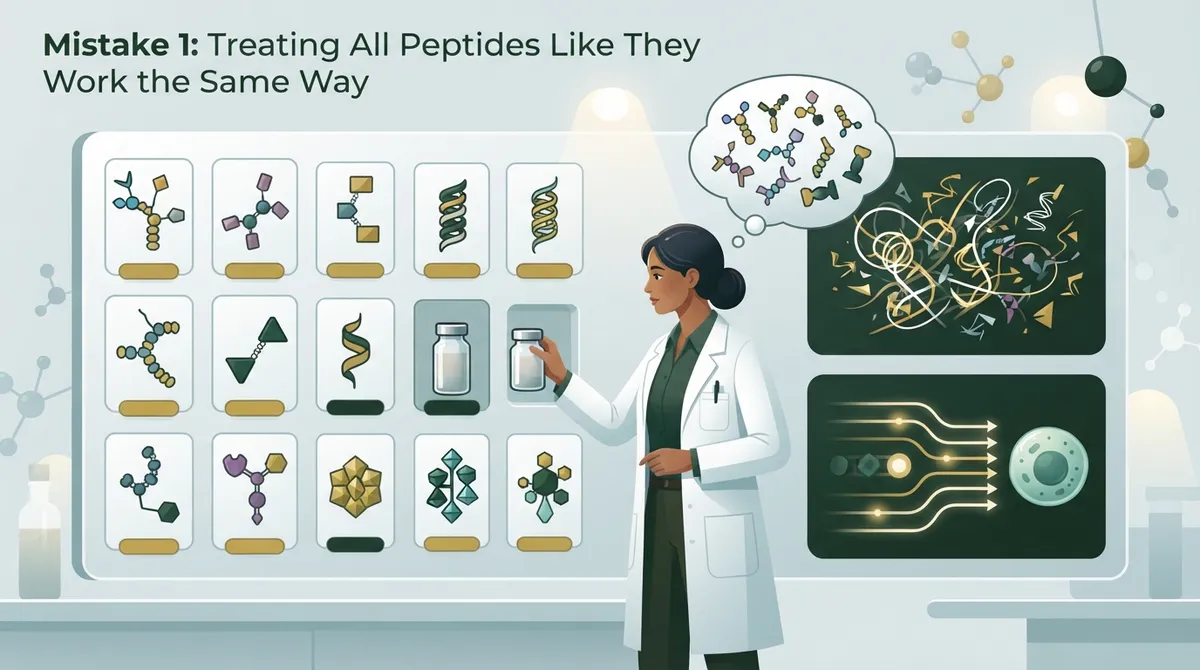
This is the biggest slip of all. It is easy to read that one peptide helped someone and assume every peptide will do the same. That is not how it works.
Each peptide has its own target, its own research history, and its own regulatory status. Evidence for one cannot be borrowed for another.
| Peptide | Common Marketing Claim | Evidence Snapshot | FDA Status for Inflammation |
|---|---|---|---|
| BPC-157 | Reduces inflammation and pain, supports tissue repair | Mostly preclinical (animal and lab) research; very few small human studies | Not FDA-approved |
| TB-500 | Supports recovery and healing | Limited human evidence | No approved anti-inflammatory use |
| KPV | Calms inflammation | Limited human evidence | No approved anti-inflammatory use |
| GLP-1 medicines | Weight and blood sugar support | Inflammatory marker effects are still being studied | Approved for diabetes or obesity, not as general anti-inflammatories |
Notice the pattern. Approved does not mean approved for inflammation. And popular does not mean proven. Curious about the details on one of the most talked-about options? See 9 BPC-157 Peptide Facts to Know Before You Start and 13 Facts About TB-500 Peptide You Need in 2026.
Mistake 2: Mixing Up Animal Studies With Proven Human Results
Here is where the hype can get ahead of the science. Many exciting headlines come from lab or animal studies. Those are valuable first steps, but they are not the same as proof in people.
Take BPC-157. A 2025 systematic review of BPC-157 in orthopaedic sports medicine included 36 studies. Of those, 35 were preclinical and only one was a clinical study. The authors concluded that human efficacy and safety are still not well established.
A separate 2025 narrative review found just three published human BPC-157 studies, all small pilot or retrospective work. Researchers noted that large, rigorous trials are missing. You can read more through the National Library of Medicine when you want to check research yourself.
What the small human studies actually show
- A 2021 retrospective knee-pain report found pain relief in 11 of 12 patients after injections into the joint. It was small and uncontrolled, so it cannot prove the peptide worked.
- A small interstitial cystitis pilot involved 12 patients.
- An intravenous safety and pharmacokinetic pilot included only two healthy adults.
These are interesting clues, not answers. They do not tell us the best dose, how long results last, or whether it is safe over time for inflammatory conditions. A friendly rule of thumb: mechanism in a lab dish is a hint, human outcomes are the proof.
Want to see how peptides stack up against standard options? Our comparison, Peptide Therapy vs. Traditional Meds for Inflammation, breaks it down, and Which Peptides for Inflammation Actually Work? goes deeper on the evidence.
Mistake 3: Ignoring the FDA and Compounding Rules
Regulations may sound boring, but they protect you. Skipping this step is a costly mistake.
BPC-157 is not FDA-approved as a drug. According to a 2025 orthopaedic review, the FDA placed it in Category 2 of the 503A bulk drug substances list in 2023. That category means there was not enough information to decide whether it could cause harm, which limits how it can be compounded. Rules can change, so always verify current FDA notices before making decisions.
This is why it pays to understand the difference between approved and compounded products. We cover it in FDA-Approved vs. Compounded Peptides: What Wins? and 503A vs. 503B: Which Peptide Compounding Wins?.
Quick regulatory reality check
- Ask whether the specific peptide has an approved use for your condition.
- Ask whether it is being prescribed by a licensed clinician.
- Ask which pharmacy prepares it and how it is regulated.
- Ask how the legal status might change, and how your provider stays current.
If a seller cannot answer these clearly, that is a red flag. Our guide to How to Verify FDA Approval Before Peptide Therapy walks you through it step by step.
Mistake 4: Buying “Research Use Only” Peptides Online
We get it. The internet makes everything look easy, and those vials can seem like a shortcut. But products sold as “research use only” are not approved medicines.
That matters for several reasons:
- Identity: The vial may not contain what the label says.
- Purity: Contaminants or leftover chemicals can sneak in.
- Concentration: The dose could be far off from what is listed.
- Sterility: Injectables need to be made in clean conditions.
- Storage: Peptides can break down if handled or shipped incorrectly.
Also, the absence of reported side effects in small studies does not mean something is safe. It may just mean nobody has studied it enough yet. For a deeper look at safe sourcing, read How to Get Prescription Peptides Safely in 2026 and Is Peptide Therapy Safe? What You Really Need to Know.
Mistake 5: Skipping the Basics, Labs, and a Licensed Clinician
Inflammation is a symptom, not a diagnosis. It can come from poor sleep, stress, food, hormones, injuries, infections, or autoimmune conditions. Reaching for a peptide before finding the cause is like painting over a leak.
That is why a personalized approach matters. Blood work can reveal markers that point toward what is really going on. A licensed provider can then decide whether a peptide even makes sense, or whether something else would serve you better.
| Step | What It Looks Like | Why It Helps |
|---|---|---|
| 1. Talk to a licensed provider | Share symptoms, history, and goals | Rules out serious causes |
| 2. Get blood work | Review inflammatory and hormone markers | Guides the plan with real data |
| 3. Build a plan | Choose options with the best evidence for you | Avoids guesswork |
| 4. Monitor and adjust | Check in and retest | Keeps you safe and on track |
If you like a data-driven approach, you will love How to Use Biomarker Testing to Guide Peptide Therapy and 5 Blood Work Analysis Steps Before Peptides in 2026. And if you are new to all this, How to Start Peptide Therapy Safely and See Real Results is a great starting point.
What Actually Helps Calm Inflammation Alongside Therapy?
Good news: you have more control than you might think. Peptides, when appropriate, work best as part of a bigger picture. A few habits support your body no matter what plan you choose:
- Prioritize consistent, quality sleep.
- Move your body daily, and rest between hard efforts.
- Eat plenty of whole foods, fiber, and healthy fats.
- Manage stress with breathing, walks, or time outdoors.
- Limit alcohol and ultra-processed foods.
Small, steady changes add up. They also make any therapy you try more likely to work well.
How Telehealth Peptide Care Can Make It Easier
For busy professionals and anyone short on time, telehealth can take the stress out of getting started. At Allura Longevity, licensed providers design personalized peptide plans based on your blood work and health goals. Clients start with a $50 virtual consultation, complete labs through LabCorp, and receive a customized six-month plan delivered to their home, with ongoing monitoring and adjustments. Care is led by Ashley, a board-certified Family Nurse Practitioner, and is available in Florida, Georgia, Texas, Connecticut, Indiana, Maryland, New York, and California.
Not sure whether a local visit or virtual care suits you best? Compare them in Local Clinic vs. Telehealth: Best Peptide Therapy Near You?. You can also explore options like peptides for women or peptides for men to see what fits your goals.
Questions to Ask Before You Start
- Is this peptide approved for my specific condition?
- What human research supports it, and how strong is that research?
- Where is it made, and how is quality verified?
- What are the possible side effects and risks for me?
- How will we measure whether it is working?
- What is the plan if it does not help?
A good provider will welcome these questions. If someone gets defensive, that is your cue to keep looking.
The Bottom Line on Peptide Therapy and Inflammation
Peptide therapy inflammation research is genuinely exciting, but it is still young. Some peptide medicines have real, approved uses. Many popular wellness peptides have promising lab results and very little human proof. Avoiding these five mistakes puts you far ahead: do not lump all peptides together, do not confuse animal studies with human results, respect the regulations, skip unregulated online vials, and never bypass labs and a licensed clinician.
You deserve care that is honest, personal, and built around your body. Ready for a smart, safe starting point? Request a consultation with Allura Longevity, or call (813) 510-6277. Spots for new clients are limited each month, so reach out while there is room. Your future self will thank you.
FAQs
Q: Can peptide therapy reduce inflammation?
A: It depends on the peptide and the condition. Some approved peptide medicines have defined uses, but popular wellness peptides like BPC-157 mostly have animal research behind them. A licensed clinician can help you sort out what makes sense for you.
Q: Is BPC-157 FDA-approved for inflammation or pain?
A: No, BPC-157 is not FDA-approved as a drug. A 2025 review reports the FDA placed it in Category 2 of the 503A bulk drug substances list in 2023, so always check current FDA notices since rules can change.
Q: Are TB-500 or KPV proven anti-inflammatory treatments?
A: Not yet. Human evidence for both is limited, and neither has an established FDA-approved use as an anti-inflammatory therapy. They are best viewed as interesting but unproven.
Q: What are the risks of unapproved or compounded peptides?
A: Products sold as research use only can have uncertain identity, purity, dose, and sterility. Working with a licensed provider and a regulated pharmacy helps lower those risks.
Q: What should I ask a clinician before considering peptide therapy?
A: Ask whether the peptide is approved for your condition, what human research supports it, where it is made, and how progress will be measured. A great provider will happily walk you through every answer.





