

Key Takeaways
-
Dietary supplements are regulated as foods and are not FDA-approved for safety or effectiveness before sale, while peptide products may be approved drugs, compounded drugs, or unapproved products.
-
Peptides are not one single category, so each product must be judged individually by its ingredient, dose, source, and regulatory status rather than by the label 'peptide.'
-
Never use peptide products labeled 'for research use only,' and confirm whether any injectable is FDA-approved or compounded and sourced from a reputable pharmacy.
-
Neither supplements nor peptides are automatically safe or effective; share your full supplement and medication list with a clinician before starting anything new.
You walk into a supplement aisle and see hundreds of bottles promising more energy, better sleep, and younger-looking skin. Then you hear friends talking about peptide therapy and wonder, is it just a fancier version of the same thing? It’s a fair question, and you’re not alone in asking it.
Here’s the short answer: they are not interchangeable. Peptides are short chains of amino acids, and the word covers a huge range of products. Some are FDA-approved prescription medicines. Others are compounded or unapproved. Over the counter supplements are regulated like foods, not drugs. That one difference changes almost everything else.
In this friendly guide, we’ll walk through nine key differences in peptides vs over the counter supplements. We’ll cover regulation, evidence, quality, delivery, and safety, so you can make smart choices for your health goals. Whether you’re a data-loving biohacker, a busy professional, or someone who has spent years building a supplement shelf, you’ll find something useful here. Let’s dive in.
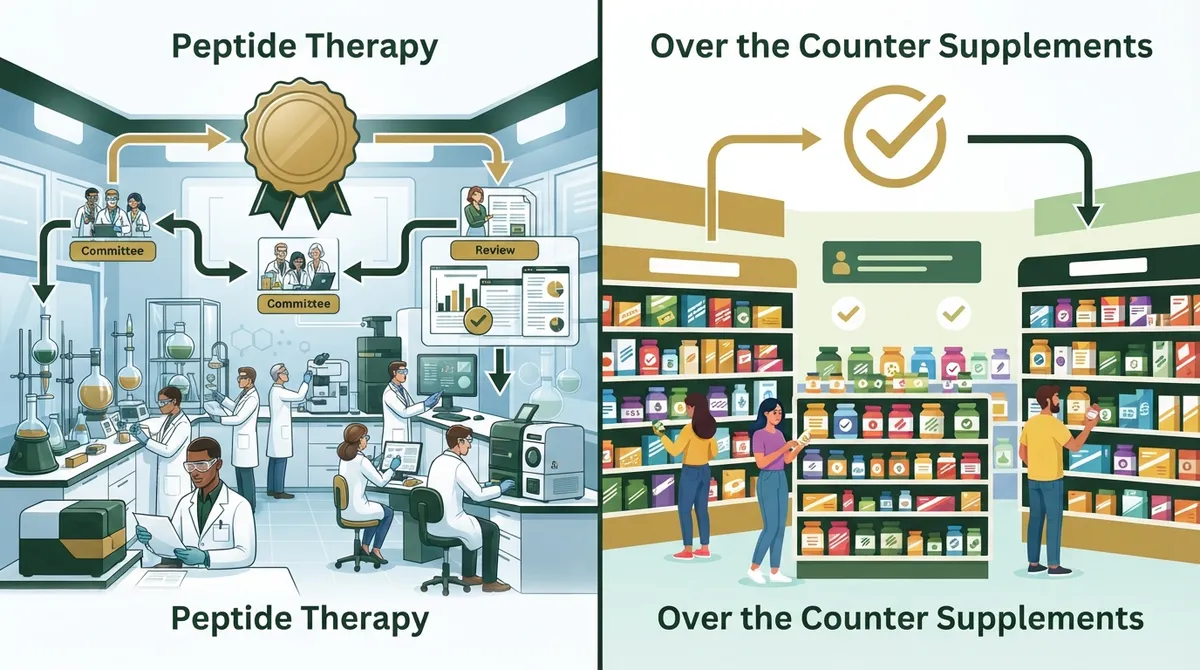
1. Regulation Works Very Differently
This is the biggest difference, so let’s start here. The two categories live under different rules.
Dietary supplements are regulated as foods under the Dietary Supplement Health and Education Act (DSHEA). The FDA does not approve them for safety or effectiveness before they hit the shelf. Many can be sold without any premarket notification at all.
Peptide products are more varied. Some are FDA-approved prescription drugs that went through premarket review for specific uses. Others are compounded drugs, which the FDA does not review the same way. And some products sold online are not approved at all. You can read a helpful overview of what are peptides if you want the basics.
| Feature | OTC Dietary Supplements | Peptide Products |
|---|---|---|
| Legal category | Regulated as foods | Approved drug, compounded drug, or unapproved product |
| FDA premarket approval | No | Yes for approved drugs; no for compounded or unapproved |
| Prescription needed | No | Usually yes for medical-grade products |
| Who oversees use | You, on your own | A licensed clinician, in a medical setting |

2. Peptides Are Not One Single Thing
Think of the word “peptides” like the word “vehicles.” A bicycle and a cargo truck are both vehicles, but you would never use them for the same job.
Peptides are short amino acid chains. Some act as medicines for specific conditions. Others are marketed for wellness, and their evidence varies a lot. That means you can’t judge peptides as a group. You have to look at each product, one by one. If you want a clear starting point, our guide on 10 peptide therapy basics every beginner should know breaks it down in plain language.
Supplements are also a mixed bag. A vitamin D capsule and a trendy herbal blend are very different. The takeaway is simple: evidence depends on the exact ingredient, dose, and use, not the label on the front of the bottle.
3. The Rules About Claims Are Not the Same
Have you ever noticed that supplement labels say things like “supports healthy function”? That’s not an accident.
Supplements can make structure/function claims, such as supporting normal body function. But they generally cannot claim to diagnose, treat, cure, or prevent a disease. These claims are not preapproved by the FDA. Labels must also carry the disclaimer that the FDA has not evaluated them. The manufacturer must notify the FDA within 30 days of marketing a product with such a claim.
FDA-approved peptide medicines work differently. Their labeled uses are backed by clinical review for a specific condition. That is a much higher bar for the claim being made.
4. Quality Control Is a Big Deal
Here’s where things get practical. What’s actually in the bottle or vial?
Supplement makers must follow current good manufacturing practices. These rules are meant to help ensure identity, purity, quality, strength, and composition. The FDA can inspect facilities and take action. But these rules do not mean the FDA checked whether the product works.
Peptide quality depends on the source. FDA-approved drugs meet strict standards. Compounded products rely on pharmacy quality, and the FDA does not run the same premarket review for them. Products labeled “for research use” are the biggest red flag, because they are not meant for human use at all.
- Ask where the product is made and by whom.
- Ask whether it is FDA-approved or compounded.
- Be careful with anything sold online with no prescription.
- Never use products labeled “research use only.”
5. Delivery Method Changes the Experience
How a product enters your body matters. Most supplements are pills, powders, or gummies. They travel through your digestive system, where many ingredients get broken down.
Many peptide therapies are given by small subcutaneous injections, often at home. Injections skip digestion, which is one reason clinicians use them for certain peptides. If the idea of a needle makes you nervous, don’t worry. Most people find the tiny needles easier than they expected. Our post on why peptide injections beat pills for results explains the thinking, and you can learn how to get peptides administered safely at home too.
Injectables do bring extra concerns, like sterility and consistent dosing. That’s why a licensed provider and a quality pharmacy matter so much.
6. Evidence Depends on the Exact Product
Here’s an important truth: being called a peptide does not make something proven. Being called a supplement does not make something useless.
Evidence depends on the specific ingredient, formulation, dose, route, and intended use. Results for an FDA-approved drug’s labeled use should not be stretched to a compounded version or a different use. That’s a common trap, and it’s worth keeping in mind.
For example, GLP-1 medicines have strong clinical research behind approved uses. Many other wellness peptides have far less human research. Read more in 14 facts on what research supports peptide therapy and approved peptides vs. wellness peptides. Reading studies and asking for sources is a very biohacker thing to do, and we love it.
7. Personalization Looks Different
A supplement bottle gives everyone the same dose. You buy it, you take it, and you guess whether it’s working.
Clinical peptide therapy can be built around you. A licensed provider reviews your goals, history, and blood work, then designs a plan. That is a big shift from guesswork. If you’ve been stacking supplements for years and still wonder what’s working, labs can bring clarity. See lab work for peptide therapy: what to test and why for the details.
At Allura Longevity, clients begin with a virtual consultation, complete LabCorp blood work, and receive a customized six-month plan delivered to their home. Licensed providers monitor progress and adjust as needed. To see how plans come together, check out 15 ways a peptide therapy plan gets personalized.
8. Safety and Risks Both Deserve Attention
Neither option is automatically safe. Neither is automatically dangerous. Both need respect.
Supplements can cause side effects, interact with medicines, or be mislabeled or contaminated. Peptide products can bring side effects too, plus extra worries for injectable or unapproved items, such as sterility and dose consistency. If you take prescription medicines, ask a clinician before adding anything new. And report any suspected adverse event.
- Share your full supplement and medication list with your provider.
- Confirm the product’s regulatory status before you start.
- Use a licensed clinician for any injectable product.
- Report side effects promptly.
Want a deeper look at safety? Read 7 peptide therapy side effects you should know and how to weigh the risks of peptide therapy safely.
9. Oversight and Support Are Not Equal
When you buy a supplement, you’re on your own. There’s no follow-up and no one adjusting your plan.
With medically supervised peptide therapy, a licensed provider checks in, reviews labs, and fine-tunes your protocol. For busy professionals, telehealth makes that support easy to fit into a packed week. For aging adults and wellness seekers, it adds peace of mind. You can learn what really happens during a peptide telehealth visit and why you should choose medically supervised peptides.
Side-by-Side Snapshot
| Question | OTC Supplements | Clinical Peptide Therapy |
|---|---|---|
| FDA review before sale | No | Yes for approved drugs; not for compounded |
| Typical form | Pill, powder, gummy | Often injection, sometimes other routes |
| Personalized dosing | Rarely | Often, based on labs and goals |
| Clinician oversight | None built in | Built into the process |
| Best way to judge it | Check ingredient, dose, and quality | Check regulatory status, source, and evidence |
So, Which Is Right for You?
You don’t have to pick a winner. Many people keep helpful basics like vitamin D or magnesium in their routine while exploring medical care for bigger goals. The key is knowing what each tool can and cannot do, and talking with a qualified clinician before you start anything new.
If you’re curious how a medical option might fit, our 15 peptide consultation questions to ask will help you show up prepared. You can also compare what separates clinical peptides from supplements and read the research summary at the National Library of Medicine.
Final Thoughts
The real story of peptides vs over the counter supplements isn’t about which is stronger. It’s about regulation, evidence, quality, and oversight. Supplements are easy to buy but loosely reviewed. Peptide therapy can be powerful and personal, but only when the product, provider, and plan are legitimate.
Allura Longevity offers personalized, medically supervised peptide therapy through telehealth in Florida, Georgia, Texas, Connecticut, Indiana, Maryland, New York, and California. Spots for new clients are limited each month, so don’t wait too long. Ready to take the next step? Request a consultation or call (813) 510-6277 to get started.
FAQs
Q: What is the difference between peptide therapy and dietary supplements?
A: Dietary supplements are regulated as foods and are not FDA-approved for safety or effectiveness before sale. Peptide products can be FDA-approved prescription drugs, compounded drugs, or unapproved products, so each one needs to be checked on its own. A licensed clinician usually oversees medical-grade peptide therapy.
Q: Are compounded peptides the same as FDA-approved peptide medications?
A: Nope, and that’s a great thing to know. Compounded drugs are not FDA-approved, and the FDA does not run the same premarket review of their safety, effectiveness, or quality. Compounding is generally meant to meet an individual patient’s medical need, so always ask your provider which type you’re getting.
Q: Are peptides safer or more effective than over the counter supplements?
A: Not automatically. Safety and results depend on the exact product, dose, quality, and use, not on whether it’s called a peptide or a supplement. Both can cause side effects or interactions, so it’s smart to talk with a qualified clinician first.
Q: What are the risks of buying peptide products online or labeled for research use?
A: These products can have problems with sterility, inaccurate dosing, contamination, or wrong labeling. Products marked “for research use” are not meant for human use at all. Working with a licensed provider and a reputable pharmacy is a much safer path.
Q: What should I ask a clinician before starting peptide therapy?
A: Ask whether the product is FDA-approved or compounded, what evidence supports your goal, and what labs you’ll need first. Also ask about side effects, drug interactions, and how your progress will be monitored. A good provider will welcome these questions.





