

Key Takeaways
-
Clinical peptide therapy is a broad label, not one treatment: FDA-approved peptide medicines and unapproved compounded or experimental products have very different evidence and should be separated.
-
FDA approval applies to a specific product, for one labeled use, dose, and route, so approval for one peptide or condition does not extend to others.
-
Compounded peptides are not FDA-reviewed for safety, effectiveness, or quality before sale, so they should not be treated as a general substitute for approved medicines.
-
The FDA has listed BPC-157, GHRP-2, and TB-500 among bulk substances raising significant safety concerns, citing limited human data, impurities, and immune reaction risks.
-
Animal and lab results do not guarantee human benefit; most unapproved wellness peptides lack clinical trial evidence establishing a safe and effective human dose.
-
Safer care involves a licensed clinician, pre-treatment lab work, confirmation of the product's regulatory status, asking about approved alternatives first, and ongoing monitoring.
If you have spent any time online lately, you have probably seen peptides everywhere. They show up in podcasts, gym chats, and wellness feeds. Some people call them a game changer. Others call them hype. So which is it?
The honest answer is this: clinical peptide therapy is not one single treatment. It is a broad label. It covers FDA-approved medicines that act like peptides, and it also covers experimental or compounded products sold for recovery, weight loss, or anti-aging. Those two groups have very different evidence behind them.
That is exactly why this guide exists. Whether you are a health optimizer, a busy professional, or just curious about what peptides actually are, you deserve clear, friendly answers. Below, we break down six truths that will help you tell real clinical care from marketing noise. Grab a coffee, and let’s dig in.
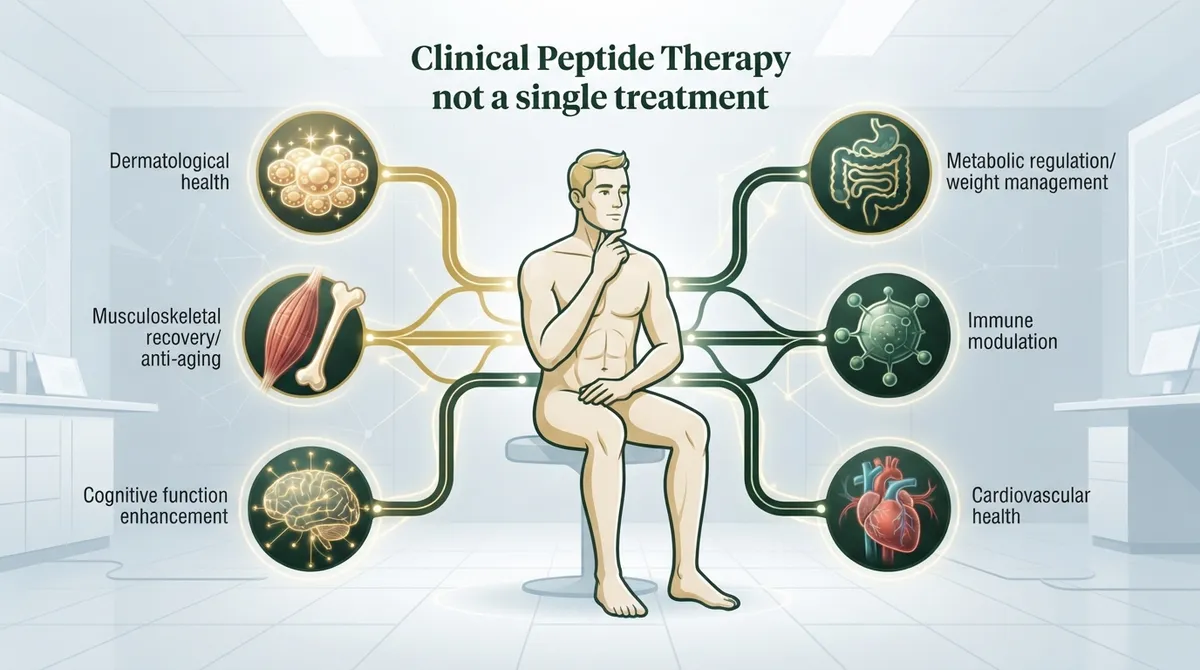
Truth 1: Clinical Peptide Therapy Is Not One Single Treatment
Think of “clinical peptide therapy” like the word “medication.” It tells you very little on its own. The real questions are: which peptide, for which condition, at what dose, and made by whom?
Peptides are short chains of amino acids. Your body makes many of them naturally. Some work as hormones, like insulin. Others help with signaling between cells. Scientists have turned a number of these into medicines.
In practice, the term usually falls into two buckets:
- Approved peptide medicines: Products reviewed by the FDA for a specific use, such as insulin for diabetes or semaglutide for weight management.
- Unapproved or compounded peptides: Products promoted for wellness, recovery, or anti-aging that have not gone through FDA review for those uses.
Treating these two groups as the same thing is the most common mistake people make. A good clinician will always separate them for you. For a plain-language overview, see this guide on what are peptides.

Truth 2: Approval Applies to a Product, Not a Whole Class
Here is a point that surprises many people. FDA approval is very specific. It applies to one product, for one labeled use, at one dose, by one route. It does not mean “peptides” as a group are approved.
Take a few well-known examples. Insulin is approved for diabetes. Semaglutide and tirzepatide are approved for certain metabolic uses. Tesamorelin is approved for HIV-associated lipodystrophy. Each of these went through a review of quality, safety, and effectiveness for its labeled purpose.
But approval for one use does not carry over to another. A peptide that helps with one condition cannot be assumed to help with a different one. That is a key reason why FDA-approved vs. compounded peptides is such an important conversation to have with your provider.
| Peptide-Based Medicine | Established Use | What Approval Means |
|---|---|---|
| Insulin | Diabetes | Reviewed for that specific indication |
| Semaglutide | Approved metabolic uses | Applies to the labeled product and dose |
| Tirzepatide | Approved metabolic uses | Applies to the labeled product and dose |
| Tesamorelin | HIV-associated lipodystrophy | Not a general anti-aging approval |
If you are curious about the weight management side, our guide to understanding GLP-1 peptide therapy walks through how these medicines are used.
Truth 3: Compounded Peptides Are Not the Same as Approved Drugs
This one matters a lot, so let’s keep it simple. Compounded drugs are not FDA-approved. The FDA does not review them for safety, effectiveness, or quality before they reach the market.
That does not make compounding bad by default. Compounding can be appropriate for an individual patient when legal conditions are met. But it is not meant to be a general swap for an approved medicine. A responsible clinic is open about this and explains it clearly.
Here is a quick comparison to keep in mind:
| Feature | FDA-Approved Drug | Compounded Product |
|---|---|---|
| FDA review before sale | Yes | No |
| Quality and safety review | Required for the labeled product | Not reviewed by FDA beforehand |
| Intended role | Standard treatment for labeled uses | Individual patient need when conditions are met |
| Evidence base | Defined clinical trials | Varies widely by substance |
Want to go deeper on how pharmacies fit in? Read 503A vs. 503B peptide compounding for a helpful breakdown.
Truth 4: Some Popular Wellness Peptides Raise Real Safety Flags
Now for the part that deserves a calm, honest look. The FDA has listed several bulk substances nominated for compounding as potential significant safety risks. These include BPC-157, GHRP-2, and the thymosin beta-4 fragment known as TB-500.
Why the concern? The FDA points to limited human safety data. It also cites peptide-related impurities, trouble characterizing the active ingredient, aggregation, and the chance of immune reactions. Being on this list is a safety concern designation. It is not proof of an approved therapy.
A few details are worth knowing:
- GHRP-2: The FDA notes reports of serious adverse events, including increased insulin needs, infection, pancreatitis, and deaths among critically ill study subjects. The agency says causality has not been established.
- TB-500: The FDA has not identified human exposure data for drug products containing this fragment.
- BPC-157: Much of the excitement comes from lab and animal work, not strong human trials.
If you want a closer look, we cover these topics in Is BPC-157 Safe? What the Research Really Shows and 13 Facts About TB-500 Peptide You Need in 2026.
The takeaway is not fear. It is clarity. Interesting early research is not the same as proven human benefit. A trustworthy provider will tell you where the evidence is strong and where it is thin.
Truth 5: Evidence Depends on the Goal, and Animal Data Is Not Enough
People often ask whether peptides work for injury recovery, anti-aging, or weight loss. The fair answer is: it depends on the exact product and the exact goal.
For weight loss, there is solid evidence for certain approved GLP-1 and dual-agonist medicines in their labeled populations. For many wellness peptides promoted for recovery or anti-aging, the picture is different. Evidence is often limited to lab studies, animal research, or small early-stage trials. These do not establish a safe and effective human dose.
Here is a simple way to think about it:
- Results in animals do not guarantee results in people.
- Results for a related peptide do not prove benefit for a different product.
- A different route or dose can change both benefits and risks.
- No reliable population-level numbers exist for benefit or harm from most unapproved wellness peptide regimens.
This is not meant to discourage you. It is meant to help you ask smarter questions. For fat loss specifics, take a look at which weight loss peptides actually work in 2026. For aging goals, see how to pick the best peptides for aging.
You can also review published research through the National Library of Medicine, which is a great place to see how studies are actually designed and reported.
Truth 6: Safe Care Starts With a Licensed Clinician and Labs
So what does responsible clinical peptide therapy look like in real life? It starts with a licensed clinician. Not a social media post. Not a product page.
A careful approach usually includes a review of your health history, goals, and current medications. It also includes lab work, so decisions are based on your numbers, not guesses. Then comes a plan, ongoing monitoring, and honest adjustments over time.
Injectables bring their own considerations too. Risks can include contamination, wrong concentration, sterility failures, dosing errors, and immune reactions. That is why product quality and clinical oversight matter so much. Our guide on how to prepare for safe, effective peptide injections is a useful starting point.
Here is a quick checklist you can use before you start any peptide plan:
- Ask for the exact product name and its regulatory status.
- Avoid anything labeled “research use only” for human use.
- Confirm a licensed provider is reviewing your history and labs.
- Ask about approved alternatives for your goal first.
- Plan for monitoring and know who to call with questions.
- Report any suspected side effects to FDA MedWatch.
You can read more about how to get prescription peptides safely and start peptide therapy safely for step-by-step tips.
How Telehealth Fits Into Clinical Peptide Therapy
Busy schedule? You are not alone. Many professionals want expert care without sitting in a waiting room. Telehealth can make that possible, as long as the care is thorough.
At Allura Longevity, clinical peptide therapy is delivered through personalized, medically supervised telehealth. Clients begin with a $50 virtual consultation and complete blood work through LabCorp. Licensed providers, led by Ashley, a board-certified Family Nurse Practitioner, then build a customized six-month plan based on your labs and goals. Your treatment is delivered to your home, with ongoing monitoring and adjustments along the way.
Allura Longevity is licensed in Florida, Georgia, Texas, Connecticut, Indiana, Maryland, New York, and California. Services focus on energy, sleep, mental clarity, immune support, skin rejuvenation, muscle recovery, metabolism, sexual wellness, GLP-1 weight loss, BPC-157 injury recovery, and testosterone replacement. If you are comparing options, our piece on local clinic vs. telehealth can help.
Curious whether it suits you? Our guide on who is a candidate for peptide therapy is a friendly place to begin. We also offer options tailored to peptides for women and peptides for men.
Quick Reference: Approved vs. Wellness Peptides
| Question to Ask | Approved Peptide Medicine | Unapproved Wellness Peptide |
|---|---|---|
| Is there an FDA-reviewed use? | Yes, for the labeled use | No |
| How strong is human evidence? | Defined by clinical trials | Often limited or early-stage |
| Product quality oversight | FDA review of the labeled product | May be hard to verify |
| Best next step | Discuss fit with your clinician | Weigh uncertainty carefully with a licensed provider |
Final Thoughts: Be Curious, Stay Careful
Clinical peptide therapy can be a meaningful part of a longevity plan when it is done thoughtfully. The big idea is simple. Know your product, know its status, and work with a licensed clinician who explains the evidence honestly, including the uncertainty.
You deserve a plan built around your labs, your goals, and your life. If you are ready to explore personalized, medically supervised care from home, request a consultation with Allura Longevity today. New client spots are limited each month, and you can reach the team at (813) 510-6277.
FAQs
Q: What is clinical peptide therapy?
A: Clinical peptide therapy is a broad term, not one single treatment. It can mean FDA-approved peptide medicines used for specific conditions, or compounded and experimental peptides promoted for wellness. A licensed clinician should explain which category your plan falls into.
Q: Are BPC-157, TB-500, or GHRP-2 FDA-approved for human treatment?
A: No, they are not FDA-approved for treating people. The FDA has listed them among bulk substances that may present significant safety risks for compounding, citing limited human data and quality concerns. It’s a great idea to talk through these openly with your provider.
Q: What is the difference between an FDA-approved peptide drug and a compounded peptide?
A: An approved drug is reviewed by the FDA for quality, safety, and effectiveness for its labeled use. A compounded product is not reviewed by the FDA before it is marketed, though it may be appropriate for an individual patient when legal conditions are met.
Q: How can I tell if a peptide treatment is evidence-based and properly supervised?
A: Look for a licensed clinician, lab work before treatment, and a clear explanation of the exact product and its regulatory status. Avoid anything labeled “research use only” for human use, and make sure there is a plan for ongoing monitoring.
Q: What are the risks of injectable peptides?
A: Risks depend on the product, but can include contamination, incorrect concentration, sterility problems, dosing errors, and immune reactions. Unapproved products can be harder to assess because strong clinical data and quality controls may be missing. If you notice a problem, report it to FDA MedWatch.





