

Key Takeaways
-
Hormone therapy eligibility is determined by symptoms and lab results (two early-morning tests showing testosterone below 300 ng/dL), not age—men in their 20s or 70s can be candidates when diagnosis fits.
-
Low testosterone can occur at any age due to stress, poor sleep, injury, or health conditions; younger men should get checked if experiencing fatigue, low libido, or mood changes rather than assuming it's an age-related issue.
-
Testosterone naturally declines roughly 1% per year starting in the mid-30s, so symptoms appearing in your 40s-50s are common; address them proactively rather than waiting until they become severe.
-
Always require two separate early-morning blood tests before diagnosis, confirm your fertility plans with your provider (testosterone can suppress sperm production), and ensure ongoing monitoring is included in any treatment plan.
-
Peptide therapy and traditional testosterone replacement are different approaches—peptides stimulate your body's natural hormone pathways while TRT directly replaces testosterone; a licensed provider can recommend which fits your situation.
-
Lifestyle factors like sleep, stress management, and nutrition significantly affect testosterone levels, so a comprehensive provider evaluates your full health picture, not just lab numbers, before recommending treatment.
If you’ve been Googling “what age start hormone therapy men” at midnight while wondering why you’re tired all the time, you’re definitely not alone. Here’s some good news right off the bat: there’s no magic birthday when a switch flips and suddenly you’re “ready” for hormone support. Age matters less than you think, and symptoms plus lab work matter a whole lot more.
We talk to men every week who assume they’re either too young or too old to look into hormone therapy. Some 32-year-olds think they should wait until 50. Some 60-year-olds think they missed their window entirely. Both groups are working off myths, not facts. Let’s clear things up together, because your energy, your mood, and your quality of life deserve real answers, not guesswork.

Why Age Alone Doesn’t Decide When You Start Hormone Therapy
Here’s the truth: there is no single federally mandated minimum or maximum age for testosterone therapy. Doctors look at your symptoms, your diagnosis, and your actual lab numbers, not just the year you were born. This is one of the biggest myths we bust for new clients considering peptides for men and hormone support.
For men with confirmed organic hypogonadism, meaning your body genuinely isn’t producing enough testosterone, treatment can be considered at any age once the diagnosis is confirmed. That could be someone in their 30s recovering from an injury or a man in his 70s who’s been feeling foggy and flat for years. Age is a data point, not a gatekeeper.
The One Number That Actually Matters More Than Age
According to the Endocrine Society’s testosterone therapy guidelines, doctors generally require two separate early-morning testosterone tests before diagnosing low testosterone. A commonly used threshold is total testosterone below 300 ng/dL on both tests. That’s the number that opens the conversation, not your driver’s license.
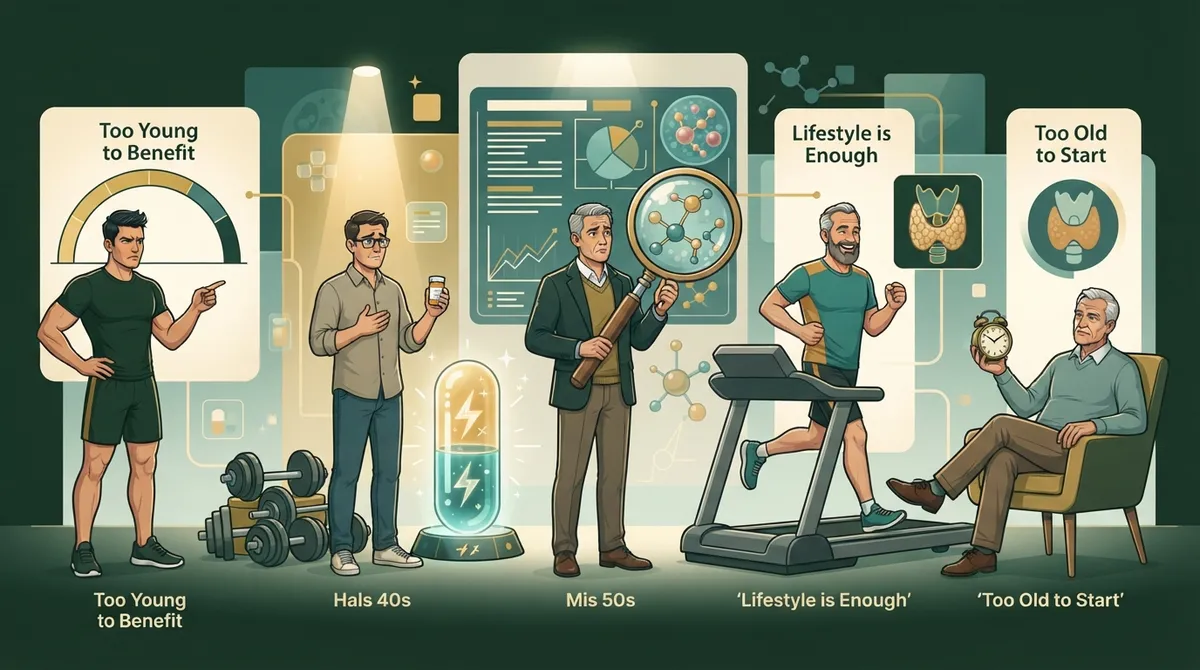
5 Age-Related Mistakes Men Make About Hormone Therapy
Let’s walk through the most common misunderstandings we see, so you can avoid wasting time or money chasing the wrong plan.
- Assuming you’re “too young” to have low testosterone. Low T can show up in your 20s and 30s due to stress, poor sleep, injury, or underlying health conditions. Waiting until you’re older to get checked just means more years feeling exhausted for no reason.
- Believing you’re “too old” to benefit. Routine testosterone therapy isn’t automatically recommended for every man over 65, but that doesn’t mean older men can’t benefit when symptoms and low labs line up. Individualized care wins every time.
- Skipping the second blood test. One low reading isn’t a diagnosis. Guidelines call for repeat early-morning testing because testosterone naturally fluctuates throughout the day.
- Ignoring fertility plans. Testosterone therapy can suppress sperm production, so if you’re planning to grow your family soon, this is a conversation to have with your provider before starting anything.
- Chasing hormone therapy without addressing lifestyle first. Sleep, stress, and nutrition all affect testosterone. A good provider looks at the whole picture, not just a number on a lab report.
What Symptoms Should Actually Prompt You to Get Checked
Instead of fixating on age, pay attention to how you feel. These are the classic signs that it might be time to ask about hormone evaluation:
- Low sex drive or reduced interest in intimacy
- Erectile difficulties that weren’t an issue before
- Constant fatigue, even after a full night’s sleep
- Noticeable loss of muscle mass or strength
- Low mood, irritability, or a sense of mental fog
- Trouble losing weight despite consistent effort
If two or more of these sound familiar, it’s worth getting your levels checked rather than guessing. This is exactly the kind of evaluation we walk clients through at Allura Longevity, starting with a simple $50 virtual consultation and LabCorp blood work.
Testosterone Decline by Decade: What the Research Shows
Testosterone doesn’t crash overnight. It’s more of a slow fade, which is part of why so many men brush off symptoms for years. Here’s a general look at how things trend with age, based on commonly cited research.
| Age Range | General Testosterone Trend | What This Means for You |
|---|---|---|
| 20s–early 30s | Peak levels for most men | Low T at this age usually points to an underlying issue worth investigating |
| Mid-30s onward | Decline of roughly 1% per year | Subtle symptoms may start appearing, often dismissed as “just stress” |
| 40s–50s | Cumulative decline becomes noticeable | Common window when men start asking about hormone evaluation |
| 55–69 | Individualized risk/benefit discussion | Guidelines emphasize symptoms and labs over age alone |
| 65 and older | Wide variation between individuals | Treatment is personalized, not automatic |
Some sources estimate the decline is closer to 1-2% per year starting around age 30, which adds up more than most men realize by the time they hit their 40s and 50s.
How the Evaluation Process Actually Works
A lot of men delay getting checked because they imagine some intense, uncomfortable process. In reality, it’s pretty straightforward. Here’s what a typical path looks like:
- Initial consultation. You talk with a licensed provider about your symptoms, health history, and goals.
- Blood work. Early-morning testosterone testing, usually done twice, along with other relevant markers.
- Review and diagnosis. Your provider looks at your full picture, not just one number, to determine if hormone support makes sense.
- Personalized treatment plan. If appropriate, a plan is built around your specific labs and lifestyle, sometimes including peptide therapy alongside hormone support.
- Ongoing monitoring. Follow-up labs and check-ins to adjust your plan as your body responds.
This is essentially the model we use at Allura Longevity, where clients get a customized six-month treatment plan delivered right to their door, with ongoing monitoring from our licensed team led by Ashley, a board-certified Family Nurse Practitioner.
Peptide Therapy vs. Traditional Hormone Therapy: What’s the Difference
Many men are surprised to learn that peptide therapy and testosterone replacement aren’t the same thing, though they often work well together. Understanding the difference helps you have a smarter conversation with your provider.
| Feature | Traditional TRT | Peptide Therapy |
|---|---|---|
| Primary goal | Directly replaces testosterone | Stimulates your body’s own hormone and recovery pathways |
| Common use case | Confirmed hypogonadism with low labs | Energy, recovery, sleep, metabolism support |
| Administration | Injections, gels, or pellets | Typically subcutaneous injections |
| Fertility impact | Can suppress sperm production | Generally lower fertility impact, but discuss with your provider |
If you’re curious how these two approaches stack up in more detail, our guide on TRT vs. Peptides: Which Hormone Fix Wins for Men breaks it down further.
What About Younger Men Who Suspect Low Testosterone
Younger guys often feel embarrassed bringing up fatigue or low libido, assuming it’s a problem reserved for older men. That’s simply not accurate. Diagnostic testosterone induction for conditions like delayed puberty is sometimes started as early as age 14-16, showing that hormone evaluation has always been about medical need, not a fixed age.
If you’re in your 20s or 30s and something feels off, don’t wait it out. Get your labs checked. The National Library of Medicine notes that confirmed low testosterone can and should be evaluated regardless of age once symptoms are present.
How Peptide Therapy Fits Into the Bigger Hormone Picture
Peptides work differently than traditional hormone replacement, but they’re often part of a smart, well-rounded plan for men who want to feel like themselves again. Certain peptides support the body’s natural production of growth hormone, while others target recovery, metabolism, or sexual wellness.
- Peptides that support natural hormone signaling and recovery
- Options aimed at improving sleep quality and energy
- Peptides that support lean muscle and metabolism
- Formulas designed to support sexual wellness alongside hormone therapy
To understand the basics before diving in, check out 8 Facts That Explain What Are Peptides in 2026. And if you’re weighing your options between hormones alone versus a combined approach, our piece on why testosterone injection therapy gets paired with peptides is worth a read.
Getting Started the Smart Way
Whether you’re 28 or 68, the smartest first step is the same: get evaluated by a licensed provider who looks at your actual health picture. Skip the guesswork, skip the internet rabbit holes, and get real numbers from real blood work, ideally through a trusted lab like what are peptides resources explain in more general terms.
Here’s a simple checklist to walk through before you commit to any hormone or peptide plan:
- Confirm your provider requires two early-morning testosterone tests
- Ask how your fertility goals factor into the plan
- Understand whether peptides, hormones, or both are recommended
- Check that ongoing monitoring is included, not just a one-time prescription
- Make sure your treatment plan is personalized to your labs, not a generic protocol
If you want more guidance on getting started safely, our article on How to Start Peptide Therapy Safely and See Real Results walks through the process step by step.
Why Telehealth Makes This Easier Than Ever
Busy schedule? Don’t want to sit in a waiting room? You’re in good company. Telehealth has made it dramatically simpler for men to get evaluated and treated without taking time off work or driving across town.
At Allura Longevity, the process starts with a $50 virtual consultation, followed by LabCorp blood work you can complete locally. From there, our licensed providers build a personalized six-month plan and ship everything directly to your home. We’re licensed in Florida, Georgia, Texas, Connecticut, Indiana, Maryland, New York, and California, with nationwide telehealth support.
Final Thoughts: Your Age Isn’t the Deciding Factor, Your Body Is
The real answer to “what age start hormone therapy men” is refreshingly simple: it’s not about age at all. It’s about symptoms, confirmed lab results, and your personal health goals. Whether you’re a busy professional chasing better energy, a biohacker optimizing every marker, or someone just trying to feel like yourself again, the path forward starts with real information, not assumptions.
Spots fill up each month, so if you’ve been putting off getting answers, now’s a great time to stop guessing and start knowing. Request a consultation with our licensed team today, or give us a call at (813) 510-6277 to see how a personalized plan could work for you.
FAQs
Q: What age should men start testosterone therapy?
A: There’s no set age. Doctors focus on your symptoms and two confirmed early-morning testosterone tests showing low levels, not your birthday. Men in their 20s and men in their 70s can both be candidates when the diagnosis fits.
Q: How do I know if I actually need hormone therapy?
A: Watch for signs like low energy, reduced muscle mass, low libido, and mood changes. If these sound familiar, getting blood work done is the best next step rather than guessing at home.
Q: Is testosterone therapy safe for men over 50?
A: It can be safe and effective when it’s based on real symptoms and confirmed lab results, not just age. Your provider should weigh your personal risks and benefits before starting any plan.
Q: Can younger men in their 20s or 30s start hormone therapy?
A: Absolutely, if labs confirm low testosterone and symptoms are present. Age isn’t a barrier; a proper diagnosis is what matters most.
Q: Does testosterone therapy affect fertility plans?
A: Yes, it can suppress sperm production, so it’s important to talk with your provider if you’re hoping to grow your family soon. There are ways to plan around this, so don’t be afraid to bring it up early.





