

Key Takeaways
-
Thymosin alpha-1, the most-studied immune peptide, has research only in specific illnesses like sepsis and hepatitis B—not for preventing colds or boosting immunity in healthy people.
-
No thymosin alpha-1 drug is FDA-approved in the United States; compounding eligibility is different from FDA approval, so verify current regulatory status before use.
-
Hospital research results do not apply to healthy adults; seriously ill patients in intensive care respond differently than busy professionals trying to avoid everyday infections.
-
Everyday immune health fundamentals—quality sleep, whole-food nutrition, regular movement, stress management, and baseline blood work—provide more proven benefit than unproven peptides.
-
Work only with licensed medical providers who offer blood work first, clear explanations of regulatory status, and ongoing monitoring rather than one-click checkout options.
-
Other immunity-marketed peptides like BPC-157 and TB-500 lack established immune therapy evidence; different peptides do different things and claims cannot transfer between them.
If you have ever caught every bug that goes around the office, you have probably wondered if there is a smarter way to look after your immune system. Maybe you have seen peptides for immune support all over social media and thought, “Could this be my missing piece?” It is a fair question, and you deserve a straight answer.
Here is the honest truth. “Peptides for immune support” is a popular marketing phrase, not a recognized medical diagnosis. Some peptides, especially thymosin alpha-1, have real research behind them. But that research is often tied to specific illnesses, not everyday wellness.
In this guide, we will walk through what peptides are, what the science says, where the hype outruns the evidence, and how to approach this topic safely. Think of it as a friendly chat with someone who wants you to make smart choices. Let’s dive in.
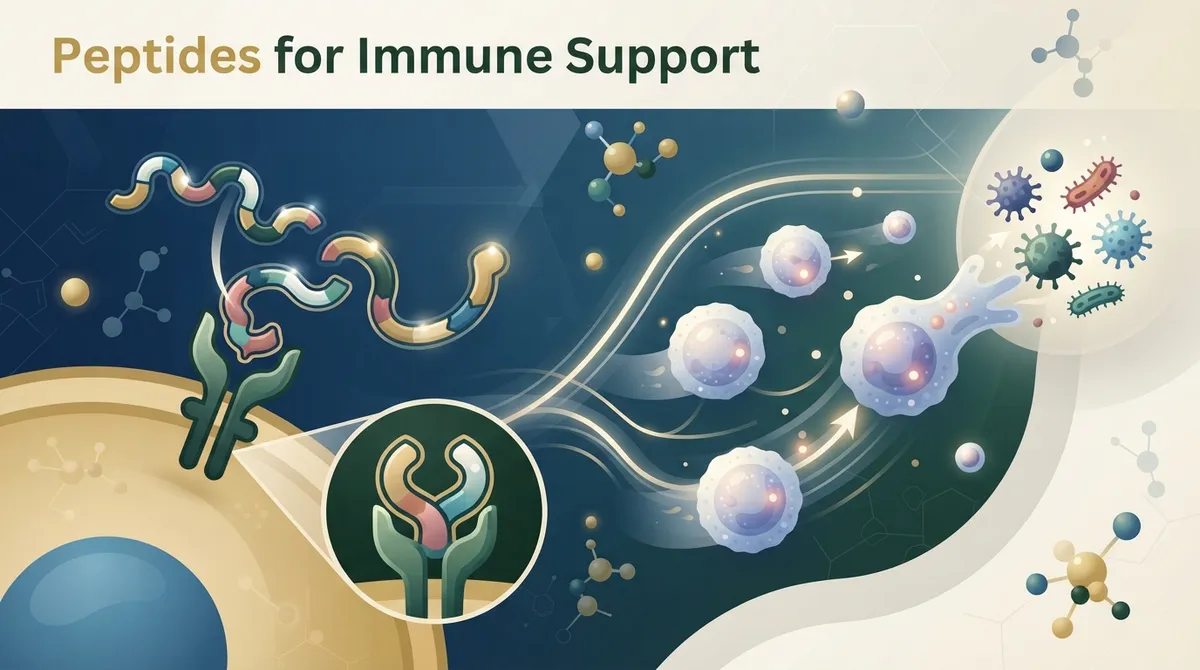
What Are Peptides, and Why Do People Link Them to Immunity?
Peptides are short chains of amino acids, the same building blocks that make up proteins. Your body already makes thousands of them. They act like tiny messengers, telling cells what to do. For a plain-English refresher, see this overview of what are peptides, or read our own guide, 8 Facts That Explain What Are Peptides in 2026.
Because your immune system runs on chemical signals, it makes sense that researchers study peptides in this area. Some peptides appear to influence how immune cells, like T-cells, behave. That is the spark behind the buzz.
But here is the key point. Different peptides do very different things. Evidence for one peptide cannot simply be copied over to another. And results in a hospital setting do not automatically apply to healthy people trying to feel their best.

Thymosin Alpha-1: The Peptide Most Linked to Immune Support
When people talk about peptides for immune support, thymosin alpha-1 (often written Tα1) is usually the star. Its lab-made form is called thymalfasin. It is studied as an immunomodulator, which means it may help adjust how certain immune cells work, especially T-cells.
That is different from being an “immune booster.” Tα1 is not established as a general-purpose way to boost immunity. Its research is tied to particular diseases and clinical settings. If you want a deeper look, we cover it in Why Is Thymosin Alpha 1 Peptide Trending for Immunity?
What the Clinical Research Looks Like
Researchers have studied Tα1 in conditions such as chronic hepatitis B, sepsis, and severe acute pancreatitis. Results vary by condition and by study. Here is a quick snapshot of two of the bigger reviews:
| Condition | Study Type | Key Finding | Important Caution |
|---|---|---|---|
| Sepsis | 2016 systematic review of 19 randomized trials (mortality data from 10 trials, 530 patients) | Pooled estimate favored Tα1 (RR 0.59, 95% CI 0.45 to 0.77) | Authors rated the supporting evidence as low quality |
| Severe acute pancreatitis | 2025 meta-analysis of 5 randomized trials (706 patients) | Fewer extrapancreatic infections (RR 0.56, 95% CI 0.40 to 0.78) | Authors said evidence was insufficient to establish overall therapeutic benefit |
| Chronic hepatitis B | Reviewed by the FDA | Studied for possible use | FDA found insufficient evidence to determine effectiveness |
The same 2025 analysis also reported higher CD4+ cell percentages and a higher CD4+/CD8+ ratio. Those are immune markers. They are interesting, but they are not proof that someone feels healthier or avoids colds.
Why Hospital Results Do Not Equal Wellness Results
This is the part many websites skip. Studies in seriously ill patients do not show that Tα1 prevents everyday infections in healthy adults. A person in intensive care and a busy professional trying to dodge winter bugs are in very different situations.
So if someone tells you a peptide will “supercharge” your immune system, a gentle dose of skepticism is healthy.
Is Thymosin Alpha-1 FDA-Approved in the United States?
This one trips up a lot of people. According to FDA materials, no drug containing thymosin alpha-1 is FDA-approved in the United States. The agency has also said the evidence is insufficient to determine its effectiveness for hepatitis B, and it has reviewed the proposed use of Tα1 in compounding.
Here is where it gets confusing. Compounding eligibility is not the same thing as FDA approval. Thymalfasin is described in the medical literature as approved for certain uses in some other countries. But approval in one country does not mean approval in the U.S. It also does not prove it works for other purposes.
Regulatory status can change, so always check current FDA records. We break down this topic further in FDA-Approved vs. Compounded Peptides: What Wins? and How to Verify FDA Approval Before Peptide Therapy.
Other Peptides People Mention for Immunity
Thymosin alpha-1 is not the only name you will hear. Some other peptides get tossed into immune conversations, but the evidence is not interchangeable. Here is a simple comparison.
| Peptide | Commonly Marketed For | Evidence Status for Immune Support |
|---|---|---|
| Thymosin alpha-1 | Immune modulation | Studied in specific illnesses; not an established general immune booster; no FDA-approved Tα1 drug in the U.S. |
| BPC-157 | Recovery and gut support | FDA says it is not a component of an FDA-approved drug and clinical safety information is insufficient; not a proven immune therapy |
| TB-500 | Tissue repair | Recovery-focused interest; not an established immune therapy |
If you are curious about the recovery side, you can explore Is BPC-157 Safe? What the Research Really Shows and 13 Facts About TB-500 Peptide You Need in 2026. Just keep in mind that recovery benefits are a different topic from immunity.
Marketing Claims vs. Clinical Research
A friendly rule of thumb: ask what kind of claim you are looking at. Not every claim carries the same weight.
- Clinical research: Studies in specific patient groups, with defined doses and outcomes.
- Regulatory status: Whether a product is FDA-approved, legally compounded, or neither.
- Marketing language: Phrases like “boost,” “supercharge,” or “reset” your immunity, which are not medical terms.
When you read about peptides for immune support, try sorting what you see into those three buckets. It makes the whole topic much less confusing.
Risks and Safety Questions to Think About
Every treatment has trade-offs, and peptides are no exception. The risks depend on the specific product, the route, the dose, and the person.
- Local reactions: A 2020 literature review describes injection-site irritation, redness, or discomfort among reported Tα1 side effects.
- Product quality: Unapproved or compounded products raise questions about sterility, dosing accuracy, and limited safety data.
- Limited long-term data: Safety findings in studied groups should not be assumed to apply to every product or use.
- Existing health conditions: If you have an autoimmune condition or take immune-related medicines, talk with a clinician before trying anything.
Medical supervision matters here. Our guides on Is Peptide Therapy Safe? What You Really Need to Know and 9 Peptide Therapy Autoimmune Facts to Know in 2026 go into more detail.
For a broader scientific backdrop, the National Library of Medicine hosts peer-reviewed research on peptide therapeutics.
Supporting Your Immune System the Everyday Way
Here is something we say with a smile: the basics still do the heavy lifting. Before you chase any peptide, it helps to look at the habits that shape immune health every single day.
- Sleep: Aim for steady, quality rest. Poor sleep and low energy often travel together.
- Nutrition: Eat a variety of whole foods with enough protein, fruits, and vegetables.
- Movement: Regular activity supports recovery and overall resilience.
- Stress care: Chronic stress can drain your energy and focus.
- Lab work: Blood tests can reveal gaps worth addressing, like hormone or nutrient imbalances.
If you are a data-driven person, step five is where things get fun. Labs give you a starting line instead of a guess. You can read more in How to Support Immune Health With Peptide Therapy and 3 Peptides for Immune Support Worth Knowing (2026).
How to Approach Peptide Therapy Safely
If you decide peptide therapy is worth exploring, a careful process makes all the difference. Here is a simple path to follow.
- Define your goal. Are you after more energy, better recovery, or better sleep? Clear goals keep expectations realistic.
- Get blood work first. Your numbers help guide any plan. See 5 Blood Work Analysis Steps Before Peptides in 2026.
- Work with licensed providers. Look for real medical oversight, not a one-click checkout.
- Ask about regulatory status. A good provider will tell you plainly what is approved, what is compounded, and what is still being studied.
- Plan for monitoring. Check-ins help adjust your plan over time.
For more on what to ask, take a look at How to Start Peptide Therapy Safely and See Real Results and 15 Peptide Consultation Questions to Ask in 2026.
Why Telehealth Works So Well for Busy People
Let’s be real. Most of us do not have spare hours to sit in a waiting room. Telehealth lets you meet with a licensed provider from your couch, get labs done locally, and have your plan delivered to your door.
That convenience matters for busy professionals and anyone juggling a full calendar. It also makes follow-up easier, which is where good results are built. If you are weighing your options, our piece on Local Clinic vs. Telehealth: Best Peptide Therapy Near You? can help.
How Allura Longevity Approaches Wellness
At Allura Longevity, the focus is personalized, medically supervised care. Clients begin with a $50 virtual consultation, complete blood work through LabCorp, and receive a customized six-month plan delivered to their home. Licensed providers, led by Ashley, a board-certified Family Nurse Practitioner, monitor progress and adjust as needed.
The team supports goals like energy, sleep, mental clarity, immune function, skin rejuvenation, muscle recovery, metabolism, and sexual wellness. Care is available through telehealth in Florida, Georgia, Texas, Connecticut, Indiana, Maryland, New York, and California. Whether you are exploring peptides for women or peptides for men, the plan starts with your own labs and your own goals, not a one-size-fits-all pitch.
Final Thoughts
So, what is the bottom line on peptides for immune support? Thymosin alpha-1 has real research behind it, but that research is condition-specific and often rated as low or mixed quality. It is not an established way to prevent colds or “boost” immunity in healthy people. Other peptides sometimes pitched for immunity have even less evidence for that use.
The good news is that you do not have to guess. Start with your labs, lean on the everyday basics, and work with licensed providers who will be honest about what is proven and what is not. New client spots are limited each month, so if you are curious, request a consultation or call (813) 510-6277 to see whether a personalized plan fits your goals.
This article is for education only and is not medical advice. Always talk with a licensed clinician about your own health.
FAQs
Q: Which peptides are used or studied for immune support?
A: Thymosin alpha-1 is the peptide most often discussed for immune modulation, and it has been studied in specific illnesses like sepsis and chronic hepatitis B. Other peptides, like BPC-157, are popular in wellness circles, but they are not proven immune therapies.
Q: Is thymosin alpha-1 FDA-approved in the United States?
A: According to FDA materials, no drug containing thymosin alpha-1 is FDA-approved in the U.S. It has been reviewed for compounding, but compounding eligibility is not the same as FDA approval, and status can change, so always check current FDA records.
Q: Does thymosin alpha-1 boost immunity in healthy people?
A: Not that we know of. Research has focused on people with specific conditions, and results in seriously ill patients do not show it prevents infections or boosts immunity in healthy adults.
Q: What are the risks and side effects of immune-related peptide therapy?
A: Reported effects include injection-site irritation, redness, or discomfort. Unapproved or compounded products also raise questions about quality, sterility, and dosing, so working with a licensed provider is important.
Q: How can I check if a peptide product is approved or legally compounded?
A: Start by asking your provider directly, then compare what you hear against current FDA records. A trustworthy clinic will explain plainly what is approved, what is compounded, and what is still being studied.





