

Key Takeaways
-
Evidence-based peptide therapy means matching a specific, named peptide to a defined goal backed by human research, not animal or lab data alone.
-
Check whether your peptide is FDA-approved or compounded; compounded drugs are not reviewed by the FDA for safety, effectiveness, or quality.
-
The FDA has flagged safety concerns for BPC-157, CJC-1295, and ipamorelin, which have limited human data and are not FDA-approved for compounding.
-
Ask any provider which human studies support your exact goal, what risks and unknowns exist, and which labs and check-ins will guide your plan.
-
Baseline blood work and ongoing monitoring are essential; without measured data, you cannot tell whether a peptide is actually working or causing harm.
-
Avoid 'research use only' products, one-size-fits-all stacks, and clinics that make big promises without citations or never discuss risks.
Peptides are everywhere right now. Scroll through social media and you will see promises about faster healing, younger skin, and endless energy. It is exciting, but it can also feel confusing. Which claims are real? Which ones are just clever marketing?
That is exactly why evidence based peptide therapy matters. It means choosing a specific peptide medicine for a specific goal, backed by credible human research, with a clear look at the dose, the route, the risks, and the regulatory status. It is not a single treatment. It is a way of thinking about care.
Whether you are a health optimizer, a busy professional, or a data-loving biohacker, you deserve straight answers. In this guide, we walk through six signs that a peptide plan is grounded in real science. We also share what to ask, what to avoid, and how to feel confident about your next step. Think of it as a friendly checklist you can take to any consultation.

What Evidence Based Peptide Therapy Really Means
Peptides are short chains of amino acids. Your body makes thousands of them naturally. But “peptide therapy” is a broad marketing term, not one standardized treatment. A peptide that is approved for one condition may have no proof for another.
So evidence based peptide therapy asks a few simple questions:
- Is there human research for this exact peptide and this exact goal?
- What are the known benefits and the known risks?
- Is the product FDA-approved, or is it compounded?
- Is a qualified clinician monitoring your results?
If you want a quick primer first, what are peptides is a helpful starting point. You can also explore our 10 Peptide Therapy Basics Every Beginner Should Know (2026) for more background.
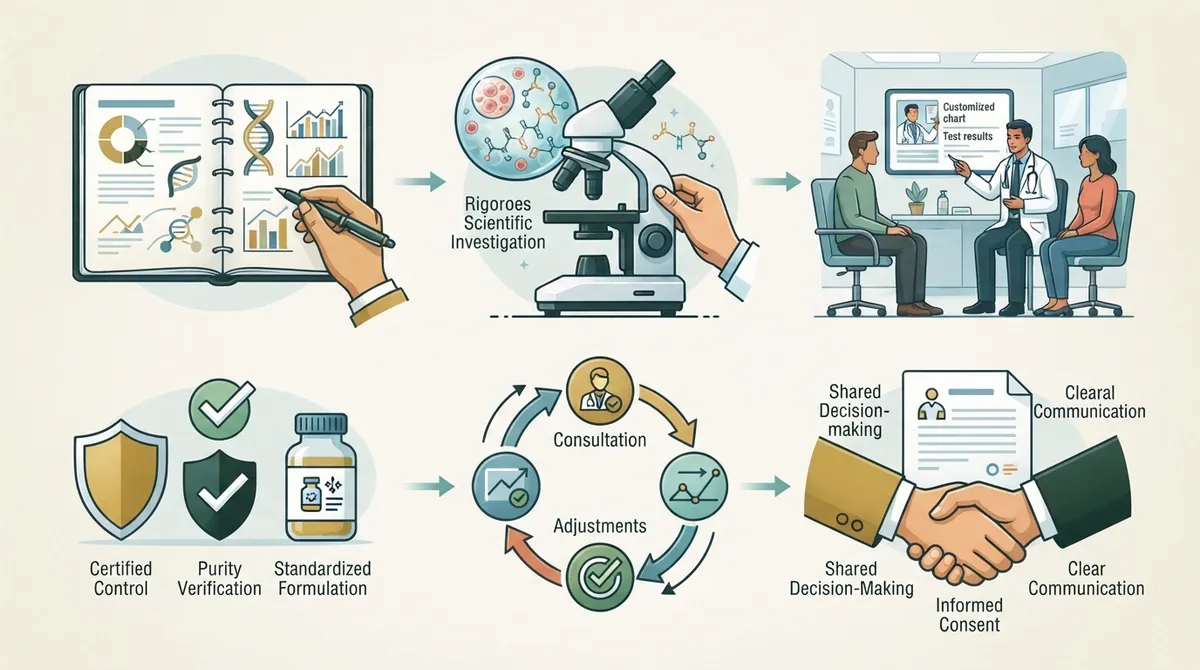
6 Signs Your Peptide Plan Is Truly Evidence Based
1. It Names the Exact Peptide and the Exact Goal
Vague promises are a red flag. A trustworthy plan says which peptide, for which purpose, at which dose. “Anti-aging blend” is not a plan. A named medicine tied to a defined goal is.
Evidence has to be judged one peptide at a time. Results for one drug do not carry over to another. Approval for one use does not prove benefit for unrelated wellness claims. This is why details matter so much.
2. It Separates Approved Medicines From Wellness Peptides
Some peptide-based medicines have strong clinical trial data and FDA approval for defined uses. Others are popular online but have little human research. Knowing the difference is the heart of evidence based peptide therapy.
Here is a simple look at how this breaks down:
| Peptide Type | Example | Regulatory Status | Human Evidence |
|---|---|---|---|
| FDA-approved metabolic peptides | Semaglutide, tirzepatide | Approved for specified metabolic indications | Strong, from large clinical trials |
| FDA-approved for a defined use | Tesamorelin | Approved for excess abdominal fat linked to HIV-related lipodystrophy | Strong for that specific use |
| FDA-approved for sexual desire | Bremelanotide | Approved for a defined sexual-desire disorder | Strong for that specific use |
| Popular wellness peptides | BPC-157, CJC-1295, ipamorelin | Not FDA-approved; flagged by FDA for compounding safety concerns | Limited human data |
For a deeper comparison, see Approved Peptides vs. Wellness Peptides: What Works?
3. It Is Honest About Compounded Products
Compounded drugs are not FDA-approved. The FDA does not review them for safety, effectiveness, and quality before they reach the market the way it reviews approved drugs. Compounding can be appropriate for specific patient needs under the law. But it is not proof that a treatment works.
A responsible provider tells you plainly whether your medicine is approved or compounded. They also explain why they chose it. If a clinic avoids this question, that is worth noticing. You can learn more in our guide on FDA-Approved vs. Compounded Peptides: What Wins?
4. It Takes Safety Concerns Seriously
This one is big. The FDA has identified potential significant safety risks for several peptides proposed for compounding, including BPC-157, CJC-1295, and ipamorelin. The concerns include limited human safety information, possible immune reactions, peptide-related impurities, and trouble characterizing the active ingredient.
The agency also cites serious adverse events tied to CJC-1295, such as increased heart rate and a systemic vasodilatory reaction. For ipamorelin, it points to a published study reporting serious adverse events, including death, when given intravenously for gastric motility. That finding is about one study and one route, so it should not be stretched to every formulation. Still, it shows why caution is smart.
Rules and guidance can change, so always check current FDA information. To go deeper, read How to Weigh the Risks of Peptide Therapy Safely in 2026 and How to Use CJC-1295 Peptides Safely for Results.
5. It Does Not Treat Animal Studies as Proof for People
Here is a common trap. A peptide shows exciting results in lab or animal studies, and suddenly it is marketed as a proven human therapy. But animal findings do not establish clinical benefit or safety in people.
BPC-157 is a great example. It gets a lot of buzz for injury recovery and tissue repair, yet the human evidence is limited. An honest provider will tell you that clearly, rather than overselling. If you are curious, our article Is BPC-157 Safe? What the Research Really Shows breaks it down in plain language.
You can also look at published research yourself. The National Library of Medicine hosts many peer-reviewed studies on peptide science and therapy.
6. It Includes Labs, Monitoring, and Follow-Up
Evidence based care is not a one-and-done purchase. It starts with a baseline, often blood work, and continues with check-ins to track progress and side effects. Without data, you are guessing.
This is especially appealing to biohackers and busy professionals who love numbers. A good plan uses your labs to guide choices, then measures whether things are actually improving. Learn more in Lab Work for Peptide Therapy: What to Test and Why and How to Know When Your Peptide Therapy Starts Working.
Red Flags to Watch For
Now that you know the signs, here are the warning flags. If you spot several of these, take a step back.
- “Research use only” products. These are not established medicines for human treatment.
- No clinician involved. Buying injectable peptides online with no medical oversight carries real quality and safety risks.
- One-size-fits-all stacks. Your body, labs, and goals are unique.
- Big promises, no citations. Claims like “reverses aging” with no human trial behind them deserve skepticism.
- No talk of risks. Every treatment has tradeoffs. If nobody mentions them, ask why.
Want to know who can explain this stuff safely? Check out Who Can Explain Peptide Therapy Safely? 2026 Guide.
How to Judge a Peptide Claim in Three Steps
You do not need a medical degree to check a claim. Try this simple routine:
- Find the exact product. Is it FDA-approved or compounded? What is the dose and route?
- Look for human research on your specific goal. Not rats. Not a different peptide. Your goal, in people.
- Ask a qualified clinician about risks and unknowns. A good provider will welcome the question.
Keep in mind that there is no single reliable success rate for “peptide therapy” as a whole. The numbers that matter come from the FDA label or peer-reviewed trials for the exact medicine and indication. That is the standard evidence based peptide therapy follows.
Questions to Ask Before You Start
Bring this short list to your first visit. It keeps the conversation focused and helps you feel in control.
- Is this peptide FDA-approved, and for what use?
- Is my product compounded, and where is it made?
- What human studies support this for my goal?
- What are the known risks, and what is still unknown?
- Which labs will you run, and how often will we check in?
- What happens if I do not see results or I have side effects?
For more ideas, our 15 Peptide Consultation Questions to Ask in 2026 is a great companion. And to avoid wasting your first appointment, read 3 Peptide Consultation Mistakes That Waste Your First Visit.
Why Personalization and Supervision Matter
Evidence is the foundation. Personalization is how you apply it. Two people can take the same medicine and respond very differently because of age, hormones, lifestyle, and health history.
That is why medical supervision is so important. A licensed provider can match a treatment to your labs, adjust over time, and stop something that is not working. It also helps with quality control and safe handling. Explore Why Should You Choose Medically Supervised Peptides in 2026? and 15 Ways a Peptide Therapy Plan Gets Personalized (2026) to see how this works in practice.
For many people, telehealth makes this easier. You can talk with a provider from home, get labs done locally, and have medication delivered to your door. If you are curious how that works, see How Does Telehealth Prescription Work for Peptides?
What Allura Longevity Offers
At Allura Longevity, we believe science and convenience belong together. We offer personalized, medically supervised peptide therapy through telehealth. You start with a $50 virtual consultation, complete blood work through LabCorp, and receive a customized six-month plan delivered to your home. Care is led by Ashley, a board-certified Family Nurse Practitioner, with ongoing monitoring and adjustments along the way.
Our services support goals like energy, sleep, mental clarity, skin rejuvenation, muscle recovery, metabolism, weight loss with GLP-1 medications, and testosterone replacement. We are licensed in Florida, Georgia, Texas, Connecticut, Indiana, Maryland, New York, and California.
Putting It All Together
Here is a quick recap of the six signs to look for:
| Sign | What It Looks Like |
|---|---|
| 1. Specific peptide and goal | Named medicine, dose, and purpose |
| 2. Approved vs. wellness clarity | Honest about regulatory status |
| 3. Transparent about compounding | Clear on what is compounded and why |
| 4. Serious about safety | Discusses known and unknown risks |
| 5. Human evidence over hype | Does not lean on animal studies alone |
| 6. Labs and follow-up | Baseline testing and ongoing monitoring |
Ready to Take the Next Step?
Choosing peptide care should feel empowering, not overwhelming. When you know what to look for, you can cut through the noise and focus on what is real. Evidence based peptide therapy is simply about being curious, asking good questions, and working with people who answer them honestly.
If you are ready for a personalized plan built around your labs and goals, we would love to help. Spots for new clients are limited each month, so don’t wait. Request a consultation today, or call us at (813) 510-6277. Your future self will thank you.
FAQs
Q: What does evidence based peptide therapy mean?
A: It means using a specific peptide for a defined goal when credible human research supports its benefits and risks. It also looks at the exact product, dose, route, and regulatory status. Think of it as choosing a treatment because the science backs it, not because the marketing sounds good.
Q: Which peptide therapies are FDA-approved?
A: Some peptide medicines are approved for specific uses. Examples include semaglutide and tirzepatide for specified metabolic indications, tesamorelin for excess abdominal fat tied to HIV-related lipodystrophy, and bremelanotide for a defined sexual-desire disorder. Approval for one use does not prove benefit for other claims, so always check the label.
Q: Is BPC-157 backed by human clinical evidence?
A: Human evidence for BPC-157 is limited. Much of the excitement comes from lab and animal studies, which do not prove benefit or safety in people. The FDA has also listed it among substances with potential safety concerns for compounding, so it is smart to talk with a qualified clinician first.
Q: Are compounded peptides FDA-approved or proven to work?
A: No. Compounded drugs are not FDA-approved, and the agency does not review them for safety, effectiveness, and quality before they are sold. Compounding can be appropriate for certain patient needs, but it does not replace solid evidence that a treatment works.
Q: Are peptide injections bought online safe?
A: Buying injectables online without medical oversight carries real risks, including quality and purity problems. Products labeled “research use only” are not established medicines for human treatment. A licensed provider, proper labs, and a trusted pharmacy are much safer paths.





