

Key Takeaways
-
Personalization matters most in assessment, contraindication screening, interaction checks, monitoring, and defined stop points, not in choosing the trendiest peptide.
-
No peptide is FDA-approved for anti-aging; approval for a specific condition does not extend to longevity, recovery, or anti-aging claims.
-
Ask the provider for the exact named product, whether it is approved or compounded, who makes it, and how its quality and purity are verified.
-
Be wary of 'research use only' peptides, which are not approved for human use and may have uncertain identity, purity, potency, and sterility.
-
A plan with no health questions, no clinician review, promises of reversing aging, or one protocol for everyone is a red flag, not personalization.
-
Start simple with a single purpose-driven peptide and clear tracking, since long stacks make it harder to know what is working or what caused a side effect.
You have probably seen the promise: a peptide plan built just for you. It sounds great. But how personal is a longevity peptide plan, really? Is it truly tailored to your body, or is it a generic stack with your name on the box?
It is a fair question, and you deserve a straight answer. A good plan can be deeply personal in the ways that matter most: how you are assessed, which options are even appropriate, how you are monitored, and when you stop. But personalization has limits. It cannot turn an unproven peptide into a proven one, and it cannot guarantee a result.
Whether you are a data-loving biohacker, a busy professional, or someone in midlife who simply wants to feel like yourself again, this guide gives you a friendly, practical way to separate real personalization from clever marketing. We will walk through what a personal plan includes, what it cannot do, and the questions to ask before you start.

What Personalization Really Means in Peptide Therapy
Personalization is not about picking the trendiest peptide. It is about a licensed clinician looking at you first. That means your health history, symptoms, current medications, goals, and relevant exam and lab findings, not a protocol copied from a forum post.
If you want a quick primer on the basics, our guide to 8 Facts That Explain What Are Peptides in 2026 is a good place to start. For a general overview, you can also read what are peptides on WebMD.
Here is the honest part. The research does not point to one validated set of tests or one standard peptide regimen for healthy aging. So a truly personal plan is built around your situation and your clinician’s judgment, not a magic formula. That is also why understanding peptide therapy safety matters before you begin.
Where Personalization Genuinely Helps
- Spotting contraindications: Your history may rule certain options out entirely.
- Checking interactions: Your medicines and supplements matter.
- Choosing monitoring: Follow-up is matched to the medicine and to you.
- Setting goals and stop points: You agree up front on what success looks like and when to pause.
Where Personalization Hits Its Limits
Personalization can improve safety and fit. It cannot make an unapproved peptide proven. Many peptides marketed for longevity have evidence that comes mostly from lab or animal studies, small human studies, or personal stories. Long-term human outcomes are often unknown. A 2026 review summarized exactly this: many investigational peptides promoted for aging lack adequate human trials and long-term safety data.
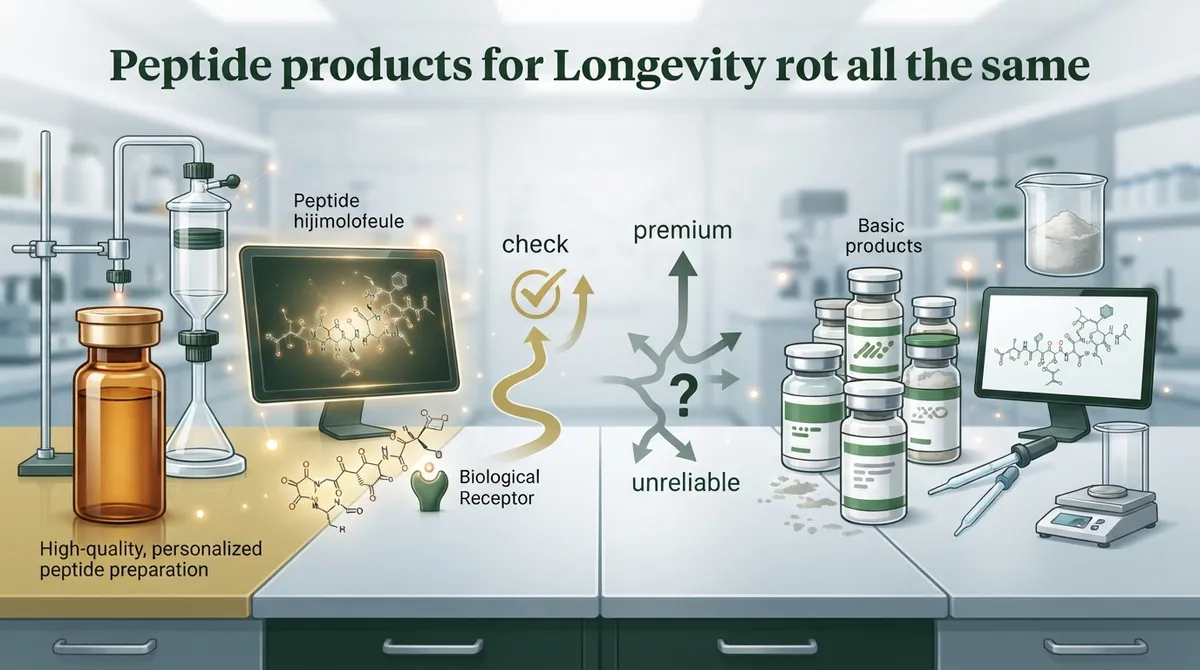
Not All Peptide Products Are the Same
The word “peptide” covers a lot of ground. Some peptide medicines are FDA-approved for specific conditions, such as certain GLP-1 medicines for diabetes or weight management. Others are sold for general wellness with far less evidence behind them.
Here is the key point: approval for one use does not mean approval, or evidence, for longevity, recovery, or anti-aging. A personal plan should be upfront about which category each product falls into.
| Product Type | Regulatory Status | What to Know |
|---|---|---|
| FDA-approved peptide medicine | Approved for specific listed conditions | Evidence applies to the approved use only, not to longevity claims |
| Compounded peptide | Not FDA-approved; not reviewed for safety and effectiveness before marketing | Quality depends heavily on the pharmacy; some peptides raise FDA safety concerns |
| “Research use only” product | Not approved for human use | Identity, purity, potency, and sterility are uncertain, especially for injectables |
For a deeper look, see FDA-Approved vs. Compounded Peptides: What Wins? and 503A vs. 503B: Which Peptide Compounding Wins?
How to Judge How Personal a Longevity Peptide Plan Is: 7 Steps
Use this checklist when you are comparing providers. A truly personal plan should pass most of these steps.
- Look for a real clinical intake. You should be asked about your history, symptoms, medications, allergies, and goals. If you can add a product to a cart without answering health questions, that is a red flag.
- Check that a licensed provider reviews your case. A clinician should make the call, not an algorithm or a salesperson.
- Ask what labs are used and why. Blood work can be useful, but the tests should fit your situation. No universal “longevity panel” has been proven for everyone.
- Ask for the exact drug and its intended use. A good plan names the specific product and explains whether it is approved, compounded, or something else.
- Ask about product quality. Where is it made? What are the regulatory status and storage needs? You should never be handed a vague “proprietary blend.”
- Confirm the follow-up schedule. Monitoring should be matched to the medicine and to you, with clear check-ins.
- Agree on stopping criteria. What results mean it is working? What side effects mean you pause or stop? Plans without exit rules are not very personal.
If you want help with the questions to bring, try 15 Peptide Consultation Questions to Ask in 2026.
What Goes Into a Personalized Plan
Here is what a thoughtful plan tends to include, and why each piece matters.
| Plan Element | What It Looks Like | Why It Matters |
|---|---|---|
| Health history review | Conditions, past reactions, family history, current medicines | Identifies contraindications and interactions |
| Goal setting | Energy, sleep, recovery, skin, body composition, or sexual wellness | Keeps the plan focused on what you actually want |
| Lab work | Tests chosen for your symptoms and history | Gives a baseline and helps guide decisions |
| Product selection | Specific named medicine with a stated purpose | Lets you weigh evidence and risk clearly |
| Monitoring | Scheduled check-ins and repeat testing when appropriate | Catches problems early and tracks real progress |
| Review and stop points | Defined timelines for adjusting or stopping | Prevents open-ended use with no clear benefit |
Curious how labs fit in? Read Lab Work for Peptide Therapy: What to Test and Why and How to Use Biomarker Testing to Guide Peptide Therapy.
Red Flags That a “Personal” Plan Is Not Personal
Some plans use the word “custom” as decoration. Watch for these warning signs:
- One protocol offered to everyone, with only the dose changing
- No health questions, no labs, and no clinician conversation
- Promises of reversing aging or guaranteed results
- “Research use only” products offered for human injection
- Pressure to buy large bundles upfront
- No explanation of side effects, interactions, or stopping rules
Regulators have noticed the same trends. The FDA has raised concerns about compounding certain peptides, including immune reactions, impurities, and limited human safety data. Reports from the National Library of Medicine and others also underline how much remains unknown. Regulatory status can change, so it is smart to verify the current FDA position on any peptide before you start.
Our article How to Spot and Avoid Peptide Therapy Risks goes deeper on this.
The Risks Depend on the Peptide, and on You
There is no single risk profile for “peptides.” Concerns vary with the specific peptide, dose, route, product quality, and the patient. Reported or regulatory concerns include allergic or immune reactions, injection-site problems, and possible effects on hormones or other body systems. For many unapproved peptides, interactions and long-term risks are still poorly understood.
This is exactly why personalization matters for safety. A clinician who knows your full picture can say “this is not a good fit for you” or “let us start with something with stronger evidence.” That honest answer is a sign of quality, not a letdown.
How Telehealth Can Make a Plan More Personal
Telehealth sometimes gets a bad rap for being impersonal. Done well, it can be the opposite. You get time with a licensed provider, labs ordered for your situation, and follow-up visits without driving across town or taking time off work. For busy professionals especially, that consistency can make a plan easier to stick with and easier to monitor.
At Allura Longevity, care starts with a virtual consultation, blood work through LabCorp, and a customized plan from a licensed provider team led by a board-certified Family Nurse Practitioner. Plans are delivered to your home, with ongoing monitoring and adjustments along the way. Services are available in Florida, Georgia, Texas, Connecticut, Indiana, Maryland, New York, and California.
Not sure whether telehealth beats a local clinic for you? See Local Clinic vs. Telehealth: Best Peptide Therapy Near You? You can also learn How to Start Peptide Therapy Safely and See Real Results.
Single Peptides, Stacks, and the “Custom Stack” Trap
It is tempting to believe that more peptides means more personalization. It does not. A long stack of products can actually make it harder to know what is working and harder to identify the cause of a side effect. Starting simple, with a clear purpose and clear tracking, is often wiser.
If you want to compare approaches, read Single Peptides vs. Peptide Stacks: Which Wins? and 15 Custom Peptide Protocols Mistakes to Avoid in 2026.
Setting Realistic Expectations
A personal plan should come with honest timelines. Some people notice changes in energy or sleep within weeks; others notice little or nothing. Results vary, and for longevity goals there is no proven way to measure “years added.” Better markers to watch are things you can actually feel and track, like energy, sleep quality, recovery, and lab trends your provider reviews with you.
For more on timing, see How Long for Peptide Therapy Results? A Real Timeline and Can Peptide Therapy Really Help Slow Aging?
Your Pre-Start Question List
Bring these to any consultation. A good provider will welcome them.
- What exact medicine are you recommending, and for what purpose?
- Is it FDA-approved, and if so, for what condition?
- If it is compounded, who makes it and how is quality verified?
- What does the evidence show in humans, and what is still unknown?
- What could interact with my medicines or supplements?
- What labs will we use, and how often will we recheck?
- When will we review progress, and when would we stop?
You can also explore How to Get Prescription Peptides Safely in 2026 for more on legitimate access.
Conclusion: Personal Means Honest, Not Just Custom
So, how personal is a longevity peptide plan? As personal as the clinician, the process, and the follow-up behind it. The best plans start with you, use evidence and labs thoughtfully, name exactly what you are taking, and give you a clear way to measure progress or stop. They do not promise miracles, and they do not hide uncertainty.
If you want a plan built around your health history, labs, and goals, with licensed providers guiding each step, we would love to talk. Spots for new clients are limited each month. Request a consultation today, or call (813) 510-6277 to get started.
FAQs
Q: How does a clinician personalize a longevity peptide plan?
A: A licensed provider reviews your health history, symptoms, medications, goals, and relevant lab results, then decides which options (if any) are appropriate for you. A good plan also sets follow-up and stopping points, so you are never left guessing.
Q: Are longevity peptides FDA-approved for anti-aging?
A: No peptide is FDA-approved specifically for anti-aging or healthy aging. Some peptide medicines are approved for specific conditions, but that approval does not extend to longevity claims. It is always worth asking a provider exactly what a product is approved for.
Q: What are the risks of compounded or online peptide products?
A: Compounded drugs are not FDA-approved or reviewed for safety and effectiveness before marketing, and the FDA has raised concerns about certain peptides, including immune reactions and impurities. Products sold as “research use only” are not approved for human use, so their purity, potency, and sterility can be uncertain.
Q: How can I tell whether a peptide treatment is evidence-based?
A: Ask what human studies support the specific peptide for your specific goal, and whether the product is approved, compounded, or something else. If a provider leans mostly on animal research, testimonials, or big promises, take that as your cue to ask more questions.
Q: How often should a peptide plan be reviewed?
A: There is no one-size-fits-all schedule, because monitoring depends on the medicine and on you. A responsible plan sets clear check-ins from the start, reviews your symptoms and labs when appropriate, and defines when to adjust or stop.





