

Key Takeaways
-
Medically supervised peptide therapy is not one standardized treatment; ‘FDA-approved’, ‘compounded’, and ‘research use only’ products have very different evidence and oversight, so check the category first.
-
Clinician supervision improves prescribing, safety screening, and monitoring, but it cannot make an unapproved peptide FDA-approved or guarantee results.
-
Approval for one use does not prove benefit for another; judge the evidence one peptide and one goal at a time, since human data for wellness uses like BPC-157 is limited.
-
A trustworthy program includes a real consultation, baseline lab work, an honest treatment rationale, safety screening, sourcing from licensed pharmacies, and ongoing follow-up.
-
Red flags include skipping labs, skipping the risk discussion, promising results for everything, or selling injectables from unverified or ‘research use only’ sources.
-
Before starting, ask which exact peptide is recommended and why, whether it is approved or compounded, what human evidence supports it, its risks and alternatives, and how it will be monitored.
Peptides are everywhere right now. Your gym buddy mentions them. Your favorite podcast hosts debate them. Your social feed is full of before-and-after posts. If you are curious but a little cautious, good news: that instinct is a smart one.
Here is the thing. Medically supervised peptide therapy is not one single treatment. It can mean an FDA-approved medicine for a proven medical use. It can also mean a compounded or off-label product used for wellness goals, and those two worlds have very different evidence and oversight.
In this guide, we will walk through what supervision really means, what it can and cannot do, and how to spot a safe, honest program. Whether you are a busy professional, a data-loving biohacker, or someone planning to age well, you will leave with clear questions to ask. If you are brand new, our primer on how to understand peptide therapy: a 2026 overview is a great place to start.

What Does Medically Supervised Peptide Therapy Mean?
Medically supervised peptide therapy means a licensed clinician oversees your treatment from start to finish. That includes reviewing your health history, ordering lab work, choosing a therapy, and following up on how you feel and what your labs show.
Peptides are short chains of amino acids. Your body makes many of them naturally, and they act as signals that influence hormones, appetite, tissue repair, and more. You can read a plain-language overview of what are peptides if you want the basics.
The phrase “medically supervised” is not a regulated category on its own. There is no single standard treatment behind it. That is why the details matter, and why it helps to ask which peptide, for which purpose, and based on what evidence.
What supervision does and does not do
Good supervision is valuable. It helps with proper prescribing, safety checks, and monitoring. But it does not turn an unapproved product into an FDA-approved one. A clinician cannot make a peptide effective just by overseeing it.
- Supervision can: confirm a reason for treatment, screen for risks, check drug interactions, and track your response.
- Supervision cannot: create FDA approval, guarantee results, or replace strong human research.
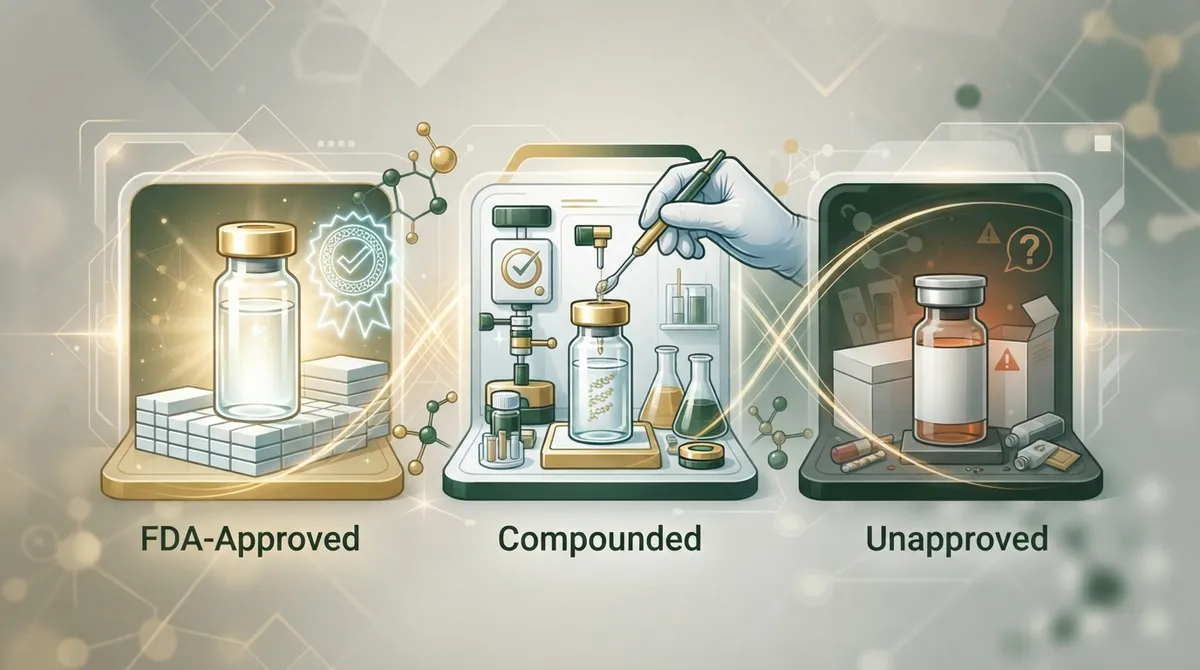
FDA-Approved, Compounded, and Unapproved: Know the Difference
This is the most important idea in the whole article. Not all peptides are treated the same way by regulators, and the label on the vial tells you very little unless you know the category.
| Category | What It Means | Examples | Level of Oversight |
|---|---|---|---|
| FDA-approved peptide medicine | Reviewed by FDA for safety and effectiveness for a specific use | Semaglutide (certain diabetes and weight-management uses); tesamorelin (HIV-associated lipodystrophy) | Highest: premarket review and ongoing monitoring |
| Compounded peptide | Made by a pharmacy for an individual patient when a prescriber identifies a need; not FDA-approved | Varies by prescriber, pharmacy, and current FDA guidance | Moderate: pharmacy rules apply, but no FDA premarket review of the finished product |
| “Research use only” product | Sold for lab use, not authorized for human treatment | Various gray-market vials | Little to none: identity, purity, and sterility are uncertain |
Approval for one use also does not prove benefit for another. A drug approved for diabetes or weight management has not been shown to help with, say, anti-aging claims. Always match the evidence to the specific peptide and the specific goal.
For a deeper dive, see our breakdown of FDA-approved vs. compounded peptides.
A quick note on counts
People often ask how many peptide drugs the FDA has approved. There is no single official FDA count, because it depends on how “peptide” is defined. One third-party, database-based census reported 43 peptide active ingredients with at least one FDA-approved application as of October 2026, with 37 listed as marketed. Treat that as a rough guide, not an official number.
Why Regulation and Quality Matter
Compounding is a legitimate practice. A prescriber may order a custom preparation when a patient has a clinical need. But compounded drugs do not go through the same FDA premarket review for safety, effectiveness, and quality as approved drugs.
The FDA has also raised concerns about certain bulk peptide substances used in compounding. The concerns include impurities, unwanted immune reactions (called immunogenicity), and limited safety data. The rules for individual substances can change, so any claim about what may be compounded should be checked against current FDA lists and guidance.
Injectables raise the stakes. Products with uncertain identity, purity, potency, or sterility can cause real harm. That is why where your peptide comes from matters as much as who prescribes it.
Not sure how to tell a legitimate source from a risky one? Our guide on how to get prescription peptides safely in 2026 walks through the red flags.
What a Safe Supervised Program Looks Like
Think of a trustworthy program as a clear, step-by-step process, not a quick checkout page. Here is what responsible care typically includes.
- A real consultation. A licensed provider reviews your history, medications, symptoms, and goals.
- Lab work first. Blood tests give a baseline so the plan fits your body, not a generic template. See 5 blood work analysis steps before peptides in 2026 for what to expect.
- An honest treatment rationale. Your provider explains why a peptide fits you, what the evidence says, and what the alternatives are.
- Safety screening. This covers contraindications, drug interactions, and your personal risk factors.
- Sourcing from regulated channels. Medications should come from a licensed pharmacy, not an unverified seller.
- Follow-up and monitoring. Check-ins track results, side effects, and any needed adjustments.
If any of these steps are missing, pause. A program that skips labs, skips the risk talk, or promises results for everything is a program to question.
Matching the Peptide to the Goal
Because peptides are so different from one another, it helps to look at them by purpose. Evidence quality varies a lot across these uses.
| Goal | Peptide Types Often Discussed | Evidence Snapshot |
|---|---|---|
| Weight management | GLP-1 medicines such as semaglutide | Stronger human data for approved uses; see our GLP-1 guide |
| Fat around the belly (specific conditions) | Tesamorelin | FDA-approved for HIV-associated lipodystrophy only |
| Injury and tissue recovery | BPC-157, TB-500 | Mostly animal and early research; human evidence is limited |
| Growth hormone support | Sermorelin, ipamorelin, CJC-1295 | Varies; discuss risks and goals with a clinician |
| Sexual wellness | PT-141 (bremelanotide) | An approved product exists for a specific use in premenopausal women |
Notice how the story changes from row to row. That is the whole point. “Peptide therapy” is not one thing, so claims should be judged one peptide at a time. If you are curious about a specific one, our posts on BPC-157 safety and research and ipamorelin benefits, dosing, and safety go deeper.
Risks and Side Effects to Discuss
Every treatment has trade-offs, and peptides are no exception. Side effects depend on the specific peptide, the dose, and your health. Some common conversation points include:
- Injection-site reactions such as redness, soreness, or swelling.
- Digestive effects with some medicines, like nausea or constipation. Our article on GLP-1 side effects and how to manage them covers this well.
- Immune reactions to impurities or the peptide itself, which is a reason quality sourcing matters.
- Unknowns. For many wellness peptides, long-term human safety data is limited.
Be extra careful if you are pregnant, planning pregnancy, have a history of cancer, or take multiple medications. Tell your provider everything, including supplements. Honest answers make the plan safer. For a balanced view, read is peptide therapy safe? What you really need to know.
Questions to Ask Before You Start
You are the customer, and you are allowed to ask plenty of questions. A good provider will welcome them. Bring this list to your first visit:
- Which exact peptide are you recommending, and why for me?
- Is it FDA-approved, compounded, or something else?
- What human evidence supports it for my goal?
- What are the risks, side effects, and alternatives?
- Where is it made, and which pharmacy supplies it?
- What labs will you track, and how often?
- What happens if I have a side effect or want to stop?
For more ideas, check out these 15 peptide consultation questions to ask in 2026.
Is Telehealth a Good Fit for Peptide Care?
For many people, yes. Telehealth removes the commute, offers flexible scheduling, and lets you do lab work at a nearby draw site. Busy professionals love it, and so do people who simply prefer to handle care from home.
The key is that telehealth does not lower the standard of care. You should still get a real clinician, real labs, and real follow-up. We compare the options in local clinic vs. telehealth, and you can read what to watch for in is telemedicine peptide therapy safe?
How Allura Longevity approaches supervised care
Allura Longevity is a telehealth clinic built around personalized, medically supervised care. New clients start with a $50 virtual consultation, complete blood work through LabCorp, and receive a customized six-month plan designed by licensed providers, led by Ashley, a board-certified Family Nurse Practitioner. Medications are delivered to your door, with ongoing monitoring and adjustments along the way.
The team supports goals like energy, sleep, mental clarity, skin rejuvenation, muscle recovery, metabolism, GLP-1 weight loss, BPC-157 injury recovery, and testosterone replacement. Care is available in Florida, Georgia, Texas, Connecticut, Indiana, Maryland, New York, and California. You can explore options designed for peptides for women and peptides for men.
Setting Realistic Expectations
Peptides are not magic, and a good provider will tell you so. Results depend on the peptide, your biology, your habits, and how consistent you are. Sleep, nutrition, strength training, and stress management still do much of the heavy lifting.
Timelines vary too. Some people notice changes within weeks, while others need months. Our guide to how long for peptide therapy results sets honest expectations. And if you want the evidence-first lens on longevity claims, see how to pick the best peptides for aging in 2026.
Remember, you should not self-prescribe or buy injectables from sellers outside regulated channels. Talk to a licensed clinician and a pharmacist. For research context, the National Library of Medicine hosts peer-reviewed studies on peptide therapeutics.
Final Thoughts
Medically supervised peptide therapy can be a smart, safe way to pursue your health goals when it is done right. That means a clear diagnosis or goal, honest talk about evidence, quality sourcing, lab-guided plans, and steady follow-up. It also means understanding that supervision is a safeguard, not a stamp of approval on every product.
If you are ready to see whether a personalized plan fits you, we would love to help. Allura Longevity keeps new-client spots limited each month, so don’t wait too long. Request a consultation today, or call (813) 510-6277 to talk with our team.
FAQs
Q: What does medically supervised peptide therapy mean?
A: It means a licensed clinician guides your care by reviewing your history, ordering labs, choosing a therapy, and following up over time. It is not a single standardized treatment, so the specific peptide and its evidence still matter.
Q: Are peptide therapies FDA-approved?
A: Some are, but many are not. Medicines like semaglutide and tesamorelin are FDA-approved for specific uses, while compounded and off-label peptides do not go through the same FDA premarket review. Always ask which category your peptide falls into.
Q: What is the difference between an FDA-approved peptide and a compounded peptide?
A: An approved peptide has been reviewed by the FDA for safety and effectiveness for a set use. A compounded peptide is made by a pharmacy for an individual patient and is not FDA-approved, so quality and evidence can vary.
Q: Are compounded peptides safe and legal to use?
A: Compounding can be appropriate when a prescriber identifies a clinical need, but safety depends on the substance, the pharmacy, and current FDA guidance, which can change. Use only regulated channels and avoid products labeled “research use only.”
Q: What should I ask a clinician before starting peptide therapy?
A: Ask which exact peptide they recommend, whether it is approved or compounded, what human evidence supports it, and what risks and alternatives exist. Also ask where it is sourced and how they will monitor you with labs and follow-ups.





