

Key Takeaways
-
Bremelanotide (PT-141) is the best-studied libido peptide; it produced a modest average improvement in desire and reduced distress versus placebo, but results vary by person.
-
Trials did not show a significant difference from placebo in satisfying sexual events, so do not expect a guaranteed increase in intimacy.
-
Common side effects include nausea (about 40%), flushing (about 20%), and headache; 18% of users stopped treatment versus 2% on placebo.
-
Bremelanotide is contraindicated for uncontrolled hypertension or known cardiovascular disease, so review your health history and labs with a licensed provider first.
If you have been wondering what results you can expect from libido peptides, you are in good company. Low desire is common, and many people are curious about whether a peptide might help. The honest answer is a little more nuanced than the marketing makes it sound.
“Libido peptides” is not one single treatment. It is a broad term that mostly points to one peptide with real clinical research behind it: bremelanotide, also known as PT-141. Other peptides are still being studied. So the results you can expect depend on which product you use, who you are, and what is behind your low desire.
Think of this guide as a friendly reality check. We will walk through ten results you can reasonably expect, what the research actually shows, and what to watch out for. Whether you are a busy professional, a health optimizer, or someone simply curious about aging well, you deserve straight talk. Let’s dive in.

First, What Are Libido Peptides?
Peptides are short chains of amino acids that act as signals in the body. If you are new to the topic, our guide on what peptides are is a great place to start, and you can also read this overview of what are peptides from WebMD.
When people say “libido peptides,” they usually mean bremelanotide (PT-141). It works in the brain’s pathways tied to sexual desire, not just in blood flow. That makes it different from many other sexual health options.
Here is a quick snapshot of the main players:
| Peptide | Status | Evidence Level |
|---|---|---|
| Bremelanotide (PT-141, Vyleesi) | FDA-approved for a specific group of women | Phase 3 randomized trials |
| Kisspeptin | Investigational | Small early studies |
| Compounded libido peptides | Not equal to approved products | Varies by product |
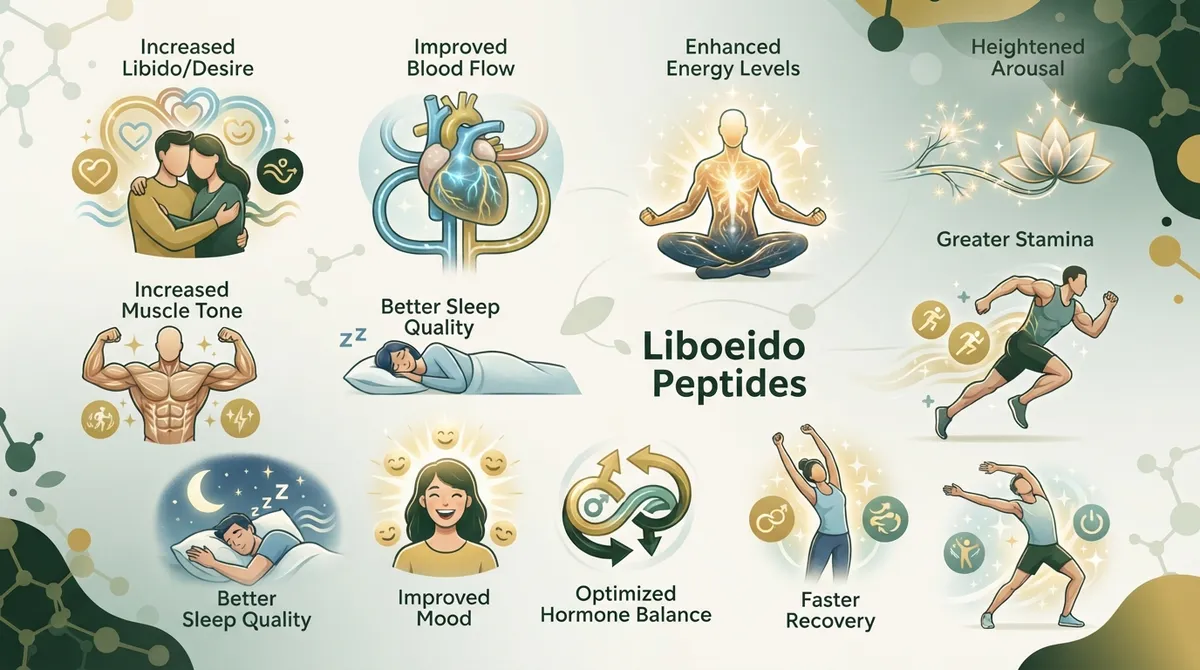
10 Results You Can Realistically Expect
1. A Possible Boost in Sexual Desire (On Average)
This is the headline result. In clinical trials, bremelanotide improved self-reported sexual desire compared with placebo. The placebo-adjusted improvement in the Female Sexual Function Index desire score was 0.35 points, which was statistically significant.
That is a modest average change. Some people notice a clear lift, while others feel little or nothing. It is not a guaranteed switch you flip.
2. Less Distress About Low Desire
Many people do not just have low desire. They feel upset, frustrated, or worried about it. In the trials, bremelanotide also reduced sexual distress, with a placebo-adjusted improvement of 0.33 points.
For some, feeling less burdened by the issue is a meaningful win on its own.
3. A Better Chance of Being a “Responder”
In two 24-week phase 3 trials of 1,247 premenopausal women, about 58% of those on bremelanotide met the studies’ responder criteria. About 35% to 36% of those on placebo did too.
Notice that placebo numbers were high. That is a reminder that expectations, stress, and context play a big role in desire.
4. Not Necessarily More Satisfying Sexual Events
Here is a result that surprises many people. The trials did not show a significant difference between bremelanotide and placebo in the number of satisfying sexual events.
So the evidence supports better desire and less distress more clearly than it supports a predictable jump in how often you are intimate.
5. Effects Tied to Timing, Not Daily Use
Bremelanotide is used as needed before anticipated sexual activity. It is not a daily supplement that slowly builds up. The FDA-labeled product is a subcutaneous injection, and a qualified prescriber should decide dosing and suitability.
If you like routines and tracking, this on-demand pattern may feel different from other peptide plans. You can learn more about how this works in our post on 9 Intimate Wellness Facts About PT-141 in 2026.
6. Side Effects That Are Fairly Common
Being honest about the downsides helps you plan. In the FDA prescribing information for Vyleesi, side effects were notable:
- Nausea in about 40% of treated participants versus about 1% on placebo
- Flushing in about 20% versus 1%
- Headache in about 11% versus 2%
- Injection-site reactions and vomiting also occurred
Adverse reactions led to stopping treatment in 18% of participants on Vyleesi versus 2% on placebo. Nausea alone caused 8% to stop. This is why a check-in with a provider matters.
7. Temporary Changes in Blood Pressure and Heart Rate
Bremelanotide can briefly raise blood pressure and lower heart rate. It is contraindicated in people with uncontrolled hypertension or known cardiovascular disease. Repeated use can also cause focal skin darkening.
This is a big reason to avoid buying random products online. A licensed clinician should review your health history first.
8. Results That Depend on Who You Are
The FDA-approved use is narrow. It applies to premenopausal women with acquired, generalized hypoactive sexual desire disorder (HSDD) that causes distress and is not explained by another medical or psychiatric condition, relationship problems, or medication or substance effects.
It is not approved for low desire in men, postmenopausal women, or sexual performance problems in general. If you are curious about men’s options, see our post on PT-141 vs. Viagra.
9. Very Early, Unproven Results for Other Peptides
Kisspeptin gets a lot of buzz, but it is investigational. A small randomized study of 32 men with HSDD, published in JAMA Network Open in 2023, found changes in brain responses to sexual cues and in measures of penile tumescence and desire.
That is interesting science, but it does not prove everyday clinical benefit, long-term results, or an approved protocol. Treat kisspeptin claims with healthy skepticism.
10. Results That Vary With Product Quality
Compounded or clinic-marketed peptides should not be assumed equal to FDA-approved Vyleesi. Evidence, product quality, dosing, and safety may differ. Our guide on FDA-approved vs. compounded peptides explains the differences in plain language.
Always ask which exact product you are being offered and what evidence supports it.
A Quick Summary of What the Research Shows
| Outcome | Evidence Supports It? | Notes |
|---|---|---|
| Improved sexual desire | Yes, on average | Modest, varies by person |
| Reduced distress | Yes, on average | Statistically significant |
| More satisfying sexual events | No significant difference | Versus placebo in phase 3 trials |
| Works for men or postmenopausal women | Not an approved use | Discuss with a clinician |
| Kisspeptin for libido | Not established | Small early study only |
How to Set Realistic Expectations Before You Start
A few simple steps can help you get more out of any plan. Here is a practical order to follow:
- Get the full picture. Low desire can come from stress, sleep problems, hormone shifts, medications, mood, or relationship factors.
- Check your labs. Blood work can reveal thyroid, testosterone, estrogen, or other issues worth treating first.
- Review your medications and health history with a licensed provider, especially heart and blood pressure concerns.
- Choose a clearly identified product and ask whether it is FDA-approved or compounded.
- Track your response. Note desire, distress, and side effects so your provider can adjust the plan.
If you like a data-driven approach, you will appreciate our guide on using biomarker testing to guide peptide therapy. And if you want a broader look at options, check out 6 Real Treatments for Low Libido in Women.
Who Tends to Feel Disappointed?
Some people expect a dramatic overnight change. When it does not happen, they feel let down. A few common reasons include:
- Expecting a peptide to fix a problem rooted in sleep, stress, or relationship strain
- Using a product not meant for their situation
- Stopping early because of nausea or flushing
- Believing marketing claims instead of clinical evidence
None of that means you did anything wrong. It just means desire is complex, and the best results usually come from looking at the whole picture. Our article on how to find the right peptide for low libido can help you sort through your options.
The Role of Medical Guidance
Because libido touches hormones, mood, heart health, and relationships, working with a licensed provider matters. A good provider will ask questions, order labs, and explain risks in plain language. You can also read the National Library of Medicine research on peptide therapeutics if you enjoy digging into the science.
At Allura Longevity, personalized peptide therapy is delivered through telehealth. Care starts with a virtual consultation and blood work through LabCorp, and licensed providers, led by board-certified Family Nurse Practitioner Ashley, design a customized plan and monitor your progress. Services are available in Florida, Georgia, Texas, Connecticut, Indiana, Maryland, New York, and California. For a deeper look at the process, see how to start peptide therapy safely and see real results.
Conclusion
So, what results can you expect from libido peptides? For the best-studied option, bremelanotide, you can reasonably expect a modest average improvement in desire and less distress about low desire. You should not expect a guaranteed boost in sexual frequency or satisfying events, and you should be ready for possible side effects like nausea and flushing.
Other peptides, like kisspeptin, remain investigational, and compounded products are not the same as FDA-approved ones. The smartest move is to start with labs, ask good questions, and work with a licensed clinician who treats you as a whole person.
Ready to explore a personalized, medically supervised plan? Request a consultation with Allura Longevity today, or call (813) 510-6277. Spots for new clients are limited each month, so reach out while there is room.
FAQs
Q: What are libido peptides, and which ones have clinical evidence?
A: “Libido peptides” is a broad marketing term, not one standard treatment. Bremelanotide (PT-141) has the clearest clinical evidence and an FDA-approved product, Vyleesi, for a specific group of premenopausal women. Kisspeptin is still investigational.
Q: Does PT-141 actually increase sexual desire?
A: On average, yes, a little. In clinical trials, bremelanotide improved self-reported desire and reduced distress compared with placebo. Your own results may differ, and it does not guarantee more satisfying sexual events.
Q: What side effects should I know about before using PT-141?
A: Common ones include nausea, flushing, headache, vomiting, and injection-site reactions. It can also temporarily raise blood pressure and lower heart rate, so it is not right for people with uncontrolled hypertension or known heart disease.
Q: Do libido peptides work for men or postmenopausal women?
A: The FDA-approved use is limited to premenopausal women with acquired, generalized HSDD. It is not approved for men or postmenopausal women, so it is best to talk with a licensed provider about what fits your situation.
Q: Are compounded libido peptides the same as prescription Vyleesi?
A: Not necessarily. Compounded products may differ in quality, dosing, evidence, and safety. Ask your provider exactly which product you are getting and what research backs it up.





