

Key Takeaways
-
Women's hormone peptide therapy is a marketing umbrella term, not one standardized or FDA-approved treatment, so first ask exactly which product is being offered and whether it is approved, compounded, or investigational.
-
Traditional HRT has well-established evidence for menopause symptoms like hot flashes, night sweats, and bone protection, while peptides are not an established menopause treatment.
-
Kisspeptin, a signaling peptide that influences LH and FSH, has been studied in small trials for egg maturation, PCOS, hypothalamic amenorrhea, and libido, but remains investigational.
-
Compounded peptide products are not FDA-reviewed for safety, effectiveness, or quality before marketing, so purity, potency, sterility, and dosing can be uncertain.
-
Start with baseline blood work, clear goals, and a licensed provider who explains evidence limits and plans follow-up monitoring rather than promising quick results.
-
Be skeptical of claims of 'no side effects' or 'hormone balance,' since reliable pooled adverse event data for marketed hormone-peptide products does not exist.
If you’ve typed “women’s hormone peptide therapy” into a search bar, you’re probably tired, a little confused, or both. Maybe your sleep has gone sideways. Maybe your energy tanks by 2 p.m. Maybe someone told you peptides can “balance your hormones” and you want to know if that’s true.
Here’s the honest, friendly answer: it’s more complicated than the marketing suggests. “Women’s hormone peptide therapy” is a catch-all phrase, not one single treatment. It can mean very different things depending on who is selling it.
In this guide, we’ll compare peptide-based approaches with traditional hormone replacement therapy (HRT) so you can see how they differ. We’ll look at what the research actually shows in 2026, where the evidence is thin, and how to talk with a licensed provider about your goals. Whether you’re a busy professional, a data-loving biohacker, or simply curious about aging well, you’ll leave with clearer questions and a smarter plan.

What Does “Women’s Hormone Peptide Therapy” Really Mean?
Let’s start with the basics. Peptides are short chains of amino acids that act as signals in your body. If you’re brand new to the topic, our guide on 8 facts that explain what are peptides in 2026 is a friendly place to begin. You can also read the overview on what are peptides from WebMD.
Women’s hormone peptide therapy is a broad marketing phrase. It is not a single standardized or FDA-approved treatment. Depending on the source, it might refer to:
- Investigational reproductive peptides, such as kisspeptin, studied in small research settings
- Approved peptide medicines used for specific medical conditions
- Compounded products marketed for general “hormone balance”
That’s a lot of different things sharing one label. Knowing which one you’re being offered is the first and most important step.
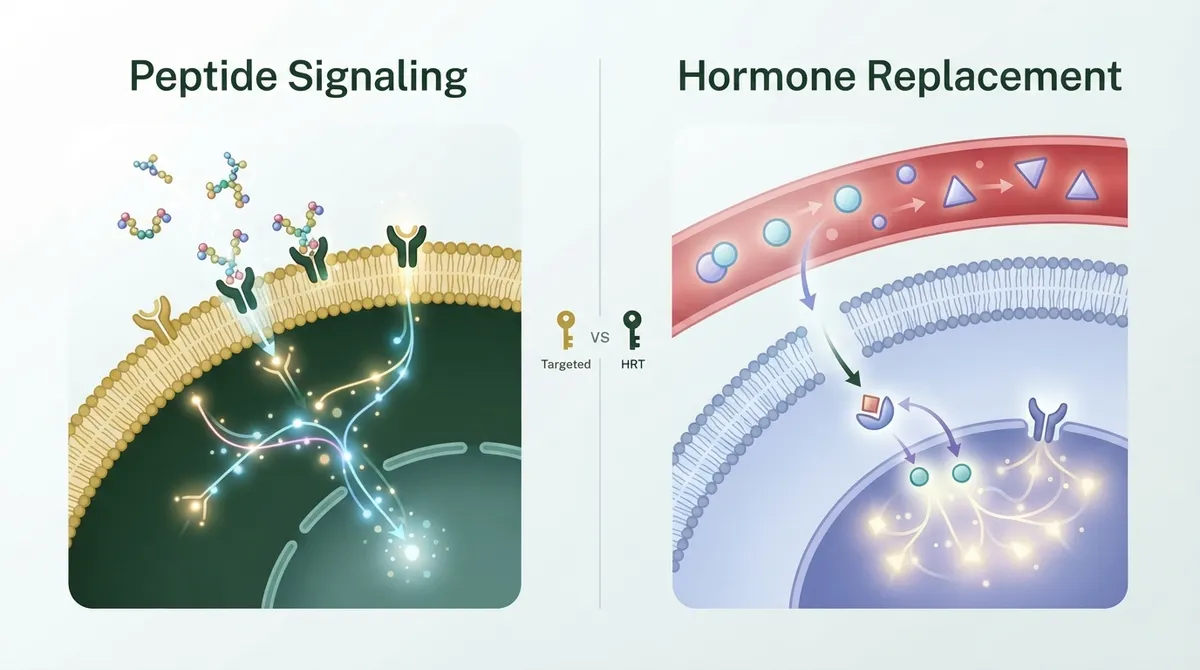
How Peptides and Hormones Work Differently
Think of hormones as the messages and peptides as some of the messengers. Many hormones are actually peptides themselves, like insulin. Others, like estrogen and progesterone, are steroid hormones built from cholesterol.
Traditional HRT replaces the hormone your body is making less of. Peptide approaches, in theory, nudge the signaling system that tells your body to make or release its own hormones. That’s a real difference, and it affects how each option is studied, regulated, and prescribed.
| Feature | Traditional HRT | Peptide-Based Approaches |
|---|---|---|
| What it does | Replaces estrogen, progesterone, or testosterone directly | Signals the body to adjust its own hormone or growth pathways |
| Evidence for menopause symptoms | Well established for hot flashes and night sweats | Not established as a menopause treatment |
| Regulatory status | Many FDA-approved options | Varies widely; many are investigational or compounded |
| Typical goals | Symptom relief, bone protection | Energy, recovery, sleep, body composition support |
The Science Spotlight: Kisspeptin and Reproductive Hormones
One peptide gets a lot of buzz in this space: kisspeptin. It’s a naturally occurring signaling peptide that acts upstream of gonadotropin-releasing hormone (GnRH). In plain English, it sits near the top of the chain of command for your reproductive hormones, influencing luteinizing hormone (LH) and follicle-stimulating hormone (FSH).
Its effects depend on context, including where a woman is in her menstrual cycle. That’s one reason it’s so interesting to researchers, and also why it’s not a simple “take this for balance” tool.
What Human Studies Have Explored
Researchers have studied kisspeptin in several reproductive settings:
- Triggering egg (oocyte) maturation in assisted reproduction
- Hypothalamic amenorrhea, where periods stop due to signaling changes
- Polycystic ovary syndrome (PCOS)
- Sexual desire in women
One small kisspeptin-54 assisted-reproduction study reported 12 clinical pregnancies among 53 women. That’s encouraging, but it was not a large, definitive comparison trial. You can explore the research landscape through the National Library of Medicine.
The Libido Trial: Interesting, But Early
A randomized trial published in JAMA Network Open in 2022 included 32 premenopausal women with hypoactive sexual desire disorder. After kisspeptin, researchers saw changes in brain responses linked to sexual processing. But there were no downstream changes in estradiol, progesterone, or testosterone.
That’s preliminary research, not proof of a routine clinical treatment. It’s a promising signal, and it deserves honesty about its limits.
MVT-602: A Small but Notable Study
A 2020 pharmacology study looked at MVT-602, a kisspeptin-receptor agonist, in 9 healthy women, 6 women with PCOS, and 6 women with hypothalamic amenorrhea. It found that the compound can stimulate LH. Larger trials are needed to show real clinical benefit and safety.
Peptides vs. HRT: Which Fits Which Goal?
Now for the part most readers care about: matching the tool to the job. Here’s a simple way to compare common goals.
| Your Goal | Where HRT Stands | Where Peptides Stand |
|---|---|---|
| Hot flashes and night sweats | Established, FDA-approved options exist | No established evidence |
| Bone protection after menopause | Established role for estrogen therapy in appropriate candidates | Not an established treatment |
| Low libido | May help in some cases, depending on cause | Early research only; one approved medicine exists for a specific type of low desire |
| Fertility support | Not typically the goal | Kisspeptin studied in small research settings |
| Energy, recovery, body composition | Indirect benefits at best | Common interest area; evidence varies by peptide |
The takeaway? HRT has the stronger evidence for classic menopause symptoms. Peptides are better thought of as a supportive or investigational layer, and only under proper medical supervision. If you’re weighing both, our article on how to choose between bioidentical hormones and peptides walks through the decision in more depth.
The Safety Question: Compounded and Unapproved Products
This is the part we never want to skip. Compounded drugs are not FDA-approved for safety, effectiveness, or quality before they’re marketed. A clinician’s prescription and a compounding pharmacy do not make an investigational peptide FDA-approved. Regulatory status can also vary by substance and may change over time.
Unapproved or compounded peptide products may have uncertain:
- Purity and potency
- Sterility
- Dosing accuracy
- Interactions with other medicines
- Long-term risks
Safety results from small, controlled studies can’t be assumed to apply to products sold directly to consumers or used without supervision. We also don’t have a reliable, pooled rate of adverse events for marketed hormone-peptide products, so anyone promising “no side effects” is overselling. For a deeper look, see FDA-approved vs. compounded peptides and is peptide therapy safe.
Who Might Explore Peptides Alongside Hormone Care?
Different readers come to this topic for different reasons. Here’s how it often breaks down.
Health Optimizers and Biohackers
If you love labs and tracking, you’ll appreciate that quality care starts with data. Baseline blood work, symptom logs, and follow-up testing help show whether anything is actually working. Our piece on using biomarker testing to guide peptide therapy is a good companion read.
Aging Adults and Wellness Seekers
If you’re in perimenopause or beyond, start with your biggest symptoms. Hot flashes, sleep disruption, and bone health have well-studied options. Explore perimenopause hormone therapy facts to understand your baseline choices before layering anything else on top.
Busy Professionals
Time is precious. Telehealth can make it easier to get labs, consult a licensed provider, and manage follow-ups without leaving your desk. The key is choosing a program with real medical oversight, not just fast shipping.
How to Approach Women’s Hormone Peptide Therapy Safely
Here’s a simple, step-by-step way to think about it if you’re curious.
- Name your goal. Is it better sleep, steadier energy, libido, recovery, or menopause symptom relief? A clear goal guides everything.
- Get baseline labs. Blood work gives your provider real numbers instead of guesses.
- Ask what’s approved and what’s investigational. A trustworthy provider will answer plainly.
- Compare options. Ask how any peptide compares with established HRT for your specific concern.
- Plan for monitoring. Good care includes check-ins, adjustments, and honest conversations about results.
You’ll find a helpful walkthrough in how to start peptide therapy safely and see real results.
Questions to Ask Any Clinician
Bring this list to your first appointment. It keeps the conversation grounded and shows you’re an engaged partner in your own care.
- Is this specific product FDA-approved, compounded, or investigational?
- What evidence supports it for my exact concern?
- What labs will you order before and after I start?
- What are the known risks and the unknowns?
- How will we decide whether it’s working, and when would we stop?
- Are there established treatments I should try or combine first?
If you want more prompts, check out 15 peptide consultation questions to ask in 2026.
Where Allura Longevity Fits In
At Allura Longevity, care is personalized and medically supervised through telehealth. It starts with a $50 virtual consultation and blood work through LabCorp. From there, licensed providers, led by board-certified Family Nurse Practitioner Ashley, design a customized six-month plan based on your labs and goals. Ongoing monitoring and adjustments are part of the process, and treatments are delivered to your home.
The focus is on goals like energy, sleep, mental clarity, immune function, skin rejuvenation, muscle recovery, metabolism, and sexual wellness. You can explore peptides for women to see how that looks in practice. Allura Longevity is licensed in Florida, Georgia, Texas, Connecticut, Indiana, Maryland, New York, and California, and always keeps an honest conversation about what the evidence does and doesn’t support.
The Bottom Line
So, which one wins: peptides or HRT? It depends on what you need. For classic menopause symptoms like hot flashes and bone protection, established hormone therapy has the stronger track record. For goals like energy, recovery, and overall vitality, peptides may play a supportive role, but the evidence varies and shouldn’t be overstated. Reproductive peptides like kisspeptin are exciting research, not a general-purpose cure for hormone imbalance.
The smartest path is simple: get real data, ask direct questions, and work with licensed providers who tell you the truth. You deserve care that treats you like the capable adult you are.
Ready to talk it through? Request a consultation with Allura Longevity to build a personalized plan. Spots for new clients are limited each month, so reach out soon or call (813) 510-6277.
FAQs
Q: What is women’s hormone peptide therapy?
A: It’s a broad marketing phrase, not one standardized or FDA-approved treatment. It can refer to investigational reproductive peptides, approved peptide medicines for specific conditions, or compounded products marketed for hormone balance. Always ask your provider exactly which product is being offered.
Q: Is kisspeptin FDA-approved for women’s hormone therapy or fertility?
A: No. Kisspeptin has been studied in small human trials for things like egg maturation, PCOS, and sexual desire, but it is not established as a general hormone or menopause treatment. Think of it as promising research, not a proven everyday therapy.
Q: Can peptide therapy help with menopause symptoms?
A: Peptides are not an established treatment for menopause symptoms like hot flashes. Traditional hormone therapy has the stronger evidence for those concerns. A licensed provider can help you compare options based on your labs and health history.
Q: What are the risks of compounded hormone peptides?
A: Compounded products aren’t FDA-reviewed for safety, effectiveness, or quality before marketing, so purity, potency, sterility, and dosing can be uncertain. Long-term risks are also not well known. Working with a licensed, supervised program helps reduce those unknowns.





