

Key Takeaways
-
Comprehensive hormone peptide therapy is a marketing phrase with no standardized medical definition; the specific diagnosis, peptide type, and evidence behind treatment must be clearly named before starting any plan.
-
FDA-approved hormone treatments require a confirmed diagnosis and follow established dosing guidelines, while compounded wellness peptides lack FDA review and carry risks including immune reactions, impurities, and limited safety data.
-
Growth hormone secretagogues are not equivalent to approved GH replacement; they have uncertain dosing, limited evidence for hormone optimization, and are only appropriate for confirmed deficiency when diagnosed through proper stimulation testing.
-
Choose a qualified provider who requests complete medical history and labs first, explains uncertainties openly, plans ongoing monitoring with repeat testing, and avoids selling identical treatment stacks to every patient.
-
Injectables pose higher immune-reaction risks than other routes due to sterility, purity, potency, and stability concerns; reactions can range from mild to life-threatening anaphylaxis, requiring close medical supervision.
-
Lifestyle fundamentals like sleep, strength training, adequate protein, and stress management have stronger effects on hormones than peptides; peptides work best as one component within a comprehensive plan, not as standalone solutions.
If you have spent any time online searching for answers to low energy, poor sleep, or stubborn weight changes, you have probably run into the phrase comprehensive hormone peptide therapy. It sounds impressive. It also sounds like one neat package that fixes everything. Here is the friendly truth: it is a marketing phrase, not a single, standardized treatment.
That does not mean it is useless. It means you deserve to know what is actually inside the box. Some peptide medicines are well-studied prescription drugs. Others are wellness peptides with much less proof behind them. Mixing the two up is where people get confused, and sometimes disappointed.
In this guide, we compare two paths side by side: FDA-approved, diagnosis-led hormone treatment and compounded wellness peptide plans. You will learn how each works, what the evidence says, what risks to weigh, and how to pick a qualified provider. Whether you are a busy professional, a data-loving biohacker, or simply curious about what peptides are, you will leave with a clear, honest picture.

What Does Comprehensive Hormone Peptide Therapy Actually Mean?
There is no official medical definition for comprehensive hormone peptide therapy. In real life, the phrase usually describes a clinic visit that looks at hormone-related symptoms, runs labs, and then considers peptide medicines or other hormone treatments.
The important part is that the details matter. Which peptide? For which diagnosis? With what proof? A good plan names all three. A vague plan that promises to “optimize everything” should make you pause.
Peptides themselves are short chains of amino acids. Your body makes many of them naturally. You can read a plain-language overview on what are peptides from WebMD. Some peptides are established prescription medicines. But approval applies to a specific product and a specific use, not to peptide therapy as a whole category.
Why the Wording Matters
When a program says “comprehensive,” it may mean thorough testing and follow-up, which is great. Or it may mean a bundle of products sold to everyone, which is not great. Look for these signs of a thoughtful approach:
- A clear diagnosis or goal tied to your symptoms and labs
- Honest talk about what is proven and what is still uncertain
- A plan for follow-up testing and side effect checks
- No promise that one panel or one “stack” suits everyone
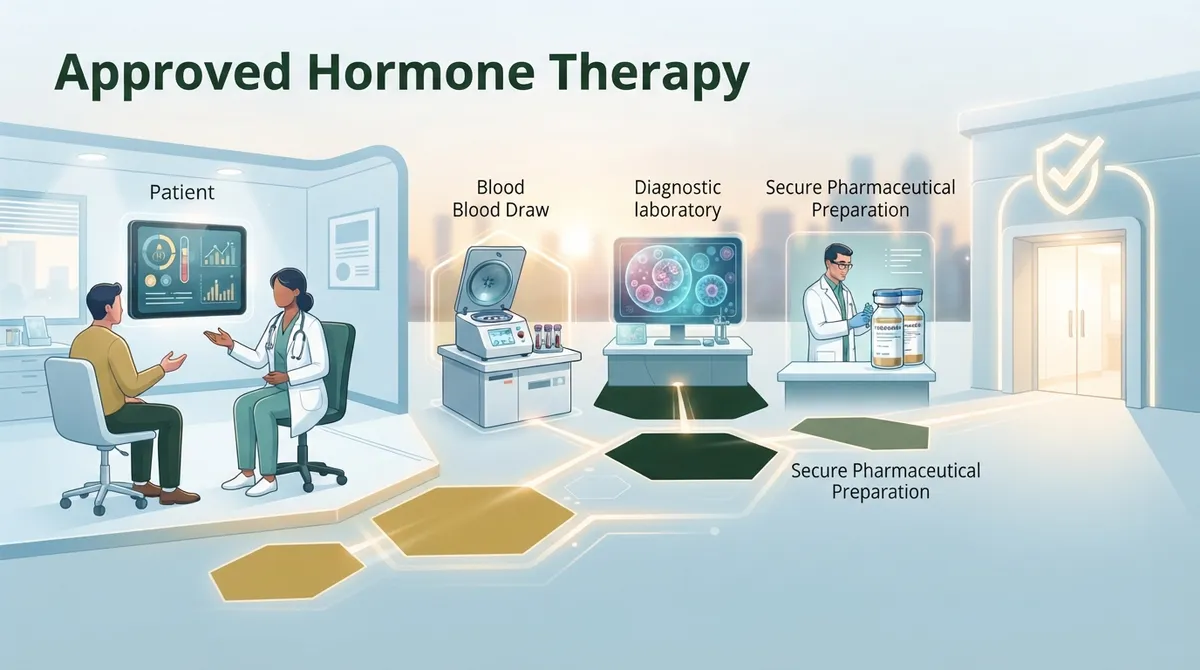
Path One: FDA-Approved, Diagnosis-Led Hormone Treatment
This path starts with a question: what is actually going on in your body? Treatment follows a confirmed diagnosis and uses approved medicines when they fit.
A classic example is growth hormone (GH) treatment. It is recommended for people with confirmed growth hormone deficiency and no contraindications. It is not meant as a general anti-aging or performance booster.
How Diagnosis Works
The Endocrine Society recommends GH stimulation testing when adult deficiency is suspected. A single GH blood measurement is not helpful for diagnosis, because GH is released in pulses throughout the day. The full guidance is available in the National Library of Medicine research library and related Endocrine Society resources.
Once deficiency is confirmed, dosing is individualized. The Endocrine Society guideline suggests starting adults younger than 60 at 0.2 to 0.4 mg per day, and those older than 60 at 0.1 to 0.2 mg per day. Doses are then adjusted, with IGF-1 kept below the upper limit of normal.
Strengths of This Path
- Clear diagnosis before treatment begins
- Products reviewed by the FDA for a defined use
- Established dosing and monitoring standards
- Well-understood risks and contraindications
Limits of This Path
Approved treatment only helps if you have the matching condition. If your labs look normal and you simply want more energy or better recovery, approved GH replacement is usually not the right tool. That gap is exactly why many people look toward wellness peptides.
Path Two: Compounded Wellness Peptide Plans
Wellness peptide plans often use compounded medications. These are prepared by a pharmacy for an individual patient. Compounded drugs are not FDA-approved, and the FDA does not review them for safety, effectiveness, or quality before they are marketed.
That does not make compounding automatically bad. Compounding has a legitimate place in medicine within legal limits. But it is not a substitute for an approved medicine when an approved option is appropriate.
What About Growth Hormone Secretagogues?
Products such as growth hormone secretagogues are often described as ways to “boost your own GH.” It is tempting to treat them as equal to approved GH replacement. They are not equivalent. Evidence, dosing, and long-term safety data are limited or uncertain for many of them, and broad claims about hormone optimization are not established.
If you want to dig into specific products, our guides on ipamorelin benefits, dosing, and safety and how GHRP peptides work go deeper.
Peptide-Specific Safety Concerns
The FDA has pointed out risks that are unique to peptides. These include immune reactions linked to the peptide itself, clumped particles called aggregates, impurities, or the formulation. For injectables, sterility, purity, potency, stability, and proper handling are all important.
An FDA presentation from 2024 on compounded peptide immunogenicity noted that injected routes, including subcutaneous, intravenous, and intramuscular, carry a higher immune-reaction risk than oral or transrectal routes. Reactions can range from mild to life-threatening anaphylaxis. The same materials noted that in ipamorelin-treated subjects, rates of low potassium (hypokalemia) and high blood sugar (hyperglycemia) were higher, and the agency said available data were not enough to rule out concerns similar to those seen with approved growth hormone products.
None of this means you can never use a peptide. It means you should go in informed, with a licensed provider watching your results.
Side-by-Side Comparison
Here is a quick look at how the two paths stack up.
| Factor | Approved, Diagnosis-Led Treatment | Compounded Wellness Peptides |
|---|---|---|
| Starting point | Confirmed diagnosis | Symptoms, labs, and goals |
| FDA review | Yes, for a specific product and use | No premarket FDA review of compounded products |
| Strength of evidence | Established for the approved use | Often limited or uncertain |
| Dosing guidance | Published, guideline-based | Varies by provider |
| Best suited for | People with a confirmed condition | People exploring wellness goals with informed consent |
| Key risk | Side effects of the medicine | Quality, purity, and immune reaction concerns plus limited data |
Neither path is a villain. The right fit depends on your diagnosis, your goals, and how comfortable you are with uncertainty. For a deeper dive on this exact question, see FDA-approved vs. compounded peptides.
Can Peptide Therapy Really Raise Growth Hormone or Testosterone?
This is one of the most common questions we hear. The honest answer has layers.
Approved GH replacement raises GH exposure in people who are truly deficient. Testosterone replacement is a separate, well-known treatment for confirmed low testosterone. Wellness peptides are different. Some are marketed to nudge your body’s own hormone signals, but proof of meaningful, lasting benefits for general “optimization” is not established.
If testosterone is your main concern, it helps to understand the difference between replacement and peptides. Our comparison of TRT vs. peptides for men and testosterone vs. peptides for women can help you sort it out.
A Smart Step-by-Step Way to Evaluate Any Plan
Whether you are exploring approved treatment or wellness peptides, this simple process keeps you safe and informed.
- Start with your story. Write down your symptoms, when they began, and what makes them better or worse.
- Get a thorough medical review. Share your history, medications, and family health details.
- Run appropriate labs. Blood work gives you a baseline. Our guide on blood work analysis before peptides explains what to expect.
- Name the diagnosis and the goal. Ask your provider what exactly is being treated and how success will be measured.
- Review options and risks. Ask about approved alternatives, contraindications, and side effects.
- Plan the follow-up. Schedule repeat testing and check-ins so any problem is caught early.
Choosing a Qualified Provider
The person guiding your care matters as much as the product. Here is what to look for.
| Green Flag | Red Flag |
|---|---|
| Licensed provider in your state | No clear credentials or license information |
| Asks for labs and history first | Sells a fixed “stack” to everyone |
| Explains uncertainty openly | Promises guaranteed anti-aging results |
| Plans ongoing monitoring | No follow-up after you receive product |
| Transparent about compounding and sourcing | Vague about where products come from |
You can learn more about vetting care in how to get prescription peptides safely and is peptide therapy safe.
How Allura Longevity Approaches Personalized Care
At Allura Longevity, the approach is built around your individual numbers and goals rather than a one-size-fits-all bundle. Care is delivered through telehealth by licensed providers, led by Ashley, a board-certified Family Nurse Practitioner. It starts with a $50 virtual consultation, followed by blood work through LabCorp. From there, you receive a customized six-month plan shipped to your door, with ongoing monitoring and adjustments along the way.
Services focus on energy, sleep, mental clarity, immune support, skin rejuvenation, muscle recovery, metabolism, and sexual wellness. Allura also supports weight loss with GLP-1 medications, injury recovery with BPC-157, and testosterone replacement. Whether you are exploring peptides for women or peptides for men, the plan is designed around what your labs and goals actually show. Telehealth is available nationwide, and Allura is licensed in Florida, Georgia, Texas, Connecticut, Indiana, Maryland, New York, and California.
For busy professionals especially, home delivery and virtual visits remove the hassle. If you want to understand the format first, read local clinic vs. telehealth.
Which Path Fits You?
Here is a simple way to think about it.
- Choose approved, diagnosis-led treatment if testing points to a confirmed hormone deficiency or condition that has an approved medicine.
- Consider a wellness peptide plan if your labs are not clearly abnormal but you want to explore goals like recovery, sleep, or skin, and you accept that evidence may be limited.
- Combine thoughtfully when a provider identifies a diagnosis and supports it with lifestyle, nutrition, and carefully chosen options.
Remember that lifestyle basics still do heavy lifting. Sleep, strength training, protein, and stress care shape your hormones more than any vial. Peptides, when used, work best as one part of a bigger plan. If you are curious how timing works, see how long peptide therapy results take.
Final Thoughts and Your Next Step
Comprehensive hormone peptide therapy is not one treatment. It is a conversation that should lead to a specific diagnosis, a clear goal, and a product whose evidence and risks you understand. Approved therapy shines when a condition is confirmed. Wellness peptides can be explored with care, honest expectations, and close monitoring.
If you are ready to talk through your own labs and goals with a licensed provider, request a consultation with Allura Longevity or call (813) 510-6277. New client spots are limited each month, so reach out while openings are available. Your health story deserves a plan built just for you.
FAQs
Q: What does comprehensive hormone peptide therapy mean?
A: It is a broad marketing phrase, not a standardized treatment. In practice it usually means a provider reviews your symptoms and labs, then considers peptide medicines or other hormone treatments. The specific therapy should always be defined by your diagnosis, the evidence, and the exact product used.
Q: Are compounded peptide injections FDA-approved or safe?
A: Compounded drugs are not FDA-approved, and the FDA does not review them for safety, effectiveness, or quality before marketing. Injectables carry added concerns like sterility, purity, and immune reactions. Working with a licensed provider who monitors you closely helps lower the risks.
Q: How is growth hormone deficiency diagnosed?
A: The Endocrine Society recommends growth hormone stimulation testing when adult deficiency is suspected. A single GH blood measurement is not helpful, since GH is released in pulses. Your provider will combine testing with your symptoms and medical history.
Q: Is peptide therapy effective for anti-aging or hormone optimization?
A: Approved growth hormone is for confirmed deficiency, not general anti-aging. For many wellness peptides, evidence for broad hormone optimization is limited or not established. It is best to set realistic expectations and track your progress with labs.
Q: How should I choose a qualified clinician for peptide therapy?
A: Look for a licensed provider who starts with your history and labs, explains risks and alternatives openly, and plans regular follow-up. Be cautious of anyone who sells the same stack to everyone or promises guaranteed results.





