

Key Takeaways
-
FDA-approved peptide medicines like semaglutide have strong clinical trial evidence, while popular wellness peptides like BPC-157 and ipamorelin rely heavily on animal studies and anecdotal reports with limited human data.
-
The FDA found insufficient evidence for ipamorelin's effectiveness for growth hormone deficiency and primary ovarian insufficiency, demonstrating that popular peptides often lack rigorous human trials despite online hype.
-
Peptide therapy effectiveness cannot be judged by the word 'peptide' alone—you must evaluate the specific molecule, dose, delivery method, and exact condition being treated, as a peptide effective for one use may have zero evidence for another.
-
Compounded peptides are not automatically FDA-approved even when prescribed by licensed providers; product quality, purity, and source matter significantly for safety and actual effectiveness.
-
Personalized peptide treatment with ongoing blood work monitoring and provider adjustments produces better real-world results than one-size-fits-all protocols, requiring regular check-ins rather than one-time dosing.
-
Ask critical questions before starting any peptide: Is it FDA-approved? What human clinical evidence exists for your specific goal? Who is prescribing it? Where is it sourced? What are known risks?
If you’ve spent any time researching peptide therapy effectiveness, you’ve probably noticed something confusing. Some peptides have decades of research behind them, while others rely mostly on buzz and Instagram testimonials. So which is which? And how do you know if the peptide you’re considering will actually work for you?
Here’s the good news: you don’t need a medical degree to understand this. You just need the right framework. In this article, we’ll break down the real difference between FDA-approved peptide medicines and popular wellness peptides. We’ll look at what the science actually says, what questions to ask, and how to make smart, informed choices for your health. Whether you’re a busy professional squeezing in research between meetings or a dedicated biohacker who reads clinical trial abstracts for fun, this guide is for you.

Why “Peptide Therapy” Isn’t One Single Thing
Here’s the first thing to understand: “peptide therapy” is not one treatment. It’s a huge category that includes many different molecules used for many different reasons. Some peptides are FDA-approved medicines with strong clinical trial data. Others are compounds used in wellness settings with much less human research behind them.
This matters because effectiveness cannot be judged by the word “peptide” alone. You have to look at the specific molecule, the exact dose, how it’s given, and what condition it’s treating. A peptide that works well for one purpose might have zero evidence for another use entirely.
According to what are peptides, these are short chains of amino acids that act as messengers in the body. Stanford Medicine reported in 2026 that roughly 100 peptide therapeutics have received FDA approval across a wide range of conditions. That’s a meaningful number, but it refers to approved medicines broadly, not to every peptide sold for wellness or anti-aging purposes.
FDA-Approved Peptide Medicines: The Gold Standard
FDA-approved peptides have gone through rigorous, indication-specific review. This means regulators looked closely at quality, safety, and how well the peptide worked for one particular condition. A few well-known examples include:
- Insulin, used for managing diabetes
- Semaglutide, approved for specific metabolic and weight-related conditions
- Tesamorelin, approved for HIV-associated lipodystrophy
These medicines have solid human trial data. For example, the STEP 1 trial published in the New England Journal of Medicine in 2021 found that semaglutide at 2.4 mg weekly produced an average weight loss of about 15% after 68 weeks in adults with overweight or obesity. That’s strong, specific evidence. But it applies to that medicine, at that dose, for that population. It doesn’t automatically mean every peptide marketed for weight loss works the same way. If you want to dig deeper into this specific medicine, check out How to Understand GLP-1 Peptide Therapy in 2026.
Wellness Peptides: Promising but Less Proven
Then there’s the other category: peptides like BPC-157, CJC-1295, and ipamorelin. These are popular in wellness and recovery circles. People swear by them for healing, muscle growth, and anti-aging benefits.
But here’s the honest truth. Much of the excitement around these peptides comes from lab studies, animal research, or small early-stage human trials. Some of it is just anecdotal reports shared online. Robust, repeated human trials that prove clear benefits are often missing.
That doesn’t mean these peptides are useless. It means the evidence is still developing, and claims should be treated with healthy skepticism. If you’re curious about one of the most talked-about wellness peptides, our article on 9 BPC-157 Peptide Facts to Know Before You Start breaks down what’s known and what isn’t.
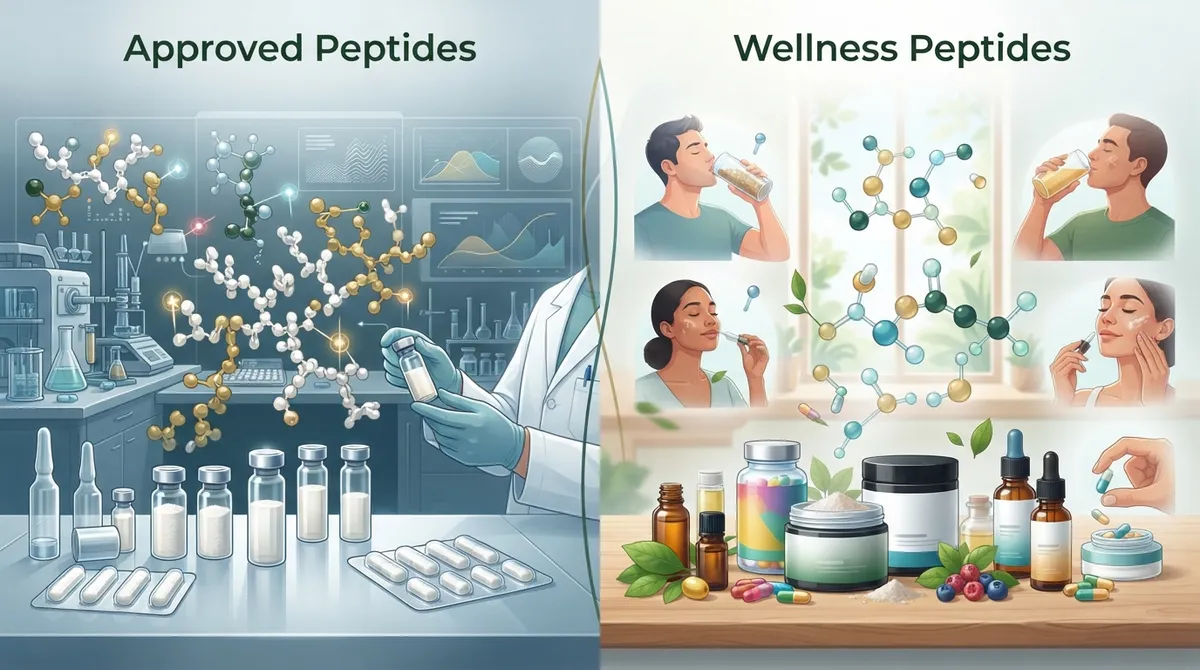
Comparing the Evidence: Approved vs. Wellness Peptides
Let’s put this side by side so you can see the differences clearly.
| Factor | FDA-Approved Peptide Medicines | Wellness Peptides (e.g., BPC-157, Ipamorelin) |
|---|---|---|
| Human Clinical Trials | Large, controlled trials required for approval | Often small, preliminary, or lacking altogether |
| FDA Review | Reviewed for safety and efficacy for a specific use | Not FDA-approved for most marketed uses |
| Dosing Standards | Established and studied dosing protocols | Dosing often based on limited data or tradition |
| Long-Term Safety Data | Monitored post-approval | Frequently unknown or limited |
| Regulatory Status | Approved medicine | May be compounded or unapproved product |
This table isn’t meant to scare you away from wellness peptides. It’s meant to help you ask better questions and set realistic expectations. Peptide therapy effectiveness always depends on matching the right molecule to the right goal, with the right medical guidance.
What the FDA Has Actually Said About Popular Peptides
This part matters a lot, especially if you’ve seen big claims about certain peptides online. On October 29, 2024, the FDA’s Pharmacy Compounding Advisory Committee reviewed evidence on ipamorelin. Their conclusion? They had not identified data supporting its effectiveness for growth hormone deficiency, in children or adults, or for primary ovarian insufficiency. The materials also noted a lack of clinical safety data for the subcutaneous route.
This is a great example of why you should always ask: is this claim tied to real evidence for this specific use? A peptide that sounds promising in theory still needs solid human trials before we can call it proven. A 2025 review of commonly marketed peptide therapies echoed this, concluding that clinical efficacy and safety remain underreported for many non-approved peptides. The review called for more rigorous randomized controlled trials and long-term human studies.
Why Animal Studies Don’t Always Translate to Humans
It’s easy to get excited when you read that a peptide worked wonders in a lab study or on animal subjects. But biology is complicated. What happens in a petri dish or a mouse doesn’t always play out the same way in a human body.
Human trials need to prove several things before a treatment can be called effective:
- The peptide creates a clinically meaningful benefit, not just a small lab measurement change
- The correct dose and delivery method are established for humans
- Results last over time, not just for a few days or weeks
- Risks and side effects are understood and manageable
Without this kind of research, a promising mechanism is just that: promising. It’s not proof. This is one reason working with a knowledgeable provider matters so much when exploring peptide therapy effectiveness for your specific goals.
Why Product Quality Is Part of Effectiveness
Here’s something people often overlook. Even if a peptide has some supporting evidence, the product itself needs to be trustworthy. Unapproved or poorly regulated products can have issues with purity, concentration, sterility, or storage. Injection also carries its own risks, including infection or dosing errors, if not done properly.
Compounded peptides are not automatically FDA-approved, even if a licensed provider prescribes them. FDA compounding rules can change, and the status of specific ingredients can shift too. That’s why it’s smart to work with a provider who stays current on regulations and only sources from reputable pharmacies. If you want a deeper look at how compounding works, this piece on FDA-Approved vs. Compounded Peptides: What Wins? is a helpful read.
Questions to Ask Before Starting Any Peptide
Before jumping into a new peptide protocol, it helps to slow down and ask a few smart questions:
- Is this peptide FDA-approved, or is it compounded and unapproved?
- What does the human clinical evidence actually show for my specific goal?
- Who is prescribing and monitoring this treatment?
- Where is the product sourced, and how is quality verified?
- What are the known risks and side effects?
Asking these questions isn’t about being difficult. It’s about being an informed, empowered patient. That’s exactly the mindset we encourage at Allura Longevity, where treatment plans are built around your actual blood work and health goals, not guesswork.
How Personalized Care Improves Real-World Results
One of the biggest factors in peptide therapy effectiveness isn’t just the peptide itself. It’s how the treatment is managed. A cookie-cutter plan rarely works as well as one built around your unique biology.
That’s why a thoughtful process matters so much. Here’s what a responsible approach typically looks like:
- Start with a consultation to review your health history and goals
- Complete comprehensive blood work through a trusted lab
- Receive a customized treatment plan based on your actual results
- Begin treatment with clear guidance on dosing and administration
- Have ongoing check-ins so your provider can adjust the plan as needed
This is the exact model Allura Longevity uses. Clients start with an affordable virtual consultation, complete blood work through LabCorp, and receive a personalized six-month plan. Licensed providers, led by a board-certified Family Nurse Practitioner, monitor progress and make adjustments along the way. Peptides are shipped directly to your home, which makes it realistic for busy schedules. If you’re wondering how this process works from start to finish, take a look at How to Start Peptide Therapy Safely and See Real Results.
Comparing Common Goals and Supporting Peptide Categories
To help you see how this plays out across different health goals, here’s a simple breakdown.
| Health Goal | Peptide Category Often Used | Evidence Strength |
|---|---|---|
| Weight loss / metabolic health | GLP-1 medications (approved) | Strong clinical trial data |
| Injury recovery / tissue repair | BPC-157 (wellness/compounded) | Early-stage, limited human data |
| Growth hormone support | CJC-1295, Ipamorelin (wellness/compounded) | Weak to insufficient for many claimed uses |
| Testosterone optimization | Testosterone replacement therapy (approved) | Well-established clinical evidence |
Notice the pattern here: strength of evidence varies a lot by category. This is exactly why generalized claims about “peptide therapy” don’t tell the full story. If you’re exploring fat loss options specifically, our guide on 13 Peptides for Fat Loss That Really Work in 2026 breaks down which options have real backing.
Setting Realistic Expectations for Your Journey
We get it. When you’re investing time and money into your health, you want results. And you deserve honest information, not hype. The most successful peptide therapy experiences come from realistic expectations paired with expert guidance.
This means understanding that some peptides, like approved GLP-1 medications, come with strong clinical backing. Others, like many wellness peptides, may offer benefits worth exploring but with less certainty. A good provider will be transparent about which category your treatment falls into and why.
For a deeper understanding of foundational peptide science, this resource from the National Library of Medicine offers useful background on how peptides function in the body. Pairing solid science with a personalized plan is really the winning formula here, not one or the other alone.
The Role of Ongoing Monitoring
Effectiveness isn’t a one-time checkbox. It’s something that should be tracked over the entire course of your treatment. Regular blood work and check-ins help your provider see what’s actually happening in your body, not just what you hope is happening.
This ongoing process allows for adjustments. Maybe your dose needs tweaking. Maybe a different peptide combination would serve you better. Without monitoring, you’re essentially guessing. With it, you’re making informed decisions backed by real data.
If you’re curious about how peptide combinations can work together for better results, check out Why Do Peptide Combinations Work Better Together? for more insight.
Making a Confident, Informed Choice
At the end of the day, understanding peptide therapy effectiveness comes down to a few core habits. Look for evidence specific to your goal. Ask about the regulatory status of any peptide you’re considering. Choose a provider who values transparency over hype. And commit to ongoing monitoring so your plan can evolve with you.
Whether you’re focused on energy, recovery, metabolism, or healthy aging, the right approach starts with good information and a provider who genuinely has your back. That’s the entire philosophy behind Allura Longevity’s telehealth model: personalized plans, licensed medical oversight, and honest conversations about what the science really supports.
Ready to get real answers about what could work for your body and your goals? Request a consultation today and take the next confident step toward feeling your best. Spots for new clients are limited each month, so don’t wait too long to get started.
FAQs
Q: Does peptide therapy actually work?
A: It depends entirely on the specific peptide and what you’re using it for. FDA-approved peptide medicines, like certain GLP-1 medications, have strong clinical trial evidence. Wellness peptides often have less proof, so it’s important to talk with a knowledgeable provider about what’s realistic for your goals.
Q: Which peptide therapies are FDA-approved, and for what conditions?
A: Great examples include insulin for diabetes, semaglutide for specific metabolic conditions, and tesamorelin for HIV-associated lipodystrophy. Around 100 peptide medicines have received FDA approval across various conditions, but each one is approved for its own specific use, not peptides in general.
Q: Is BPC-157 effective in humans for injury recovery or pain?
A: Right now, most of the exciting research on BPC-157 comes from animal and lab studies rather than large human trials. That doesn’t mean it’s ineffective, but it does mean we should treat the claims with some healthy caution until more human research comes in.
Q: Do CJC-1295 or ipamorelin improve growth hormone levels, muscle, or recovery?
A: The FDA reviewed ipamorelin in 2024 and said they hadn’t found data supporting its effectiveness for growth hormone deficiency or primary ovarian insufficiency. This is a good reminder that popular doesn’t always mean proven, so it’s worth discussing evidence with your provider before starting.
Q: Are compounded peptides FDA-approved or proven effective?
A: No, compounded peptides are not the same as FDA-approved medicines, even when a licensed provider prescribes them. Rules around compounding can change, so it’s smart to work with a clinic that stays current on regulations and sources products carefully.





