

Key Takeaways
-
A legitimate telehealth peptide prescription requires a live evaluation by a licensed clinician, review of your health history, often lab work, and a personalized prescription—not just an online form or "add to cart" purchase.
-
FDA-approved peptides like semaglutide have undergone official review, while compounded peptides are custom-made by licensed pharmacies for individual patients; both can be legal but require different regulatory oversight and informed provider knowledge.
-
Before starting any telehealth peptide program, verify the clinician's active state license, confirm the pharmacy is licensed, understand if the peptide is FDA-approved or compounded, and ensure there's a documented monitoring plan with scheduled follow-ups.
-
Most peptides are not controlled substances, so the strict in-person visit requirements typically don't apply federally; however, state telemedicine rules vary and may require real-time video visits, identity verification, and specific lab testing intervals.
-
Ongoing monitoring with periodic lab reviews and dosage adjustments based on your body's response is essential for effective peptide therapy and separates real medical programs from one-time transactions.
-
Telehealth peptide therapy supports diverse goals including weight loss, muscle recovery, hormone support, and anti-aging, but personalization depends entirely on individual bloodwork results and medical evaluation before any prescription is issued.
Curious about starting peptide therapy but not sure how the online process actually works? You’re not alone. More people are turning to telehealth for personalized care, from energy support to weight loss to muscle recovery. But before you sign up for any program, it helps to know exactly what happens behind the scenes.
This guide walks you through how telehealth prescriptions work for peptide therapy, step by step. We’ll cover what a real medical evaluation looks like, why some peptides are FDA-approved while others are compounded, and what makes a telehealth provider legitimate versus risky. Whether you’re a busy professional squeezing in a lunchtime consultation or a biohacker who wants to understand every detail of your protocol, this article gives you the facts you need to make a confident, informed choice.
What Is a Telehealth Prescription, Exactly?
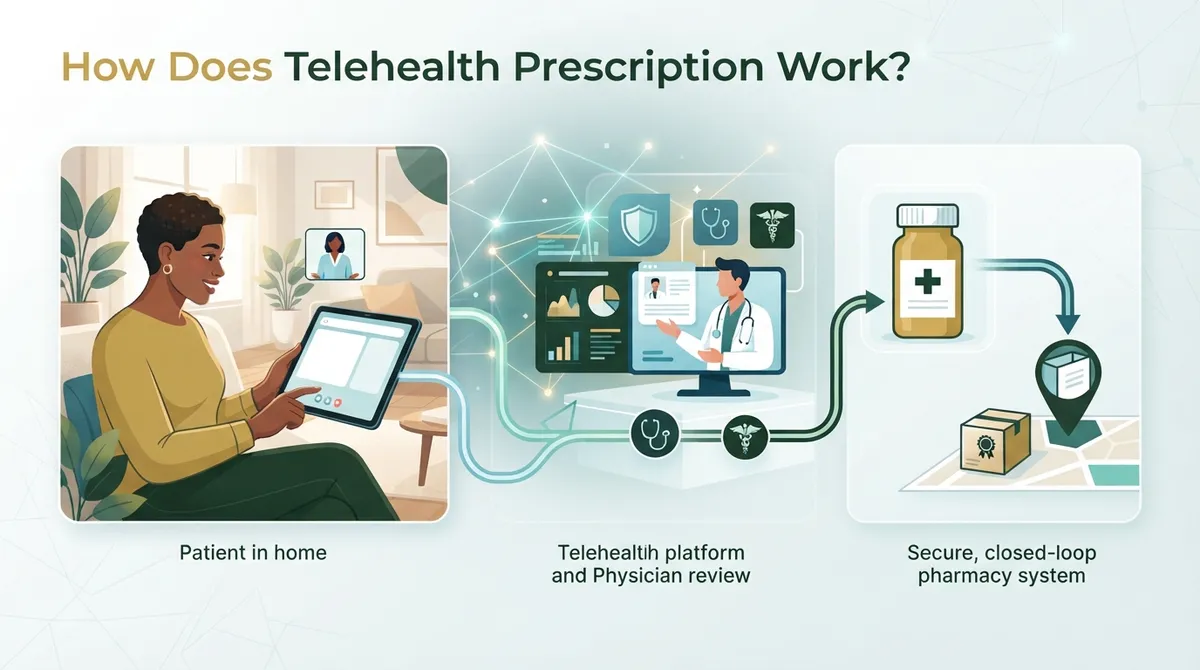
A telehealth prescription is a medication order written by a licensed medical provider after a virtual visit, instead of an in-person office appointment. For peptide therapy, this usually means a video or phone consultation, a review of your health history, and sometimes lab work, before any prescription gets written.
The key word here is “prescription.” A real one comes from a licensed clinician who reviews your specific health situation. It is not the same as clicking “add to cart” on a website that ships peptides without any medical review. If you want to understand more about what peptides actually are and how they work in the body, this guide on what peptides are is a helpful starting point.

The Step-by-Step Telehealth Prescription Process
While every clinic runs things a little differently, most legitimate telehealth peptide programs follow a similar path. Here’s what you can generally expect:
- Intake and medical history: You’ll fill out a detailed questionnaire covering your symptoms, current medications, allergies, and health goals.
- Live evaluation with a licensed provider: A nurse practitioner or physician reviews your intake and talks with you directly, often through video call, to ask follow-up questions.
- Lab work when needed: Many peptide protocols require bloodwork to check hormone levels, metabolic markers, or other health indicators before a safe plan can be created.
- Prescription decision: If treatment is appropriate, the provider writes a patient-specific prescription. If it’s not a good fit, they should tell you honestly, not push a sale.
- Pharmacy dispensing: The prescription goes to a licensed pharmacy. This might be a standard retail pharmacy for an FDA-approved medicine, or a licensed compounding pharmacy for certain custom formulations.
- Home delivery: Your medication ships directly to your door, often with instructions for storage and administration.
- Ongoing monitoring: A responsible provider schedules follow-ups to track your progress and adjust your plan as needed.
This is exactly the model Allura Longevity follows. Clients start with an affordable virtual consultation, complete labs through LabCorp, and receive a personalized six-month treatment plan shipped straight to their home, with ongoing check-ins from licensed providers along the way.
FDA-Approved Peptides vs. Compounded Peptides
This is one of the most important distinctions to understand before starting any peptide program. Not all peptides are treated the same way under the law, and telehealth access does not automatically make a product approved or safe.
| Category | What It Means | Examples |
|---|---|---|
| FDA-Approved Peptide Medicines | Approved for a specific formulation, dose, and indication after FDA review | Semaglutide, tirzepatide, tesamorelin, bremelanotide products |
| Compounded Peptides (503A) | Prepared for an individual patient by a licensed pharmacy based on a valid prescription | Custom formulations not commercially available |
| 503B Outsourcing Facilities | Compound certain products under separate federal oversight rules | Larger-batch compounded products |
According to the National Library of Medicine, peptide compounding eligibility depends on current FDA policy, drug shortage lists, and state pharmacy rules, all of which can change. This is why a trustworthy provider always checks current regulations rather than relying on outdated marketing claims. If you want a deeper look at this topic, this comparison of FDA-approved versus compounded peptides breaks it down clearly.
Are Peptides Controlled Substances?
Good news here: most peptides are not classified as controlled substances under federal law. This means the strict Ryan Haight Act rules, which normally require an in-person visit before prescribing controlled substances online, usually don’t apply to peptide therapy.
That said, DEA and HHS have extended certain temporary telemedicine flexibilities for controlled substances through December 31, 2026. Even though most peptides fall outside this category, providers must still confirm a medication’s legal classification and follow all applicable state and federal rules. This is one more reason working with a licensed, experienced provider matters so much.
What Makes a Telehealth Peptide Program Legitimate
Not every online peptide seller is created equal. Some skip the medical review entirely, which is a major red flag. Here’s what a legitimate program should always include:
- A real evaluation by a licensed clinician, not just an automated quiz
- A documented clinical reason for treatment, based on your health history and goals
- Discussion of risks, benefits, and alternatives before you start
- Informed consent that you actually understand and agree to
- A clear monitoring plan with scheduled follow-ups
- Instructions on dosing, administration, and what to do if side effects occur
- Verification that the pharmacy filling your prescription is properly licensed
If a website promises guaranteed peptides with no medical review, that’s not real healthcare. That’s a shortcut, and it could put your health at risk. The FDA has issued warnings about unapproved products with dosing errors, contamination, and misleading claims, so it pays to be selective.
State Licensing and Telehealth Rules
Telehealth providers must be licensed in the state where you’re physically located when you have your visit, not just where the clinic is based. States also have their own telemedicine rules, which may require:
- Real-time audio-video visits instead of just a written questionnaire
- Identity and location verification
- Specific follow-up intervals
- Additional lab testing before or during treatment
Allura Longevity is currently licensed in Florida, Georgia, Texas, Connecticut, Indiana, Maryland, New York, and California, with care led by Ashley, a board-certified Family Nurse Practitioner. This means clients in those states can access personalized, medically supervised peptide therapy with confidence that licensing requirements are being met.
Common Peptide Goals Treated Through Telehealth
Telehealth peptide therapy can support a wide range of health goals, always based on your individual labs and evaluation. Some of the most common reasons people start include:
- Weight loss and metabolic support using GLP-1 medications, which you can learn more about in this guide on which weight loss peptides actually work
- Muscle recovery and fat loss through targeted peptide protocols, covered in this article on peptides for fat loss
- Injury recovery using peptides like BPC-157, an option worth understanding through this resource on TB-500 peptide facts
- Hormone support for both men and women, including testosterone-related therapy
- Energy, sleep, and mental clarity improvements for busy professionals and aging adults alike
- Skin rejuvenation and anti-aging support for those focused on long-term vitality
- Confirm the clinician’s license is active in your state
- Ask which pharmacy fills prescriptions, and confirm it’s licensed too
- Find out if the peptide is FDA-approved or compounded, and understand the difference
- Ask about the source and labeling of the product you’ll receive
- Understand the refill process and what happens if you have side effects
- Confirm there’s an actual monitoring plan, not just a one-time sale
- Follow-up labs every few months to track progress
- Dosage adjustments based on results and side effects
- Check-ins about energy, sleep, mood, and physical changes
- Updates to your protocol as your goals evolve
Since these are individualized treatments, the process always starts with understanding your own bloodwork and goals. This step-by-step guide on starting peptide therapy safely is a great next read if you want more detail before booking a consultation.
Telehealth vs. Local Clinic: Which Fits Your Life?
| Factor | Telehealth Peptide Therapy | Local In-Person Clinic |
|---|---|---|
| Convenience | Consultations from home, medication shipped to your door | Requires travel and in-office visits |
| Time Commitment | Fits busy schedules with virtual check-ins | Often requires time off work for appointments |
| Personalization | Based on labs, history, and goals reviewed remotely | Based on in-person exam plus labs |
| Availability | Nationwide, within licensed states | Limited to local providers |
Both models can offer quality care when done properly. If you’re weighing your options, this comparison of local clinic versus telehealth peptide therapy can help you decide what fits your lifestyle best.
How to Verify a Telehealth Peptide Provider
Before you commit to any program, take a few minutes to check these details. It’s a small step that protects your health and your wallet.
According to what are peptides, these small protein-based molecules can have powerful effects on the body, which is exactly why proper medical oversight matters so much. A good provider treats peptide therapy as real medicine, not a trend to sell quickly.
Why Ongoing Monitoring Matters
Your first prescription is just the beginning. Peptide therapy works best when your provider checks in regularly, reviews new labs, and adjusts your plan based on how your body responds. This might include:
This kind of ongoing care is what separates a real medical program from a one-time purchase. It’s also why Allura Longevity builds every plan around a full six-month arc of support, not a single transaction.
Ready to Start Your Own Telehealth Peptide Journey?
Understanding how telehealth prescriptions work takes some of the mystery out of the process, and hopefully some of the worry too. When you choose a provider that takes medical evaluation seriously, uses proper labs, and offers real follow-up care, you’re setting yourself up for a much safer and more effective experience.
Allura Longevity offers exactly this kind of care, with licensed providers, personalized treatment plans, and nationwide telehealth access in Florida, Georgia, Texas, Connecticut, Indiana, Maryland, New York, and California. Spots for new clients are limited each month, so if you’re ready to explore what personalized peptide therapy could do for your energy, recovery, or long-term vitality, now’s a great time to request a consultation and take the first step toward a plan built just for you.
FAQs
Q: How does a telehealth consultation for peptide therapy work?
A: You’ll start by filling out a health questionnaire, then meet with a licensed provider through video or phone. They’ll review your history, discuss your goals, and often order labs before deciding if a peptide protocol is right for you. It’s a real medical process, not just a quick form to fill out!
Q: Do I need blood tests before receiving a peptide prescription through telehealth?
A: In most cases, yes. Bloodwork helps your provider understand your hormone levels and overall health, so your treatment plan can be truly personalized. At Allura Longevity, for example, labs are done through LabCorp before your custom plan is created.
Q: What is the difference between an FDA-approved peptide and a compounded peptide?
A: FDA-approved peptides, like certain semaglutide or tirzepatide products, have gone through official review for a specific dose and use. Compounded peptides are custom-made by a licensed pharmacy for an individual patient and are not FDA-approved in that exact formulation, though they can still be legally prescribed under the right conditions.
Q: How do I verify that an online peptide provider and pharmacy are legitimate?
A: Check that your provider is licensed in your state and that the pharmacy filling your prescription holds a valid license too. A trustworthy program will happily answer these questions, since transparency is part of good care.
Q: Are peptides controlled substances under federal law?
A: Most peptides are not controlled substances, so the strict in-person visit rules for controlled substances usually don’t apply. Still, every medication’s legal status should be confirmed individually, since rules can vary and change over time.





