

Key Takeaways
-
"Lab-guided sexual wellness peptides" is a marketing phrase, not a medical diagnosis or standard treatment protocol, and no lab test can predict whether a peptide will work for you.
-
Labs can flag contributors to low desire such as hormone shifts, thyroid changes, blood sugar, or low iron, but they cannot reveal a "peptide deficiency" or guarantee results.
-
The only FDA-approved peptide medicine for this area is bremelanotide (Vyleesi), approved solely for acquired, generalized HSDD in premenopausal women when the low desire causes distress.
-
Vyleesi is not approved for men, postmenopausal women, or performance enhancement, and it should not be used with uncontrolled high blood pressure or known cardiovascular disease.
-
Approval of Vyleesi does not prove that compounded or wellness-marketed peptides sold for libido are safe, effective, or consistently sourced, so ask for evidence and the product source.
-
A responsible provider starts with a conversation about your symptoms, medical history, medications, and stress before choosing labs, and treats peptides as only one option among several.
If you have ever searched for ways to bring back your spark, you have probably run into a flood of bold promises. Peptides for desire. Peptides for performance. Peptides for everything. It can feel like a lot, and honestly, a little confusing. You deserve clear answers, not hype.
Here is the friendly truth. Lab-guided sexual wellness peptides is a marketing phrase, not a medical diagnosis or a standard treatment protocol. In plain terms, it usually means using blood work and a licensed clinician’s oversight when you and your provider are talking about peptide medicines for sexual health concerns.
That is a smart idea, as long as it is done honestly. Labs can help look for some contributors to low desire or other concerns. They cannot guarantee a peptide will work. In this guide, we will walk through what the phrase really means, what is actually FDA-approved, what labs can and cannot tell you, and the safest way to move forward. Think of it as a chat with a well-informed friend who wants you to feel confident and safe.

What Does Lab-Guided Sexual Wellness Peptides Actually Mean?
The phrase has three parts, so let’s break it down.
- Lab-guided: Blood work and other tests help a clinician understand your overall health picture.
- Sexual wellness: A broad term covering desire, arousal, comfort, and satisfaction.
- Peptides: Short chains of amino acids that act as signaling molecules in the body. If you are brand new to the topic, our guide on what peptides are in 2026 is a great starting point, and this overview of what are peptides covers the basics too.
Put together, the phrase simply describes a careful, personalized approach. It does not describe a special category of medicine. No single lab panel can diagnose every cause of low desire or erectile difficulty. And no lab test can reveal a “peptide deficiency” that a peptide will fix.
That honesty matters. Anyone who tells you a blood test will predict your peptide results is overselling. A good provider will tell you what testing can and cannot do.
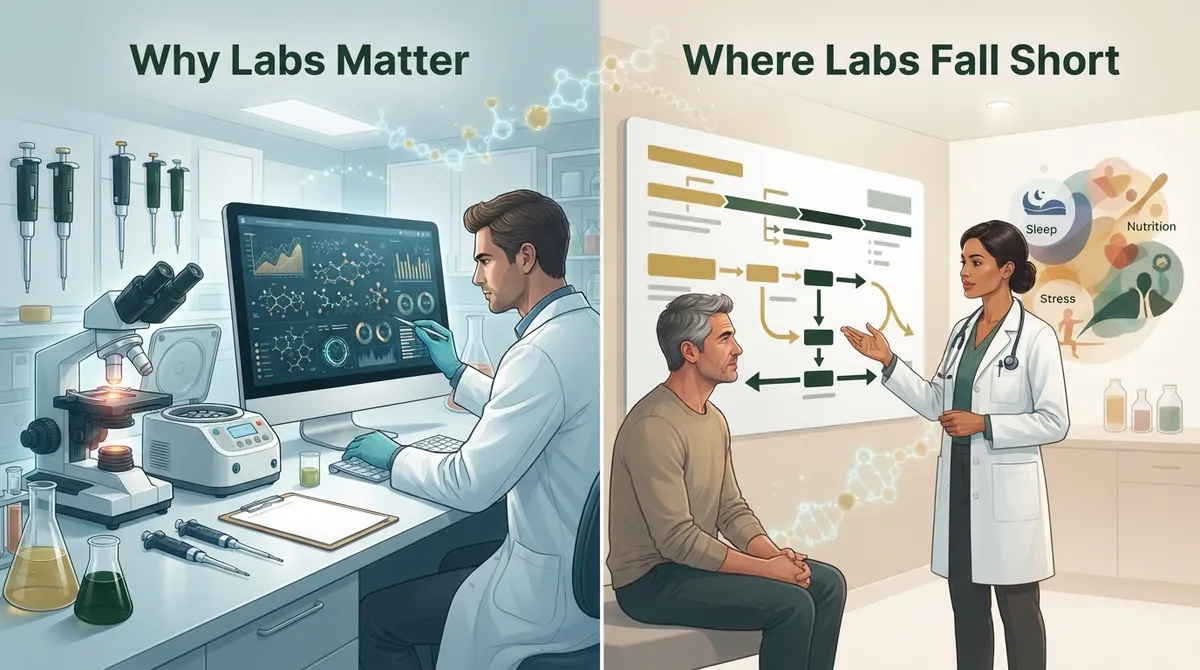
Why Labs Matter (And Where They Fall Short)
Sexual health is connected to the rest of your body. Energy, stress, sleep, hormones, blood sugar, heart health, and medications can all play a part. Labs help your clinician spot some of those pieces.
Think of labs like a map with a few landmarks marked. They are helpful, but they do not show the whole journey. Your story, symptoms, and daily life fill in the rest. For a deeper look at this idea, see why hormone level testing matters for peptides.
Tests a Clinician Might Consider
Testing should be chosen for you, not handed out as a one-size-fits-all package. Depending on your symptoms and history, a clinician may consider items like these:
| Area Checked | Why It Might Matter | Important Limit |
|---|---|---|
| Sex hormones (such as testosterone or estradiol) | Hormone shifts can affect desire, energy, and comfort | Normal results do not rule out a concern |
| Thyroid markers | Thyroid changes can affect mood, energy, and libido | Not a direct test of sexual function |
| Blood sugar and A1c | Metabolic health can influence blood flow and energy | Only one piece of a bigger picture |
| Cholesterol and lipids | Heart and vessel health connect to arousal and erectile function | Does not diagnose sexual dysfunction |
| Blood count and iron | Low iron or anemia can cause fatigue and low drive | Fatigue has many other causes |
| Vitamin D and other nutrients | Deficiencies can affect energy and mood | Fixing a number may not fix the symptom |
Notice what is missing from that table. There is no test that says, “You need this peptide.” Labs guide safety and context. They do not guarantee a result.
The First Step: A Real Conversation About Your Symptoms
Before any test or treatment, a thoughtful clinician starts with you. That means talking through:
- Your symptoms: Is it low desire, trouble with arousal, discomfort, or something else? How long has it lasted, and how much does it bother you?
- Your medical history: Heart health, blood pressure, diabetes, and past surgeries all matter.
- Your medications and supplements: Some common medicines can lower desire or affect arousal.
- Your mental health and stress: Anxiety, low mood, and burnout can quietly dim desire.
- Your relationships and life season: Sleep, new babies, caregiving, and busy careers all play a role.
Only after that talk does it make sense to pick labs. This order protects you. It keeps treatment tied to your real needs instead of a trend.
The FDA-Approved Example: Bremelanotide (Vyleesi)
When people ask for the clearest example of a peptide medicine in this area, it is bremelanotide, sold as Vyleesi. It is the best-known FDA-approved option, and its approval is very specific.
Vyleesi is a prescription melanocortin-receptor agonist approved for acquired, generalized hypoactive sexual desire disorder (HSDD) in premenopausal women. The low desire has to cause distress, and it cannot be better explained by another medical or psychiatric condition, relationship problems, or medication or drug use.
That is a narrow lane. Vyleesi is not approved for men, for postmenopausal women, or for boosting sexual performance. And approval of this one medicine does not prove that other peptides sold for libido are safe or effective.
How Vyleesi Is Used, According to the FDA Label
| Label Detail | What It Says |
|---|---|
| Dose | 1.75 mg by subcutaneous injection, as needed |
| Timing | At least 45 minutes before anticipated sexual activity |
| Daily limit | No more than one dose in 24 hours |
| Monthly limit | More than eight doses per month is not recommended |
| Stopping rule | Stop after eight weeks if symptoms have not improved |
Safety Points Worth Knowing
Every medicine has trade-offs, and Vyleesi is no exception. According to the FDA prescribing information:
- Contraindications: It should not be used with uncontrolled high blood pressure or known cardiovascular disease.
- Blood pressure and heart rate: It can temporarily raise blood pressure and lower heart rate. These changes generally resolve within 12 hours.
- Common side effects: Nausea, flushing, injection-site reactions, headache, and vomiting were reported in more than 4% of patients.
- Other cautions: The label also covers pregnancy precautions and possible effects on how oral medicines are absorbed.
This is exactly why medical oversight matters. Your blood pressure and heart health need a real review before a medicine like this is even considered.
Approved Medicines vs. Wellness Marketing
This is where many people get tripped up. Online, you will see peptides promoted for libido, erectile function, and “general sexual wellness.” Many are marketed as compounded or research-style products, and they are not the same as an FDA-approved medicine.
Here is a simple way to compare the two.
| Question | FDA-Approved Peptide Medicine | Wellness-Marketed or Compounded Peptide |
|---|---|---|
| Reviewed for a specific use? | Yes, for a defined condition | Not for sexual wellness claims in general |
| Clear dosing and label? | Yes | Varies by product and provider |
| Safety data published? | Yes, in prescribing information | Often limited or unclear |
| Proven to work for everyone? | No medicine is | Claims often go beyond the evidence |
If you want to explore the difference in more depth, read FDA-approved vs. compounded peptides and approved vs. compounded peptides for sexual wellness. Both break down what each label really means.
The takeaway is simple. Be gently skeptical of any claim that a peptide “reliably” improves sexual function. Ask for the evidence and the source.
What About PT-141 and Related Questions?
Bremelanotide is sometimes discussed under another name, PT-141, especially in conversations about men’s sexual health. It is worth being careful here. The FDA-approved product, Vyleesi, is approved only for premenopausal women with the specific HSDD condition described above. Using the same molecule for other purposes is a different conversation, and one that belongs with a licensed clinician who can explain the risks and the evidence.
If you are curious, these related reads can help you ask better questions: 9 intimate wellness facts about PT-141 and PT-141 vs. Viagra for men’s sexual health. For women’s concerns, 6 real treatments for low libido in women offers a wider look at options.
How a Responsible, Lab-Guided Approach Works
So what does a careful process look like? Here is a friendly step-by-step picture of how a telehealth provider might guide you.
- Share your story. You describe your symptoms, goals, and health history in a virtual visit.
- Review your medications. Your provider checks whether anything you take could be part of the picture.
- Choose labs that fit you. Testing is picked for your situation, not a universal checklist. Many people complete blood work at a local lab and review it from home. This guide to lab work for peptide therapy explains what to expect.
- Discuss all options. That includes lifestyle steps, treating other health issues, hormone care when appropriate, and approved medicines where they fit.
- Decide together. If a treatment makes sense, you review benefits, risks, and a plan to monitor how you feel.
- Follow up. Your plan gets adjusted, paused, or stopped based on how you respond.
Notice that peptides are not step one. They are one possible option among several, and only when they fit your evaluation.
Who Might Benefit From This Kind of Evaluation?
A lab-guided, clinician-led approach can be especially helpful if you relate to any of these:
- Busy professionals who want convenient telehealth care without scheduling headaches.
- Health optimizers and biohackers who like data and want a provider who respects it, while staying honest about its limits.
- Midlife and older adults noticing changes in energy, desire, or comfort and wanting a safe, informed plan.
- Wellness seekers already investing in prevention who want to understand their options clearly.
If your concern is mostly about hormones, you might also like how hormone therapy supports sexual health and 12 facts on sexual wellness for men.
Questions to Ask Before You Consider Peptides
Feeling a little nervous about what to say in your appointment? That is completely normal. Here are questions that help you stay informed and in the driver’s seat:
- Is this medicine FDA-approved for my specific situation?
- What does the evidence actually show for people like me?
- Which labs do you recommend, and why those?
- What are the risks, especially for my blood pressure and heart?
- How will we know if it is working, and when would we stop?
- Where does the product come from, and who prepares it?
A trustworthy provider welcomes these questions. If you want a longer list, 15 peptide consultation questions to ask is a handy checklist. And if you are weighing safety, is peptide therapy safe is worth a read before you decide.
Red Flags to Watch For
Your safety comes first, so keep an eye out for these warning signs:
- Promises that a lab test will “prove” you need a specific peptide
- Guarantees of results or claims that a peptide reliably restores libido
- No review of your medical history, blood pressure, or medications
- Pressure to buy quickly or skip a conversation with a licensed provider
- Vague answers about where a product comes from or what is in it
A responsible clinic will slow down, listen, and be upfront about what is known and unknown. For more on picking a trustworthy source, see how to get prescription peptides safely in 2026.
How Allura Longevity Approaches It
At Allura Longevity, we believe your care should feel personal, clear, and safe. We are a telehealth clinic offering medically supervised peptide therapy, with licensed providers led by Ashley, a board-certified Family Nurse Practitioner. Clients start with a $50 virtual consultation, complete blood work through LabCorp, and receive a customized six-month plan delivered to their home, with ongoing monitoring and adjustments along the way.
Sexual wellness is one of several areas we support, alongside energy, sleep, mental clarity, immune health, metabolism, and more. We are licensed in Florida, Georgia, Texas, Connecticut, Indiana, Maryland, New York, and California. You can learn more about peptides for women or peptides for men, and review the National Library of Medicine for research on peptides as a wider topic.
Your Next Step Toward Feeling Like Yourself Again
Sexual wellness is a normal, important part of health, and you should never feel embarrassed to ask about it. The best path is a calm, honest one: talk with a qualified clinician, use labs to understand your overall health, and choose treatments that have real evidence behind them for your situation.
Lab-guided care is about safety and personalization, not shortcuts. When you are ready to talk it through with a licensed provider, request a consultation with Allura Longevity or call (813) 510-6277. New client spots are limited each month, so reach out when you are ready. We would love to help you feel confident, informed, and cared for.
FAQs
Q: What does “lab-guided sexual wellness peptides” mean?
A: It is a marketing phrase, not a medical diagnosis or standard treatment. It generally means using lab testing and clinician oversight when considering peptide medicines for sexual symptoms, with treatment chosen for your individual needs.
Q: Can blood tests identify the cause of low libido?
A: Blood tests can point to some contributors, like hormone shifts, thyroid changes, or low iron. But no single panel can diagnose every cause of low desire, so labs work best alongside a full conversation about your symptoms, history, and medications.
Q: Is bremelanotide (Vyleesi) FDA-approved for low sexual desire?
A: Yes, but only for acquired, generalized HSDD in premenopausal women when the low desire causes distress and is not explained by another condition, relationship issue, or medication. It is not approved for men, postmenopausal women, or performance enhancement.
Q: Are compounded sexual wellness peptides FDA-approved or proven effective?
A: No. FDA approval of one peptide medicine does not establish the safety, quality, or effectiveness of other peptides or compounded formulations. Always ask a licensed clinician about the evidence and the source of any product.
Q: What are the side effects of Vyleesi?
A: Common side effects include nausea, flushing, injection-site reactions, headache, and vomiting. It can also temporarily raise blood pressure and lower heart rate, which is why it is not used with uncontrolled high blood pressure or known cardiovascular disease.





