

Key Takeaways
-
Medical sleep peptide support is a marketing phrase, not an official insomnia treatment category, and major sleep guidelines do not recommend peptide therapy for insomnia.
-
CBT-I is the guideline-backed first-line treatment for chronic insomnia, supported by moderate-quality evidence from 49 studies and a strong AASM recommendation.
-
No established clinical evidence shows that peptides such as CJC-1295 or ipamorelin safely or effectively treat insomnia, and none are FDA-approved for sleep.
-
Compounded peptides are not reviewed by the FDA for safety, effectiveness, or quality, so ask your clinician and pharmacist exactly which product is used and where it is made.
-
Before trying any fix, get a proper workup to rule out causes like sleep apnea, circadian rhythm issues, medication effects, mood concerns, and other medical conditions.
-
Keep a two-week sleep diary, start with CBT-I, and only discuss peptides for specific broader goals like recovery or energy, with a clinician who explains what is and isn't supported.
You’ve tried the blackout curtains. You’ve cut the late-night coffee. Maybe you’ve even bought the fancy sleep tracker that scores your nights like a report card. Yet you still wake up feeling foggy. If that sounds like you, you’re in good company, and it’s no surprise you’ve heard about medical sleep peptide support as a possible fix.
Here’s the friendly, honest truth. “Medical sleep peptide support” is a marketing phrase, not an official treatment category. It describes peptides that some wellness providers promote for sleep. Meanwhile, major sleep guidelines point to a very different first step for chronic insomnia: cognitive behavioral therapy for insomnia, or CBT-I.
So which one is the better path? In this guide, we’ll compare the two side by side, look at what the evidence does and does not say, and help you build a smart plan. We’ll keep it simple and kind, because good sleep should not feel like homework.
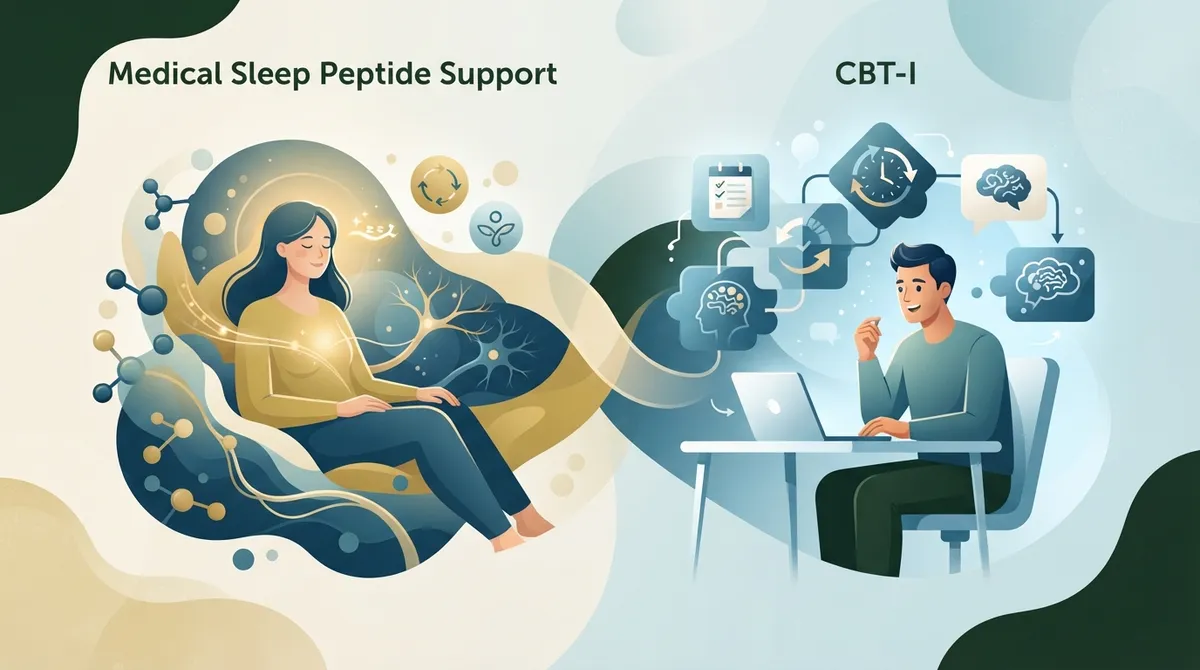
What Does “Medical Sleep Peptide Support” Actually Mean?
Let’s start with the basics. Peptides are short chains of amino acids, the building blocks of proteins. Your body makes many of them naturally. If you want a quick refresher, our guide 8 Facts That Explain What Are Peptides in 2026 walks through the basics, and what are peptides is a helpful plain-language overview.
“Medical sleep peptide support” usually points to a few things:
- Growth-hormone-axis peptides such as CJC-1295 and ipamorelin, which are sometimes promoted with sleep-related claims
- Peptides like DSIP (delta sleep-inducing peptide), which have a long history in sleep research talk but limited modern clinical proof
- Provider-guided plans that pair peptides with labs, lifestyle coaching, and follow-up
Here is the important part. This is not a diagnosis. It is not a recognized treatment category in major insomnia guidelines. And none of these peptides are FDA-approved insomnia medicines. A trustworthy provider will say so clearly, name the exact peptide, and explain the evidence and regulatory status.
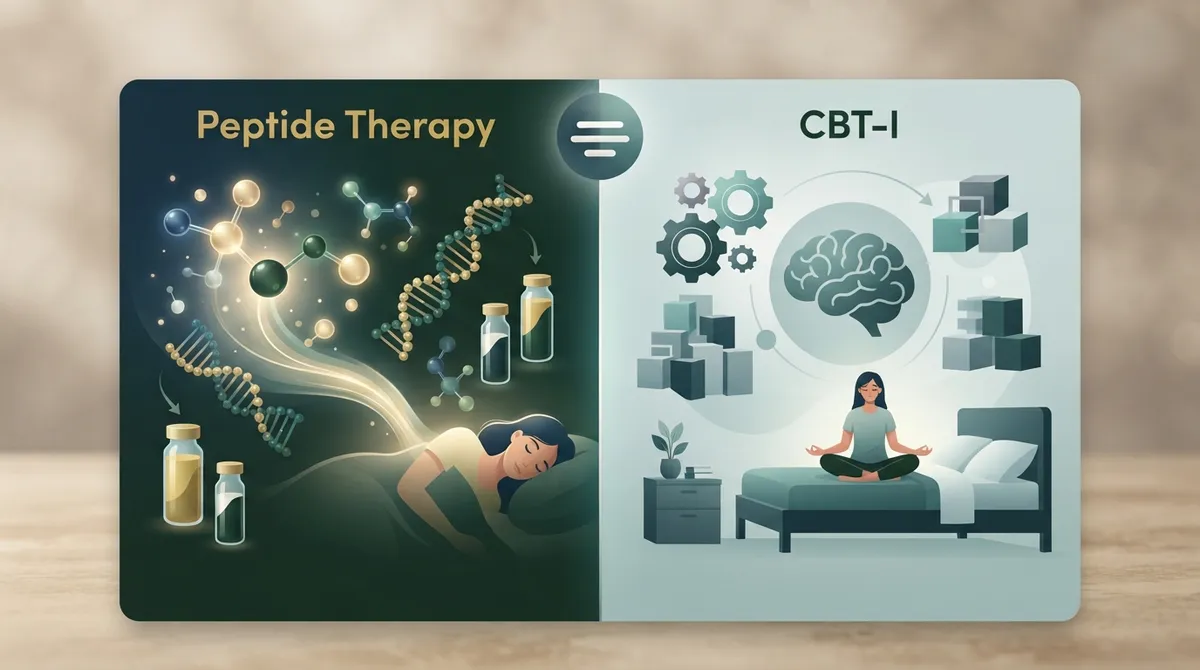
Meet the Contenders
Contender One: Peptide-Based Sleep Support
Peptide support is a personalized, provider-guided approach. A licensed clinician reviews your health history and labs, then may discuss whether a peptide fits your goals. Some people are drawn to growth-hormone secretagogues because growth hormone release is linked with deep sleep stages in the body. That is an interesting idea, and it deserves respect.
But there is a catch. Showing that a peptide affects growth hormone is not the same as showing it treats insomnia or improves restorative sleep. The available evidence does not establish that peptides such as CJC-1295 or ipamorelin safely or effectively treat insomnia. Think of it like this: a key may fit one lock, but that doesn’t mean it opens every door.
Contender Two: CBT-I
CBT-I is a structured, skills-based program that helps you change the thoughts and habits that keep insomnia going. It often includes sleep scheduling, stimulus control, and relaxation training. It’s not a pill and it’s not a shot. It’s a toolkit you keep for life.
The American Academy of Sleep Medicine strongly recommends multicomponent CBT-I for adults with chronic insomnia. That recommendation rests on moderate-quality evidence from 49 studies. The AASM’s pharmacologic guideline also names CBT-I as the initial intervention. Its guidance does not recommend peptide therapy for insomnia.
Head-to-Head Comparison
| Factor | Peptide Sleep Support | CBT-I |
|---|---|---|
| Guideline status | Not recommended in major insomnia guidelines | Strong recommendation, first-line for chronic insomnia |
| Evidence for insomnia | No established clinical evidence in available sources | Moderate-quality evidence from 49 studies |
| FDA status for insomnia | Not approved for insomnia | Not a drug; a recognized behavioral treatment |
| Delivery | Injections or other prescribed forms, often compounded | Guided sessions with a trained provider or program |
| Side effect concerns | Uncertain long-term effects; possible local injection reactions | Short-term sleepiness during sleep restriction for some people |
| Best for | Broader wellness goals, discussed with a clinician | Chronic trouble falling or staying asleep |
Looking at this table, the picture is pretty clear. For treating insomnia itself, CBT-I has the stronger track record by a wide margin. That doesn’t make peptides “bad.” It just means they are answering a different question.
What the Evidence Does and Doesn’t Say
We want you to feel confident, so let’s be plain about the research. There is no reliable clinical-trial statistic in the available sources showing that peptide therapy improves insomnia. That means you should be careful with any promo that quotes a big percentage of better sleep. Those numbers often come from unrelated hormone studies, not sleep outcomes.
For a deeper look at one popular name, see 9 DSIP Sleep Peptide Facts Worth Knowing in 2026. You can also compare approaches in DSIP vs. CBT-I: Which Sleep Fix Actually Works?.
A Note on Compounded Products
Many peptides in wellness settings are compounded. Compounded drugs are not FDA-approved, and the FDA does not review them for safety, effectiveness, or quality before they are marketed. The FDA has also raised safety concerns about compounded versions of certain peptides. So it’s smart to ask your clinician and pharmacist about the exact product and where it comes from. To learn more, read FDA-Approved vs. Compounded Peptides: What Wins?.
One more gentle reminder: a peptide is not safe just because it is called natural or because a clinician supervises it. Safety depends on the specific peptide, the formulation, and your health.
Why Your Sleep Problem Needs a Real Workup First
Before choosing any fix, it helps to know why you’re sleeping poorly. Poor sleep can come from many sources, and the right answer depends on the cause. A thoughtful clinician will usually look at:
- Sleep apnea, which can mimic insomnia and needs its own treatment
- Circadian rhythm issues, like shift work or irregular schedules
- Medication effects, including some antidepressants and stimulants
- Mood concerns such as anxiety or depression
- Other medical conditions, including pain, reflux, and hormone changes
This step matters for every audience. Busy professionals may be dealing with late-night screens and stress. Aging adults may face hormone shifts and nighttime waking. Biohackers may be chasing better wearable scores. In each case, peptides should not replace evaluation or evidence-based care. If hormones may be part of your story, our piece on 9 Sleep Optimization Steps Before Trying Peptides is a great place to begin.
A Smart Order of Operations
So how do you put this all together? Here is a simple path many people find helpful:
- Name the problem. Is it trouble falling asleep, staying asleep, or waking unrefreshed? Keep a two-week sleep diary.
- Rule out other causes. Ask about sleep apnea, medication effects, and mood.
- Start with CBT-I. This is the guideline-backed first step for chronic insomnia.
- Get baseline labs. Blood work can reveal hormone, thyroid, or nutrient issues worth addressing.
- Talk about peptides only for the right reasons. If your goals include recovery, energy, or body composition, a clinician can explain what is and isn’t supported.
- Track and adjust. Regular check-ins keep any plan honest and safe.
Where Allura Longevity Fits In
Allura Longevity is a telehealth wellness clinic that offers personalized, medically supervised peptide therapy. Clients start with a $50 virtual consultation, complete blood work through LabCorp, and receive a customized six-month plan delivered to their home. Ashley, a board-certified Family Nurse Practitioner, leads care, with ongoing monitoring and adjustments along the way.
What makes this approach helpful for sleep-minded clients is the honesty and the process. Your provider looks at the whole picture first, including labs and goals, and can talk with you about what peptides may or may not do. Peptides are not presented as a replacement for CBT-I or a medical sleep workup. If you want to understand the process, see What Really Happens During a Peptide Telehealth Visit? and How to Start Peptide Therapy Safely and See Real Results.
Allura Longevity serves clients in Florida, Georgia, Texas, Connecticut, Indiana, Maryland, New York, and California, with a focus on personalized plans and licensed providers.
Questions to Ask Any Clinician About Sleep Peptides
Whether you work with us or someone else, bring these questions to your visit. They protect you and show you’re an informed patient.
- Which exact peptide are you suggesting, and why?
- What is the evidence for my specific sleep problem?
- Is this product FDA-approved, or is it compounded? Where is it made?
- What are the risks, side effects, and unknowns?
- Have we ruled out sleep apnea and other medical causes?
- How will we measure whether it’s working, and when will we stop if it isn’t?
A good provider will welcome every one of these. If answers feel vague, that is useful information too. Our checklist 15 Peptide Consultation Questions to Ask in 2026 goes even deeper, and Is Peptide Therapy Safe? What You Really Need to Know covers safety in more detail.
So, Which One Wins?
For chronic insomnia, CBT-I wins on evidence, and it isn’t close. It is the guideline-backed first step, and the skills last. Peptide support doesn’t have established proof as an insomnia treatment, so it’s best seen as a separate conversation about broader wellness goals like recovery, energy, and healthy aging.
The good news? You don’t have to choose in a rigid way. Many people use CBT-I for sleep and work with a provider on labs, hormones, and other goals at the same time. Sleep quality often improves when the whole picture is cared for. For ideas on the broader wellness side, take a look at Which Peptides Actually Help You Sleep Better? and the research summary from the National Library of Medicine.
Ready for a personalized, honest look at your health? Request a consultation with Allura Longevity, or call (813) 510-6277. Spots for new clients are limited each month, so reach out while there’s room. Better rest and renewed energy are worth the conversation.
FAQs
Q: Do sleep peptides actually work for insomnia?
A: The available evidence does not show that peptides safely or effectively treat insomnia. The American Academy of Sleep Medicine recommends CBT-I as the first-line treatment for chronic insomnia and does not recommend peptide therapy for it. If you’re curious about peptides, talk with a licensed clinician about your exact goals.
Q: Are CJC-1295 or ipamorelin FDA-approved for sleep?
A: No, they are not FDA-approved insomnia medicines. They are growth-hormone secretagogues sometimes promoted in wellness settings, and compounded versions are not reviewed by the FDA for safety, effectiveness, or quality before marketing. Always ask your clinician and pharmacist about the exact product and its source.
Q: What are the risks of peptide therapy for sleep?
A: Risks depend on the peptide and formulation. For growth-hormone-axis peptides, long-term effects are uncertain, and injections can cause local reactions like redness or soreness. A peptide isn’t safe just because it’s called natural or used under supervision, so ask about risks before you start.
Q: What is the difference between peptide therapy and CBT-I?
A: CBT-I is a structured behavioral program that retrains sleep habits and thoughts, and it has strong guideline support for chronic insomnia. Peptide therapy is a medication-based approach with no established evidence for treating insomnia. Many people start with CBT-I and discuss peptides separately for broader wellness goals.
Q: What should I ask a clinician before trying a peptide marketed for sleep?
A: Ask which exact peptide it is, what evidence supports it for your sleep problem, and whether it’s FDA-approved or compounded. Also ask whether sleep apnea and other causes have been ruled out, and how you’ll measure results. A good provider will happily answer all of these.





