
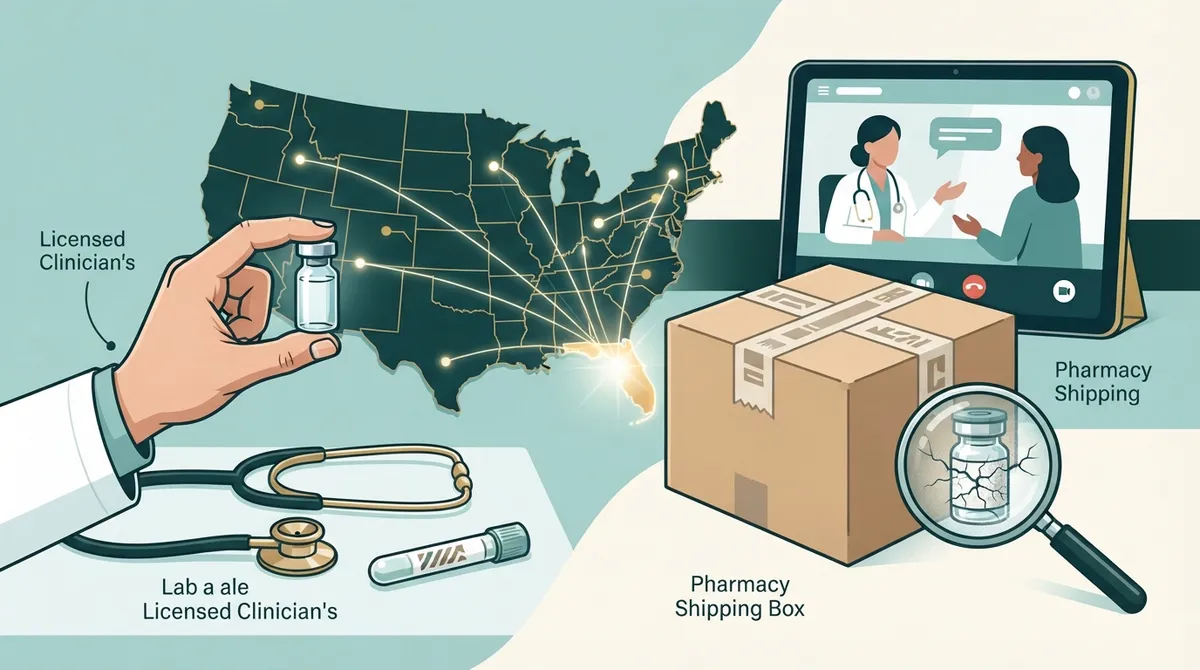
Key Takeaways
-
A Florida address does not automatically allow a clinic to treat patients in every state; telehealth care is generally regulated where the patient is physically located, so ask which states your provider is licensed in.
-
Compounded peptides are not FDA-approved, and the FDA does not review them for safety, effectiveness, or quality before marketing, so verify whether any product you're offered is approved or compounded.
-
Ask the clinic which licensed pharmacy fills your order and confirm it can ship to your state; a trustworthy clinic will answer without hesitation.
-
Reputable clinics require a personal evaluation, informed consent, and lab work before prescribing, and they monitor you with regular follow-ups rather than just shipping a product.
-
Avoid products labeled for research use only, since they are not intended as medicines for human use, and be cautious of online peptides with unclear sourcing or quality concerns.
-
Before booking, screen providers with a few targeted questions about licensure, lab requirements, pharmacy source, product status, and side effects to protect your time, money, and safety.
If you have ever searched for a Florida based nationwide peptide clinic, you probably want two things at once: the polish of a dedicated clinic and the ease of care that comes to your door. That is a fair thing to want. Busy schedules, travel, and long drives to a specialist make in-person visits tough for a lot of us.
The good news is that telehealth has made this possible. The less obvious news is that “nationwide” does not always mean what it sounds like. A clinic that is headquartered in Florida is not automatically allowed to treat patients in every state. Laws, licenses, and product rules all matter.
In this friendly guide, we will walk through what these clinics do, how the rules work in 2026, what safety questions to ask, and how to pick a provider you can trust. Whether you are a health optimizer, a biohacker, or simply a wellness seeker who wants to age well, you will leave with clear, practical answers.

What Is a Florida-Based Nationwide Peptide Clinic?
A Florida-based nationwide peptide clinic is a clinic headquartered in Florida that offers peptide-related care by telehealth to patients in more than one state. You meet with a licensed provider by video or phone, share your health history, and review lab work. If treatment makes sense, a plan is built for you.
Here is the key point. The phrase “nationwide” is a marketing description, not a legal guarantee. Telehealth is generally regulated where the patient is located. That means a Florida address alone does not give a clinician the right to treat people in all 50 states.
For a deeper look at how this model works, see 5 Things a Nationwide Telehealth Peptide Clinic Does.

How Peptide Therapy Works Through Telehealth
Peptides are short chains of amino acids. Your body makes many of them naturally, and they act as signals that help guide processes like recovery, metabolism, and sleep. If you want a plain-language primer, the what are peptides overview from WebMD is a good starting point.
Most telehealth peptide programs follow a similar path:
- Book a consultation. You talk with a licensed provider about your goals, symptoms, and medical history.
- Get lab work. Blood tests help show where you stand today, so treatment is based on data and not guesswork.
- Receive a personalized plan. Your provider reviews the results and designs a protocol that fits you.
- Get your medication delivered. A licensed pharmacy ships it to your home, with instructions for use.
- Follow up regularly. Your provider checks in, reviews progress, and adjusts the plan as needed.
That last step is easy to overlook, but it matters. A good clinic does not just ship a product and disappear. If you want to know what a first visit looks like, read What Really Happens During a Peptide Telehealth Visit?
Can a Florida Clinic Legally Treat Patients in Every State?
This is the biggest question people have, and it deserves a straight answer. In most cases, the treating clinician must be authorized to practice where the patient is physically located. Prescribing, follow-up, and pharmacy rules also follow the patient’s state.
Florida does have a process for out-of-state clinicians who want to treat patients located in Florida. According to Florida Statutes §456.47 and Florida Department of Health guidance, those providers must register and meet several requirements:
- An active, unencumbered license that is comparable to a Florida license
- No relevant disciplinary action in the prior five years
- A Florida registered agent
- Professional liability coverage at least equal to what Florida requires of its own practitioners
Florida-licensed clinicians do not need that registration to treat Florida patients by telehealth. But Florida licensure alone does not open the door to Texas, New York, or California. Those states have their own rules.
| Question | What It Means for You |
|---|---|
| Where is the clinic headquartered? | Tells you the business location, not where care is allowed |
| Where are you located during the visit? | This is the state whose rules usually apply |
| Is the provider authorized in your state? | Required before you receive a prescription |
| Which pharmacy fills the order? | Should be licensed to ship to your state |
A simple rule: ask the clinic directly if your treating provider is authorized in your state. A trustworthy clinic will answer without hesitation. For more on this topic, see Which States Allow Telehealth Peptide Prescriptions?
Are Compounded Peptides FDA-Approved?
No. This is one of the most important facts to understand. Compounded drugs are not FDA-approved. The FDA does not review compounded products for safety, effectiveness, or quality before they are marketed.
Compounding can serve a real purpose when a provider decides a patient has a specific medical need. But it also carries risks, so be careful with any claim that a compounded peptide is “FDA-approved” or “proven equivalent” to an approved drug.
The rules in this area are also changing. The Federal Register reported an HHS enforcement-discretion policy for certain 503A peptide compounding on October 30, 2026. That is a narrow, conditional policy. It does not mean the covered peptides are FDA-approved, and it does not mean all compounding is permitted. Because the situation can shift, clinics and patients should check the current FDA materials and state rules before assuming anything about a specific peptide.
The FDA has also raised safety concerns about certain bulk peptide substances. For example, it lists potential immunogenicity risks tied to aggregation and impurities for injectable or nasal GHRP-2, along with reports of serious adverse events where causality has not been established. In plain terms: not every peptide you see online is a good idea, and the product source matters a lot.
To understand the difference between product types, see Approved Peptides vs. Wellness Peptides: What Works? and 503A vs. 503B: Which Peptide Compounding Wins?
What a Responsible Peptide Clinic Should Do
A good clinic acts more like a care team than a storefront. Here is what safe, patient-first practice looks like:
- An individual evaluation. A licensed clinician reviews your history, medications, and goals.
- Honest talk about evidence. You hear what is well studied and what is still uncertain.
- Informed consent. You understand the benefits, risks, and alternatives before you begin.
- Lab work and monitoring. Testing guides decisions, and follow-ups track how you respond.
- Pharmacy transparency. The clinic tells you which pharmacy fills your order and the status of the product.
- No research-use-only products. Items labeled for lab research are not medicines for human use.
If a clinic skips these steps, take that as a red flag. For a longer checklist, see 15 Ways to Evaluate a Peptide Clinic Before You Commit (2026).
Why Lab Work Matters Before You Start
Biohackers love data, and for good reason. Your numbers tell a story that a symptom list cannot. Blood work can show hormone levels, metabolic markers, and other signals that help your provider decide whether peptides, hormones, or neither is the right next step.
Skipping labs is like driving without a dashboard. You might get somewhere, but you will not know how the engine is doing. Learn what is commonly tested in Lab Work for Peptide Therapy: What to Test and Why.
Key Questions to Ask Before You Book
Think of this as your quick screening checklist. A few good questions can save you time, money, and worry.
- Is my treating provider licensed to practice in my state?
- Do you require an evaluation and lab work before prescribing?
- Which pharmacy prepares my medication, and is it licensed?
- Is the product FDA-approved, or is it compounded?
- How often will I follow up, and who will I talk to?
- What side effects should I watch for, and what do I do if they happen?
You can also use 15 Peptide Consultation Questions to Ask in 2026 to go even deeper. And if you want to avoid common slip-ups, read 3 Peptide Consultation Mistakes That Waste Your First Visit.
Telehealth vs. Local Clinic: Which Fits You?
Neither option is better for everyone. It depends on your schedule, location, and comfort level.
| Factor | Telehealth Peptide Clinic | Local In-Person Clinic |
|---|---|---|
| Convenience | Visits from home, medication delivered | Travel and wait times |
| Access to specialists | Often wider, across state lines where licensed | Limited to your area |
| Hands-on exams | Limited, though labs can be done locally | Available in the office |
| Scheduling | Flexible, fits busy days | Set office hours |
Many busy professionals lean toward telehealth because it fits into real life. If you are weighing both, see Local Clinic vs. Telehealth: Best Peptide Therapy Near You?
What Peptide Care Can Support
Peptide therapy is not one single thing. Different protocols are used for different goals, and each one has its own evidence level and risks. Common areas people ask about include energy, sleep, recovery, skin, metabolism, and sexual wellness. Some options, like certain GLP-1 medications for weight management, are FDA-approved drugs. Others sit in a less clear space.
That is why a personalized approach is so important. Your provider should match the plan to your labs, goals, and health history rather than hand you a one-size-fits-all stack. See 15 Ways a Peptide Therapy Plan Gets Personalized (2026) for examples.
Where Allura Longevity Fits In
Allura Longevity is a Florida-based telehealth clinic offering personalized, medically supervised peptide therapy. Care starts with a $50 virtual consultation. From there, clients complete blood work through LabCorp and receive a customized six-month treatment plan delivered to their home. Licensed providers monitor progress and adjust the plan along the way, led by Ashley, a board-certified Family Nurse Practitioner.
Allura Longevity is licensed in Florida, Georgia, Texas, Connecticut, Indiana, Maryland, New York, and California, so it is upfront about where care is available. Services include peptide therapy for energy, sleep, recovery, skin, and sexual wellness, along with GLP-1 weight management, BPC-157 for injury recovery, and testosterone replacement. If you want to see how the home-delivery side works, read How Does Peptide Therapy Delivered to Your Home Work?
Final Thoughts
A Florida-based nationwide peptide clinic can be a smart, convenient way to get expert care without leaving home. The best ones are open about where they are licensed, which pharmacy they use, and what is known and unknown about each product. You are not being picky when you ask these questions. You are being a smart patient.
Take your time, ask for details, and choose a team that treats you like a person instead of a purchase. If you are ready to take the next step, request a consultation with Allura Longevity or call (813) 510-6277. Spots for new clients are limited each month, so reach out soon to see if peptide therapy is right for you.
FAQs
Q: What does a Florida-based nationwide peptide clinic offer?
A: It is a clinic headquartered in Florida that provides peptide-related care by telehealth to patients in multiple states. You usually get a virtual consultation, lab work, a personalized plan, and home delivery of medication, plus follow-up care. Just remember that “nationwide” does not always mean every state, so check where your provider is licensed.
Q: Can a Florida peptide clinic legally treat patients in every state?
A: Not automatically. Telehealth is generally regulated where the patient is located, so the treating clinician must be authorized in your state, and prescribing and pharmacy rules there must be followed. Florida licensure alone does not authorize care nationwide, so always ask the clinic to confirm.
Q: Are compounded peptides FDA-approved?
A: No, compounded drugs are not FDA-approved, and the FDA does not review them for safety, effectiveness, or quality before they are marketed. A responsible clinic will tell you plainly whether a product is approved or compounded and which pharmacy prepares it.
Q: What should I ask a peptide clinic before starting treatment?
A: Ask whether your provider is licensed in your state, whether labs are required, which pharmacy fills your order, and whether the product is FDA-approved or compounded. Also ask how follow-ups work and what side effects to watch for. Clear, confident answers are a good sign.
Q: How does telehealth work for peptide therapy?
A: You start with a virtual visit, complete blood work, and review results with a licensed provider who builds your plan. Your medication is shipped to your home, and you check in regularly so your provider can monitor progress and adjust as needed.





