

Key Takeaways
-
Menopausal hormone therapy and peptide therapy are not interchangeable: approved hormone options have established evidence for specific uses, while many wellness peptides lack FDA approval for those uses.
-
If you have a uterus and take systemic estrogen, a progestogen is generally needed to protect the uterine lining, since estrogen alone can raise endometrial cancer risk.
-
Ask any provider whether a product is FDA-approved or compounded and for what condition; compounded products are not FDA-reviewed for safety, effectiveness, or quality before marketing.
-
Testosterone treatment is meant for confirmed hypogonadism with symptoms, not as a general anti-aging treatment, and requires lab work and a clinical review.
-
Before starting, get blood work and a full health and family history review, since fatigue or sleep issues can stem from thyroid, iron, or blood sugar problems rather than hormones.
-
In February 2026, the FDA removed some boxed warnings from six menopausal hormone products, but risks like blood clots, stroke, and breast cancer still remain in the labeling.
If you are somewhere between 40 and 65, you may have noticed some changes. Sleep feels lighter. Energy dips by mid-afternoon. Your body composition seems to shift even when your habits stay the same. You are not imagining it, and you are definitely not alone.
Many people in midlife start searching for help, and two terms come up again and again: hormone therapy and peptide therapy. They sound alike, and some online sellers blur them together. But they are not the same thing. Knowing the difference can help you ask better questions and make safer choices.
In this guide, we will walk through midlife hormone and peptide therapy in plain, friendly language. You will learn what each approach is, what the evidence supports, where the hype creeps in, and how to build a plan with a licensed provider. Think of this as a chat with a knowledgeable friend who wants you to feel informed, not pressured.

What Does Midlife Hormone and Peptide Therapy Actually Mean?
The phrase covers two different categories of care. Let’s separate them clearly.
Hormone therapy in midlife
“Midlife hormone therapy” is not one single treatment. It can mean menopausal hormone therapy (estrogen, with a progestogen when needed), testosterone treatment for people with a diagnosed deficiency, or other prescribed options. Each has its own purpose, evidence base, and risks. If you want a refresher on the basics, this guide on what hormone replacement therapy is and whether you need it is a good starting point.
Peptide therapy in midlife
Peptides are short chains of amino acids that act as signaling molecules in the body. You can read a simple overview in this explainer on what are peptides, or our own article, 8 Facts That Explain What Are Peptides in 2026.
“Peptide therapy” is a broad marketing term, not one proven treatment. Some peptide medicines are FDA-approved for specific conditions. Many others promoted for wellness or anti-aging are not approved for those uses. That is a key point we will return to.
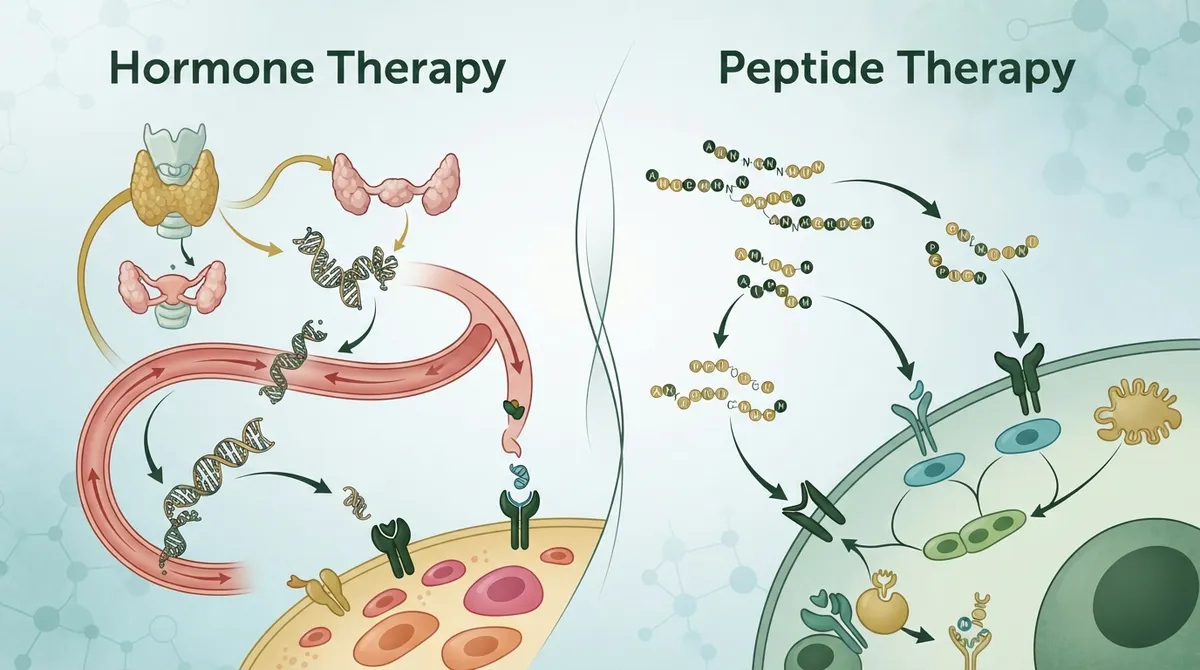
How Are Hormone Therapy and Peptide Therapy Different?
Here is a quick side-by-side look. It helps to see the two approaches next to each other.
| Feature | Menopausal Hormone Therapy | Peptide Therapy (Wellness Category) |
|---|---|---|
| What it is | Estrogen, often with a progestogen | Signaling peptides, varied by type |
| Main purpose | Menopause symptoms, bone loss prevention | Goals like recovery, energy, body composition |
| FDA status | FDA-approved products exist for menopause | Varies widely; many are not approved for wellness uses |
| Evidence level | Well studied for approved indications | Varies; often limited human data |
| Interchangeable? | No. They are different tools for different goals. | |
The takeaway: peptides are not a replacement for established menopause care. If hot flashes or night sweats are your main concern, that is a conversation about approved hormone options first.
What Are the Common Midlife Changes People Want Help With?
Midlife brings a mix of changes. Not all of them are hormone-related, and a good provider will sort out the causes before suggesting anything.
- Hot flashes and night sweats during perimenopause and menopause
- Sleep disruption and restless nights
- Lower energy and slower recovery after workouts
- Changes in body composition, such as less muscle and more belly fat
- Mood shifts, brain fog, and low motivation
- Lower libido and vaginal or sexual comfort concerns
- Skin changes, including dryness and loss of elasticity
Some of these respond well to approved hormone treatment. Others may respond to sleep habits, strength training, nutrition, or medical care for another condition. That is why a proper evaluation matters.
What Does Approved Menopausal Hormone Therapy Do?
For menopause symptoms, FDA-approved hormone therapy can relieve hot flashes and night sweats and treat vaginal symptoms. Systemic therapy can also help prevent bone loss. The right product, route, and dose depend on your symptoms, medical history, and whether you have a uterus.
Why a progestogen matters
If you have a uterus and use systemic estrogen, a progestogen is generally needed to protect the uterine lining. Estrogen alone can raise endometrial cancer risk in that group. If you want to learn more, see our article on progesterone therapy for women.
What the 2026 labeling updates mean
You may have seen headlines this year. In February 2026, the FDA approved labeling changes for six menopausal hormone therapy products. Cardiovascular disease, breast cancer, and probable dementia statements were removed from the boxed warning for those products. The endometrial cancer boxed warning remains for systemic estrogen-alone products.
Important: this does not mean all risks disappeared. Risk information remains elsewhere in the labeling. Potential concerns still include blood clots, stroke, heart attack, breast cancer, and gallbladder disease for some patients. A history of certain cancers, stroke, heart attack, or blood clots may affect whether hormone therapy is right for you. You can read more on the National Library of Medicine site, and always check current product-specific labeling with your clinician.
Where Do Peptides Fit in Midlife Care?
Here is where honesty matters most. Some peptide medicines have FDA approval for specific conditions, such as certain GLP-1 medicines used for diabetes or weight management. But approval for one use does not prove safety or benefit for aging, menopause, or “hormone optimization.”
Peptides often discussed in wellness circles include BPC-157 and CJC-1295. These lack FDA approval for the uses they are commonly promoted for. The FDA has also raised concerns about compounding certain peptides, including limited human safety data, impurities, and problems with ingredient characterization.
That does not mean you should never explore peptides. It means you should approach them carefully, with a licensed provider, realistic expectations, and clear information about what is and is not proven. For deeper reading, try FDA-Approved vs. Compounded Peptides: What Wins? and Is Peptide Therapy Safe? What You Really Need to Know.
Can peptides help with menopause symptoms?
There is no established evidence that peptide therapy replaces menopausal hormone therapy for hot flashes or bone protection. Some people explore peptides for goals like sleep, recovery, or body composition alongside proper menopause care. If you are curious, our piece on MHT vs. Peptides: Which Helps Menopause More? breaks this down further.
Approved Medicines vs. Compounded and Online Products
This is one of the most important distinctions in midlife care. Not every product labeled “hormone” or “peptide” has the same oversight.
| Product Type | FDA Review for Safety and Effectiveness? | What to Know |
|---|---|---|
| FDA-approved prescription medicine | Yes, before marketing | Labeling lists approved uses, warnings, and dosing |
| Compounded preparation | No, not FDA-approved or reviewed for safety, effectiveness, and quality before marketing | Made by a pharmacy for an individual prescription; quality and evidence vary |
| Products sold online without a prescription | No | Highest risk of impurities, wrong dosing, and false claims |
Compounded medicines can have a role when a licensed clinician decides they are appropriate. But they deserve extra scrutiny. Learn more in 4 Compounded Peptides Facts You Need in 2026 and How to Get Prescription Peptides Safely in 2026.
What About Testosterone in Midlife?
Testosterone treatment is appropriate for people who are appropriately diagnosed with hypogonadism, meaning confirmed low levels along with symptoms. It is not a general anti-aging shot. For men, our guides on understanding testosterone replacement therapy and how to tell when men need hormone therapy cover the details. For women, see Testosterone vs. Peptides for Women: Which Wins?
Who May Be a Candidate, and Who Should Be Cautious?
Candidacy is individual. A clinician will weigh your symptoms, age, time since menopause, and health history. Generally, a careful review includes:
- Symptom review: What are you feeling, and how much does it affect daily life?
- Medical history: Past cancers, stroke, heart attack, blood clots, liver issues, or unexplained bleeding.
- Family history: Breast cancer, clotting disorders, and cardiovascular disease.
- Lab work: Blood tests to look at hormones, metabolic markers, and other health indicators.
- Goals and preferences: What you want to achieve and what risks you are comfortable with.
People with certain histories may not be good candidates for systemic hormone therapy. That is exactly why self-treatment is risky and why working with a qualified clinician is so valuable.
Why Do Labs and Personalization Matter So Much?
Two people can feel tired for completely different reasons. One may have thyroid issues. Another may be dealing with poor sleep, low iron, or blood sugar changes. Guessing is not a plan.
Lab testing gives your provider real data. It helps rule out other causes and track how your body responds. Read more in Why Does Hormone Level Testing Matter for Peptides? and 5 Blood Work Analysis Steps Before Peptides in 2026.
How Does Allura Longevity Approach Midlife Care?
Allura Longevity offers personalized, medically supervised peptide therapy through telehealth. The process is designed to be simple and thoughtful, especially for busy people who want convenient care.
- A $50 virtual consultation to talk through your goals and history
- Blood work through LabCorp to guide decisions with real data
- A customized six-month plan built by licensed providers, led by Ashley, a board-certified Family Nurse Practitioner
- Home delivery of treatment, so you can fit care into your schedule
- Ongoing monitoring and adjustments as your body responds
Allura Longevity is licensed in Florida, Georgia, Texas, Connecticut, Indiana, Maryland, New York, and California. Whether you are exploring peptides for women or peptides for men, the goal is the same: a clear plan, honest guidance, and a provider who explains what is proven and what is still being studied.
How Can You Start Safely? A Step-by-Step Path
If you are ready to explore, here is a simple roadmap.
- Get clear on your goals. Write down your top two or three concerns, such as sleep, energy, or hot flashes.
- Schedule a consultation with a licensed provider. Be open about your full health history.
- Complete lab work. Do not skip this step.
- Ask about FDA status. For every product suggested, ask whether it is FDA-approved or compounded, and for what use.
- Start with a plan, not a guess. Agree on timelines and check-ins.
- Monitor and adjust. Report side effects, and plan follow-up labs.
For more on starting out, see How to Start Hormone and Peptide Therapy the Safe Way and 15 Peptide Consultation Questions to Ask in 2026.
What Questions Should You Ask Before Starting?
Bring this list to your appointment. A good provider will welcome your questions.
- Is this medicine FDA-approved, and for what condition?
- If it is compounded, what pharmacy prepares it and how is quality checked?
- What are the likely benefits for me, and what does the evidence actually show?
- What are the risks given my personal and family history?
- Do I need a progestogen if I have a uterus?
- How will we monitor progress, and when will we reassess?
- What happens if I want to stop?
Setting Realistic Expectations
Midlife health is rarely about one magic fix. The best results usually come from combining medical care with strength training, protein-rich meals, good sleep habits, stress management, and regular check-ups.
Peptides and hormones can be part of that bigger picture for the right person. They are tools, not shortcuts. Results vary, and some peptide goals have limited human evidence. A trustworthy clinic will say so plainly.
Final Thoughts: Your Midlife, Your Plan
Midlife can feel like a puzzle, but you do not have to solve it alone. Remember the big ideas: hormone therapy and peptide therapy are not interchangeable, approved medicines differ from compounded and online products, and the safest path starts with labs, honest conversation, and a licensed provider.
If you are ready to explore personalized, medically supervised care from home, request a consultation with Allura Longevity or call (813) 510-6277. Spots for new clients are limited each month, so reach out when you feel ready. You deserve care that is thoughtful, transparent, and built around you.
FAQs
Q: What is the difference between midlife hormone therapy and peptide therapy?
A: Midlife hormone therapy usually means menopausal hormone therapy (estrogen, with a progestogen when needed) or testosterone for diagnosed deficiency, and it has FDA-approved options for specific uses. Peptide therapy is a broad marketing term, and many peptides promoted for wellness are not FDA-approved for those uses. They are different tools, so they should not be treated as interchangeable.
Q: Can peptide therapy help with menopause symptoms or perimenopause?
A: There is no established evidence that peptide therapy replaces FDA-approved menopausal hormone therapy for hot flashes, night sweats, or bone protection. Some people explore peptides for goals like sleep or recovery alongside proper menopause care. Talk with a licensed clinician to sort out what fits your situation.
Q: Are BPC-157 and CJC-1295 FDA-approved for hormone optimization or anti-aging?
A: No. BPC-157 and CJC-1295 lack FDA approval for the uses they are commonly promoted for, and the FDA has raised concerns about compounding certain peptides, including limited human safety data and impurities. Always ask any provider about a product’s FDA status before starting.
Q: Does someone with a uterus need progesterone when taking systemic estrogen?
A: Generally, yes. A progestogen is usually needed to protect the uterine lining, because estrogen alone can raise endometrial cancer risk for people with a uterus. Your clinician will choose the right combination for you.
Q: What are the risks of compounded peptide injections?
A: Compounded drugs are not FDA-approved and are not reviewed by the FDA for safety, effectiveness, and quality before marketing. Risks can include limited human safety data, impurities, and inconsistent ingredients. Working with a licensed provider and asking how products are sourced and tested can help you make safer choices.





