

Key Takeaways
-
"Bioidentical" only describes molecular structure, not safety or naturalness—both FDA-approved and compounded products can be bioidentical, and this distinction significantly affects regulatory oversight and manufacturing standards.
-
Major medical organizations (ACOG, Endocrine Society, National Academies) recommend FDA-approved hormone options over compounded versions due to limited high-quality evidence and inconsistent potency in compounded bioidentical hormone therapy.
-
Peptide therapy and bioidentical hormone therapy are different categories with different mechanisms—peptides are amino acid chains that influence pathways, not direct hormone replacements, and each requires separate evidence for safety and efficacy.
-
Proper evaluation should include blood work (not just saliva/urine tests), detailed symptom review, medical history assessment, and ongoing monitoring with a licensed provider to determine if hormone therapy, peptide therapy, or a combined approach fits your goals.
If you’ve spent any time researching hormone health, you’ve probably seen the term “bioidentical hormone therapy” everywhere. Maybe a friend mentioned it. Maybe you saw an ad promising it’s more “natural” than other options. It’s a confusing topic, and honestly, a lot of the marketing out there muddies the waters even more. We’re here to clear things up in a friendly, no-pressure way, so you can make informed choices about your health.
At Allura Longevity, we work with people every day who are trying to sort fact from fiction when it comes to hormones, peptides, and everything in between. This guide breaks down what bioidentical hormone therapy actually means, how it differs from peptide therapy, and what the science really says. Let’s dig in together.

1. What “Bioidentical” Actually Means
The word “bioidentical” simply describes chemical structure. A bioidentical hormone has the exact same molecular makeup as a hormone your body naturally makes. That’s it. It doesn’t automatically mean the product is safer, more natural, or FDA-approved.
This is one of the biggest misunderstandings out there. Many people assume “bioidentical” means “custom-made” or “plant-based” or “better than the alternative.” In reality, it’s just a description of molecular structure, nothing more. Both FDA-approved and compounded products can be bioidentical.
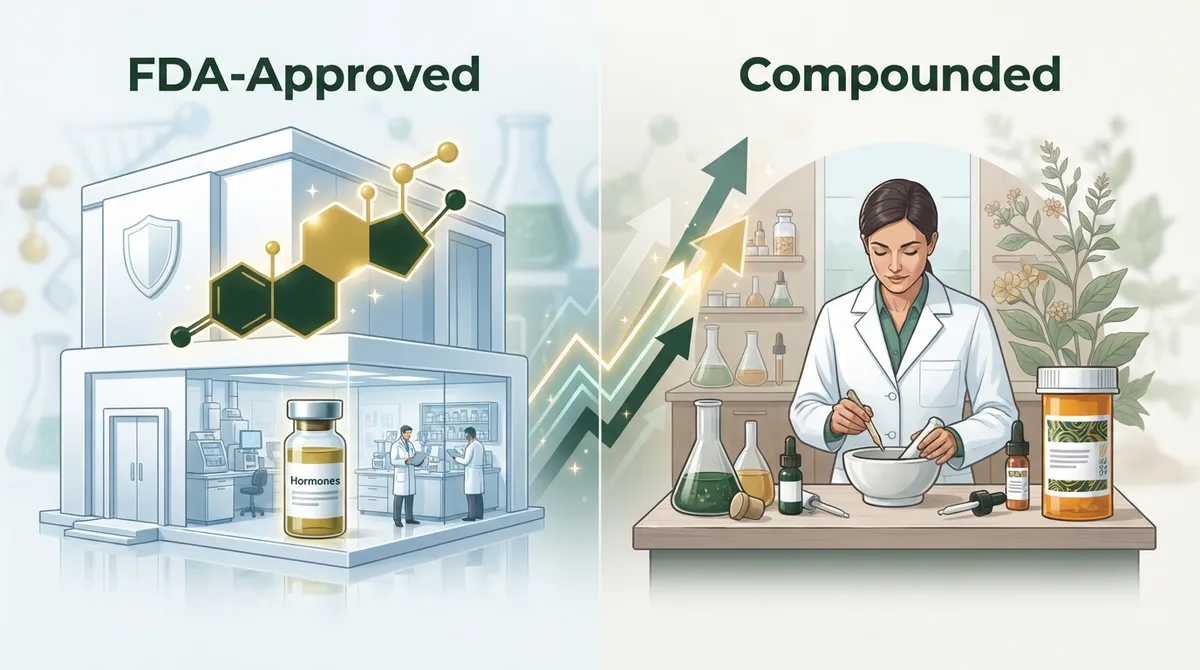
2. FDA-Approved vs. Compounded: A Big Difference
Here’s where things get important. FDA-approved bioidentical hormone products do exist. These include prescription estradiol, micronized progesterone, and certain DHEA products. They go through rigorous FDA review for safety, effectiveness, manufacturing quality, and labeling accuracy.
Compounded bioidentical hormone therapy is different. These custom-mixed products may contain estradiol, estrone, progesterone, testosterone, DHEA, pregnenolone, or combinations of these, made into pills, creams, sublingual drops, injections, or pellets. Many patient-specific compounded drugs are exempt from the FDA’s premarket approval process and standard manufacturing checks.
| Feature | FDA-Approved Bioidentical Hormones | Compounded Bioidentical Hormones |
|---|---|---|
| Regulatory Review | Yes, full FDA approval process | Often exempt from FDA review |
| Manufacturing Standards | Standardized, GMP-regulated | Varies by compounding pharmacy |
| Labeling | FDA-approved labeling | Not standardized |
| Dosing Consistency | Tested for potency and purity | Potential for variability |
| Clinical Evidence | Established through trials | Limited high-quality evidence |
3. What Major Medical Groups Say
This isn’t just our opinion. Several respected medical organizations have weighed in on compounded bioidentical hormone therapy, and their conclusions are pretty consistent.
- The American College of Obstetricians and Gynecologists recommends against routine use of compounded bioidentical menopausal hormone therapy when FDA-approved options are available. Their 2023 Clinical Consensus points to limited high-quality evidence and inconsistent potency.
- The Endocrine Society states that claims of compounded bioidentical hormones being safer or more effective aren’t backed by strong scientific evidence. They support regulatory oversight regardless of a product’s chemical structure.
- The National Academies of Sciences, Engineering, and Medicine reviewed the evidence in 2020 and found it was largely low quality. They concluded there wasn’t enough evidence to establish the clinical usefulness of compounded bioidentical hormone therapy for menopause or male hypogonadism.
These aren’t small, obscure groups. They represent decades of combined medical research and patient care experience. If you want to dig deeper, you can read more from ACOG’s clinical consensus on compounded bioidentical hormone therapy.
4. Why Peptide Therapy Is a Different Category Entirely
Here’s something we want to be crystal clear about: peptide therapy and bioidentical hormone therapy are not the same thing, even though they sometimes get lumped together in marketing.
Peptides are short chains of amino acids. They act as signaling molecules in your body, helping regulate things like growth hormone release, tissue repair, metabolism, and immune function. You can learn more about the basics in our article on what peptides actually are. But peptides are not automatically hormones, and they shouldn’t be marketed as a swap-in replacement for estradiol, progesterone, or testosterone.
Some peptides do influence hormone-related pathways. For example, certain peptides can support your body’s natural growth hormone production. But that doesn’t make them “bioidentical hormone therapy.” Each peptide needs its own evidence about how it works, how it’s dosed, and how safe it is. For a deeper explanation of the science, the what are peptides overview from WebMD is a helpful starting point.
5. Common Myths About Bioidentical Hormones
Let’s tackle some of the most common misconceptions we hear from clients.
- Myth: “Bioidentical” means natural and safe. Reality: it only describes molecular structure, not safety or regulatory status.
- Myth: Compounded hormones are always more effective. Reality: there’s no strong evidence proving compounded versions outperform FDA-approved options.
- Myth: Saliva or urine hormone tests can perfectly customize your dose. Reality: ACOG reports that evidence doesn’t support routine dosing based on these tests alone.
- Myth: Peptides and bioidentical hormones do the same job. Reality: they’re different categories of molecules with different mechanisms and different evidence bases.
- Myth: If it’s injectable or custom-made, it must be superior. Reality: delivery method and customization don’t automatically equal better outcomes.
Marketing language like “natural,” “custom,” and “hormone balancing” sounds appealing, but it doesn’t establish superior safety or effectiveness. It’s worth reading past the buzzwords and asking your provider for the actual evidence behind any treatment.
6. What Proper Evaluation Looks Like
Whether you’re considering hormone therapy or peptide therapy, the process should always start with a thorough, individualized evaluation. Here’s what that typically involves:
- Symptom review. Your provider should ask detailed questions about your energy, sleep, mood, libido, and other symptoms.
- Medical history check. This includes past conditions, medications, and any contraindications.
- Lab work. Blood tests give a clearer picture than saliva or urine panels alone, according to current guidance.
- Treatment goals discussion. What are you hoping to achieve? Better sleep? More energy? Improved recovery?
- Follow-up monitoring. Your provider should track your response over time and adjust as needed.
This is exactly the process we follow at Allura Longevity. Every client starts with a $50 virtual consultation and completes blood work through LabCorp before receiving a personalized six-month plan. Our licensed providers, led by board-certified Family Nurse Practitioner Ashley, monitor your progress and make adjustments along the way. If you’re curious how this works in practice, check out our guide on how to start peptide therapy safely and see real results.
7. How to Choose Between Hormone Therapy and Peptide Therapy
So how do you know which path fits your goals? It really depends on what you’re trying to address.
| Goal | Consider Discussing |
|---|---|
| Menopause symptoms like hot flashes | FDA-approved hormone therapy with your provider |
| Low testosterone symptoms | Testosterone therapy evaluation |
| Energy, recovery, and sleep support | Peptide therapy options |
| Muscle recovery or injury healing | Peptides like BPC-157 |
| Weight management support | GLP-1 peptide therapy |
Many people actually benefit from a combined approach, where hormone health and peptide therapy work together under medical supervision. We cover this topic in more detail in our article on how to choose between bioidentical hormones and peptides. If you’re a man exploring these options, our piece on bioidentical hormone therapy for men is worth a read too.
Bringing It All Together: Making an Informed Choice
The bottom line is this: “bioidentical” is a description of molecular structure, not a guarantee of safety or superiority. Whether you’re considering FDA-approved hormone therapy, compounded options, or peptide therapy, the most important step is working with a licensed provider who evaluates your unique labs, symptoms, and goals.
Research from the National Library of Medicine continues to support the idea that individualized, evidence-based care leads to better outcomes than one-size-fits-all approaches or unverified marketing claims. That’s the philosophy we build every treatment plan around.
At Allura Longevity, we believe in transparency. We’re licensed in Florida, Georgia, Texas, Connecticut, Indiana, Maryland, New York, and California, and we offer nationwide telehealth care with peptides shipped straight to your door. Every plan is built around your actual blood work, not guesswork or one-size-fits-all templates. If you want to explore weight loss support, check out our breakdown of 13 peptides for fat loss that really work in 2026, or if muscle recovery is your goal, take a look at 14 peptides for muscle gain worth knowing.
Ready to Get Personalized, Science-Backed Guidance?
We know hormone health and peptide therapy can feel overwhelming, especially with so much conflicting information online. That’s exactly why we’re here. Our team takes the guesswork out of the equation with real lab work, licensed medical oversight, and treatment plans built specifically for you.
Spots fill up fast each month, so if you’re ready to get real answers about your hormone health and explore whether peptide therapy is right for you, request a consultation today and take the first step toward feeling like yourself again. You can also give us a call at (813) 510-6277 if you have questions before booking.
FAQs
Q: What is bioidentical hormone therapy?
A: Bioidentical hormone therapy uses hormones that share the exact same chemical structure as the ones your body naturally makes. It can come in FDA-approved forms or as compounded products, and knowing the difference really matters for your safety.
Q: Is bioidentical hormone therapy a type of peptide therapy?
A: No, they’re two different things. Peptides are amino acid signaling molecules, while bioidentical hormones are structurally identical to hormones like estrogen or testosterone. We know it’s confusing, but understanding this distinction helps you make better choices for your health.
Q: Can peptide therapy replace estrogen, progesterone, or testosterone therapy?
A: Not automatically. Some peptides may influence hormone-related pathways, but each one needs its own evidence about safety and effectiveness. It’s best to talk with a licensed provider about which approach fits your specific goals.
Q: Are hormone pellets and injectable bioidentical hormones safe?
A: This depends heavily on the source, dosing, and oversight involved. Compounded pellets and injections don’t go through the same FDA review as approved medications, so working with a licensed, experienced provider is essential.
Q: What lab tests are needed before starting hormone or peptide therapy?
A: A thorough evaluation typically includes blood work, a review of your symptoms, and a look at your medical history. At Allura Longevity, we start every client with LabCorp blood work so your plan is based on real data, not guesswork.





