

Key Takeaways
-
Systemic estrogen therapy reduces hot flash frequency by about 75% compared to placebo and remains the most effective treatment for moderate-to-severe hot flashes.
-
If you still have your uterus, taking estrogen alone raises your risk of endometrial hyperplasia and cancer; progesterone must be added alongside estrogen.
-
Peptides are amino acid chains, not steroid hormones, and cannot replace estrogen for hot flashes despite marketing claims from some clinics.
-
Start HRT sooner rather than later—current guidance suggests it's most appropriate before age 60 or within 10 years of your last period to optimize the risk-benefit balance.
-
Fezolinetant (Veozah), an FDA-approved nonhormonal option, reduced moderate-to-severe hot flashes by roughly half, with some people improving in as little as one week.
-
Always get proper blood work and work with a licensed provider who monitors your progress; avoid unregulated compounded products and clinics without medical oversight.
Hot flashes can hit at the worst times. Maybe you’re in a big meeting, or trying to sleep, and suddenly you feel like you’re standing next to a furnace. If you’ve been researching HRT for hot flashes, you’ve probably noticed a lot of confusing information out there, including claims about peptides that just don’t hold up. We want to clear things up, warmly and honestly, so you can make choices that actually help you feel better.
At Allura Longevity, we work with people every day who are trying to sort fact from fiction about hormones, peptides, and menopause relief. This guide walks through the most common mistakes people make when researching or starting HRT for hot flashes, so you can skip the trial-and-error and get straight to feeling like yourself again.
Mistake 1: Confusing HRT With Peptide Therapy
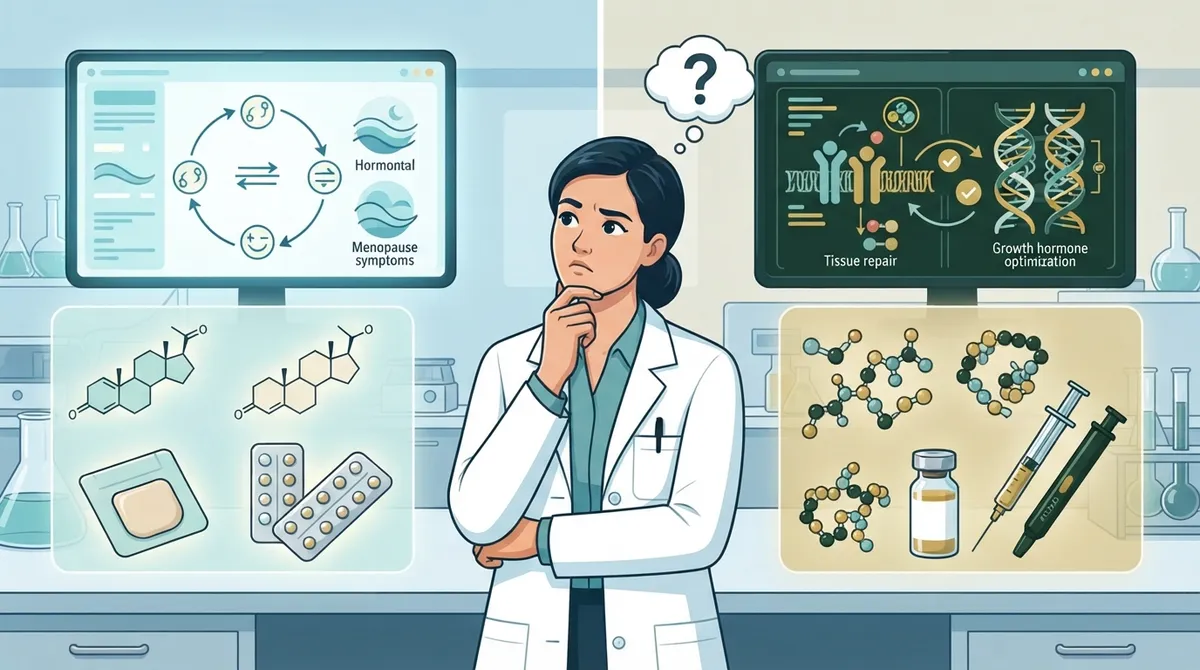
This is the biggest mix-up we see. Hormone replacement therapy, also called menopausal hormone therapy (MHT), uses steroid hormones like estrogen and progesterone. Peptides are completely different. They are short chains of amino acids that signal your body to do things like build tissue or regulate hormones, but they are not the same as steroid hormones themselves. If you want to understand the science better, this article on what are peptides is a great starting point.
Some clinics blur this line to sell products. A trustworthy provider will always be upfront about the difference and won’t pretend a peptide injection can replace estrogen therapy for hot flashes.
Mistake 2: Believing Peptides Alone Can Replace Estrogen
We love peptides for many things, like energy, recovery, and metabolism support. But right now, there is no peptide product approved to replace estrogen for moderate-to-severe hot flashes. Investigational research into kisspeptin and neurokinin signaling is interesting, but it’s not ready for prime time.
According to a review published by the National Library of Medicine, systemic estrogen therapy remains the most effective treatment for vasomotor symptoms, reducing hot flash frequency by about 75% compared with placebo. That’s a big number, and it’s why estrogen-based HRT still leads the pack for many women.
Mistake 3: Skipping Progesterone When You Still Have a Uterus
Here’s a mistake that can actually be risky. If you still have your uterus, taking estrogen alone can raise your risk of endometrial hyperplasia and even endometrial cancer. That’s why most people with an intact uterus need a progestogen alongside estrogen.
People who’ve had a hysterectomy usually don’t need this extra step, so treatment plans really do need to be personalized based on your specific situation.
Mistake 4: Ignoring Your Personal Risk Factors
Not everyone is a good candidate for hormone therapy. Some situations call for extra caution or a completely different approach. Before starting HRT, it’s smart to review your history with a licensed provider who can check for:
- Unexplained vaginal bleeding
- Current or past estrogen-sensitive cancers
- History of blood clots, stroke, or heart disease
- Significant liver disease
- Inherited clotting disorders
If any of these apply to you, your provider may suggest a nonhormonal option instead, which we’ll cover further down.
Mistake 5: Assuming All Estrogen Delivery Methods Are the Same
Estrogen comes in several forms, and picking the right one matters more than people realize. Here’s a simple breakdown:
| Delivery Method | How It’s Used | Good to Know |
|---|---|---|
| Oral Tablets | Swallowed daily | Convenient, but processed through the liver |
| Transdermal Patch | Worn on skin, changed weekly or twice weekly | May carry lower clotting risk for some patients |
| Topical Gel or Spray | Applied daily to skin | Flexible dosing, avoids first-pass liver metabolism |
| Vaginal Ring/Cream | Local application | Mainly for vaginal symptoms, less systemic effect |
Your provider should walk you through which option fits your health profile, not just hand you a default prescription.
Mistake 6: Waiting Too Long to Start Treatment
Timing matters with hormone therapy. Current guidance suggests that MHT is generally most appropriate for people younger than 60 or within 10 years of their last period, assuming there are no contraindications. Waiting many years past menopause onset can change the risk-benefit balance.
If you’re on the fence, don’t just wait it out and suffer through the night sweats. Talk to a provider sooner rather than later.
Mistake 7: Using the Wrong Dose for Too Long
More isn’t always better. The standard approach is to use the lowest effective dose for the shortest time needed to control symptoms, then reassess. This isn’t about rushing you off treatment, but about making sure your plan stays right-sized for your body and your goals.
Mistake 8: Overlooking Nonhormonal Options
Not everyone wants or can take hormones, and that’s okay. There are solid nonhormonal choices backed by real clinical trials. Here’s a quick rundown:
- Fezolinetant (Veozah): An oral neurokinin-3 receptor antagonist approved by the FDA in May 2023. It’s not a hormone or a peptide, but it targets the brain pathway involved in temperature regulation.
- Paroxetine: An SSRI specifically approved for menopausal hot flashes.
- Other SSRIs/SNRIs: Sometimes prescribed off-label for symptom relief.
- Gabapentin: Can help reduce nighttime hot flashes and improve sleep.
- Oxybutynin: Another option your provider might consider based on your history.
Clinical trials on fezolinetant showed it cut moderate-to-severe hot flashes by roughly half in postmenopausal participants, with some people noticing improvement in as little as one week. Benefits held up through 52 weeks in extension studies, which is reassuring for anyone worried about long-term results.
Mistake 9: Trusting Unregulated Compounded Products
Compounded bioidentical hormones and unapproved peptide injections are sometimes marketed as safer or more natural. But there isn’t strong evidence to back up those claims. In fact, quality control and dosing consistency can be real problems with compounded products.
If a product promises to reverse menopause or eliminate hot flashes overnight, that’s a red flag. Reliable providers focus on FDA-approved options first, and only consider other approaches with careful monitoring.
Mistake 10: Not Getting Proper Blood Work First
You wouldn’t build a house without a blueprint, right? The same goes for hormone health. A proper workup should look at your hormone levels, liver function, and other markers before your provider recommends anything. This is exactly why Allura Longevity starts every client with a $50 virtual consultation and LabCorp blood work, so your plan is based on your actual numbers, not guesswork.
Mistake 11: Choosing a Clinic Without Licensed Medical Oversight
Hormone therapy isn’t a set-it-and-forget-it deal. It needs regular check-ins and dose adjustments. Look for a clinic with licensed providers who monitor your progress over time.
Allura Longevity’s care is led by Ashley, a board-certified Family Nurse Practitioner, who designs personalized six-month treatment plans and adjusts them based on how your body responds. If you’re curious how this process works, this guide on how to start peptide therapy safely and see real results breaks it down step by step.
Mistake 12: Forgetting That Hot Flashes Can Be Part of a Bigger Picture
Hot flashes rarely show up alone. Many women also deal with sleep issues, mood swings, low energy, or changes in metabolism during this stage of life. A good treatment plan looks at the whole picture, not just one symptom.
This is where personalized peptide therapy can play a supporting role, addressing things like sleep quality, energy, and recovery alongside your primary hormone treatment. If you’re curious about how peptides support overall wellness, check out this resource on 8 facts that explain what are peptides in 2026.
Mistake 13: Assuming Telehealth Can’t Handle This
Some people think hormone therapy has to happen in person, but that’s not true anymore. Telehealth makes it possible to get blood work done locally, meet with a licensed provider virtually, and have your treatment delivered right to your door.
This matters a lot for busy professionals who don’t have time for repeated office visits. If you’re weighing your options, this comparison of local clinic vs. telehealth for peptide therapy might help you decide what fits your lifestyle.
Mistake 14: Giving Up After One Bad Experience
Maybe you tried a hormone product once and it didn’t work, or you had side effects that scared you off. Please don’t let one experience close the door forever. Hormone therapy is highly individualized, and the right dose, delivery method, or combination can make a huge difference.
Here’s a quick checklist to help you reset and move forward with confidence:
- Get updated blood work before trying anything new
- Ask your provider about different delivery methods (patch vs. oral vs. gel)
- Discuss whether a nonhormonal option might suit you better
- Make sure someone is monitoring your progress regularly
- Give any new plan at least a few weeks before judging results
How Allura Longevity Supports Your Hormone Health Journey
We know navigating hot flashes and hormone health can feel overwhelming. That’s exactly why Allura Longevity focuses on personalized, medically supervised care. Every client starts with blood work, gets a customized six-month plan, and receives ongoing support from licensed providers who actually track your progress.
We’re proud to offer telehealth services nationwide, with licensing in Florida, Georgia, Texas, Connecticut, Indiana, Maryland, New York, and California. Whether you’re exploring hormone therapy, peptide support for energy and recovery, or both together, our team is here to help you build a plan that fits your body and your life. Spots are limited each month, so if you’ve been putting this off, now’s a good time to reach out.
A Quick Comparison: HRT vs. Peptide Therapy vs. Nonhormonal Options
| Approach | What It Is | Best For |
|---|---|---|
| HRT (Estrogen +/- Progestogen) | Steroid hormone replacement | Moderate-to-severe hot flashes, no contraindications |
| Fezolinetant | Nonhormonal oral medication | Those who can’t or don’t want to use hormones |
| Peptide Therapy | Amino acid chains supporting body signaling | Energy, recovery, metabolism, sleep support |
Understanding where each option fits can help you have a more productive conversation with your provider. If you’d like to explore how peptide therapy might complement your overall wellness goals, take a look at peptides for women to see what’s possible.
Final Thoughts on Choosing the Right Path
Hot flashes don’t have to run your life, and you don’t have to figure this out alone. Whether HRT, a nonhormonal medication, or a combination approach fits you best, the key is working with a provider who takes time to understand your health history and goals. We’d love to help you build a plan that actually works for your body. Request a consultation with our team today, or give us a call at (813) 510-6277 to get started. You deserve to feel comfortable, confident, and like yourself again.
FAQs
Q: Is HRT the most effective treatment for hot flashes?
A: Yes, for most people with moderate-to-severe hot flashes, systemic estrogen therapy is still the gold standard. It can reduce hot flash frequency by about 75% compared to placebo, which is a pretty impressive number if you’ve been struggling with symptoms.
Q: What is the difference between HRT and peptide therapy for menopause?
A: Great question, and one we get a lot! HRT uses steroid hormones like estrogen and progesterone, while peptides are amino acid chains that work differently in the body. They’re not interchangeable, though peptides can be a helpful complement for energy, recovery, and overall wellness alongside hormone care.
Q: Can peptide therapy replace estrogen or progesterone for hot flashes?
A: Not right now. While research into peptides like kisspeptin is interesting, there’s no approved peptide product that replaces estrogen for treating hot flashes. We always recommend sticking with evidence-based options for symptom relief.
Q: What are the nonhormonal alternatives to HRT for menopausal hot flashes?
A: There are several solid choices, including fezolinetant (approved by the FDA in 2023), paroxetine, other SSRIs or SNRIs, gabapentin, and oxybutynin. Your provider can help you figure out which one lines up best with your health history.
Q: How quickly does HRT or fezolinetant relieve hot flashes?
A: Many people notice improvement within a few weeks of starting HRT, and fezolinetant has shown symptom reduction in as little as one week in clinical trials. Everyone responds a little differently, so patience and good communication with your provider really help.





