

Key Takeaways
-
Intimate health peptide therapy is a marketing phrase, not a diagnosis, and only bremelanotide (Vyleesi) has an FDA-approved sexual-health indication: premenopausal women with acquired, generalized HSDD.
-
Bremelanotide's label limits matter: 1.75 mg subcutaneously at least 45 minutes before sex, no more than one dose in 24 hours, no more than eight doses per month, and stop after eight weeks without improvement.
-
Bremelanotide can briefly raise blood pressure and lower heart rate, so uncontrolled hypertension or known cardiovascular disease is a contraindication; disclose your blood pressure, heart history, and all medications.
-
Oxytocin and kisspeptin evidence for sexual function is mixed or preliminary, and some randomized trials found no significant benefit over placebo, so promising animal or lab results are not proof of human results.
-
Research-market 'research use only' peptides carry unknown identity, purity, and sterility risks; a clinician-guided prescription with labs, dose guidance, and follow-up is the safer route.
-
Low desire can stem from thyroid issues, low testosterone, perimenopause, depression, sleep problems, or medications, so get a clinician evaluation and labs before starting any peptide.
Let’s be honest: talking about sexual wellness can feel awkward. Maybe your desire isn’t what it used to be. Maybe you’ve seen ads for a “miracle peptide” and wondered if it could help. You’re not alone, and there is no shame in asking questions.
Here’s the tricky part. Intimate health peptide therapy is a catchy marketing phrase, not a medical diagnosis. It can mean very different things depending on who is using the words. Some peptides have real FDA approval for a narrow use. Many others have only early research behind them. Mixing those up is where people get into trouble.
In this friendly guide, we’ll walk through nine common mistakes people make in 2026 when exploring peptides for sexual wellness. You’ll learn what is proven, what is still unproven, and how to protect your health and your wallet. Think of this as a chat with a knowledgeable friend who wants you to feel informed and confident. If you’re new to the topic, our guide 8 Facts That Explain What Are Peptides in 2026 is a great starting point.

What Intimate Health Peptide Therapy Really Means
Peptides are short chains of amino acids that act as signals in the body. Some influence hormones, some affect the brain, and some help tissue repair. For a plain-language overview, see this explainer on what are peptides.
When people say “intimate health peptide therapy,” they usually mean peptides discussed for:
- Low sexual desire
- Trouble with arousal
- Erectile concerns
- Reproductive hormone pathways
The evidence is not the same for each one. The table below gives a quick snapshot.
| Peptide | Often Discussed For | FDA Sexual-Health Indication? | Evidence Level |
|---|---|---|---|
| Bremelanotide (Vyleesi, also called PT-141) | Low desire in premenopausal women | Yes, for acquired, generalized HSDD | Pivotal trials supported approval |
| Oxytocin | Arousal and bonding | No | Mixed or limited |
| Kisspeptin | Reproductive hormone signaling | No | Preliminary |
| Melanotan II | Tanning, sometimes libido | No | Insufficient safety data |
| Gonadorelin | Hormone axis support | No sexual-health indication | Not established for sexual function |
Notice how only one row has a clear FDA-approved sexual-health use. That single fact helps you avoid most of the mistakes below.
Mistake 1: Assuming All “Intimate” Peptides Are Approved
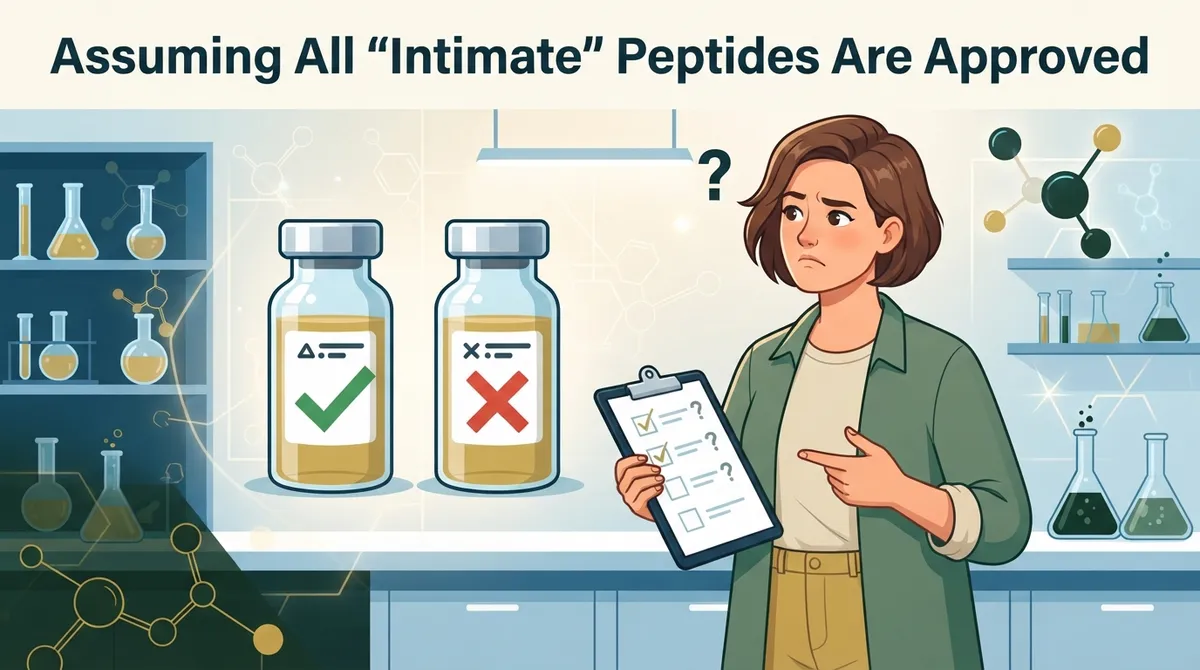
This is the big one. FDA approval of bremelanotide for one specific group does not approve other peptides, other formulas, or other claims.
Vyleesi is approved for premenopausal women with acquired, generalized hypoactive sexual desire disorder (HSDD). The low desire must cause distress and not be mainly explained by another medical or psychiatric condition, relationship problems, or medication or substance effects. It is not approved for men, for postmenopausal women, or for general performance enhancement.
So if a website claims a peptide is “FDA approved for libido” and it isn’t bremelanotide for that narrow group, be skeptical.
Mistake 2: Ignoring the Official Dosing Rules
More is not better. The FDA label for bremelanotide is quite specific:
- The dose is 1.75 mg by subcutaneous injection in the abdomen or thigh.
- Use it at least 45 minutes before anticipated sexual activity.
- Do not use more than one dose in 24 hours.
- Do not exceed eight doses per month.
- Stop after eight weeks if you notice no improvement.
These limits exist because of how the medicine affects blood pressure and nausea. A clinician should confirm you meet the indication and review your history before you start. You can read the full prescribing information on the FDA’s site.
Mistake 3: Skipping the Cardiovascular Check
Bremelanotide can cause a short-term rise in blood pressure and a drop in heart rate. For that reason, it is contraindicated in people with uncontrolled high blood pressure or known cardiovascular disease.
Many people never think to mention their blood pressure when they ask about libido. But it matters a lot. A good provider will ask about:
- Your blood pressure readings
- Heart history and family history
- Every medication and supplement you take
- Any history of nausea, stomach emptying problems, or skin pigmentation changes
The label also warns about focal hyperpigmentation and delayed gastric emptying, and it advises caution with certain other medicines. Honest answers keep you safe.
Mistake 4: Brushing Off the Side Effects
Side effects are real, and you deserve to hear about them up front. Commonly reported effects of bremelanotide include:
- Nausea (the most talked-about one)
- Flushing
- Headache
- Vomiting
- Injection-site reactions
None of this means the treatment is “bad.” It means it is a real medicine with real effects. If you want a broader look at safety, check out Is Peptide Therapy Safe? What You Really Need to Know.
Mistake 5: Believing Animal Studies Prove Human Results
You may have read that a peptide “boosts desire in studies.” Often, those studies were in animals or in tiny groups. Biological plausibility is not the same as clinical proof.
Oxytocin is a perfect example. A 2024 narrative review describes its sexual-function evidence as mixed. In one study, intranasal oxytocin did not change sexual drive, arousal, or orgasm during self-stimulation. A 2022 randomized study of intravaginal oxytocin also found no significant improvement in its primary sexual-function outcome compared with placebo. The authors called for more research. You can browse studies like these through the National Library of Medicine.
The lesson: “promising” is not “proven.”
Mistake 6: Expecting a Pill-Like Fix for Everything
In the FDA label’s two pivotal studies, bremelanotide beat placebo on the Female Sexual Function Index desire domain and on a distress measure. That is encouraging. But statistical significance does not mean every person benefits, and it does not mean every part of sexual function improves.
Desire is complex. Stress, sleep, mood, relationships, hormones, and medications all play a role. Peptides, when appropriate, are one piece of a bigger picture. That is why a full assessment matters more than any single product. Our article on 8 Peptide Facts That Redefine Sexual Wellness in 2026 goes deeper on this big-picture view.
Mistake 7: Buying From Research-Market Sellers
This one worries clinicians the most. Unapproved or “research use only” products sold online can have uncertain identity, purity, strength, and sterility. You might not be injecting what the label says.
Here is a simple comparison.
| Factor | Clinician-Guided Prescription | Research-Market Product |
|---|---|---|
| Medical screening | Yes, history and labs reviewed | Usually none |
| Dose guidance | Based on label and your profile | Guesswork or forum advice |
| Product quality | Sourced through regulated pharmacy channels | Unknown purity and sterility |
| Follow-up | Ongoing monitoring | None |
To understand the difference between product types, read FDA-Approved vs. Compounded Peptides: What Wins? and How to Get Prescription Peptides Safely in 2026.
Mistake 8: Assuming Peptides Are Only for Women (or Only for Men)
Sexual wellness looks different for everyone. Bremelanotide’s approved use is specific to premenopausal women with HSDD. For men, sexual health concerns often involve testosterone, blood flow, stress, sleep, or medications, and a different type of workup applies.
That doesn’t mean men are out of options. It means the right path starts with proper testing and a conversation, not a trendy injection. If you’re curious about male-focused options, explore PT-141 vs. Viagra: Which Wins for Men’s Sexual Health? and our overview of peptides for men. Women can learn more in 6 Real Treatments for Low Libido in Women (2026) and our page on peptides for women.
Mistake 9: Starting Without Labs or a Clinician
If you take only one thing from this article, let it be this: don’t self-inject based on a forum post. Low desire can be tied to thyroid issues, low testosterone, perimenopause, depression, sleep problems, or medication side effects. Treating the wrong cause wastes time and money.
A smart start looks like this:
- Book a visit with a licensed clinician who listens.
- Share your full health history and current medications.
- Get blood work to look for hormone and metabolic clues.
- Review which options are approved, which are off-label, and which are unproven.
- Set a clear check-in plan to measure real progress.
This is the approach we describe in How to Start Peptide Therapy Safely and See Real Results.
Questions to Ask a Clinician Before You Begin
Bring this short list to your appointment. It helps you feel prepared and in charge.
- Do I meet the approved indication, or would this be off-label?
- What is the evidence for this specific peptide and my situation?
- What are the risks given my blood pressure and medications?
- Where does the product come from, and who prepares it?
- How will we decide whether it is working, and when do we stop?
A confident provider will welcome these questions. If someone gets defensive, that tells you something too.
How Allura Longevity Approaches Sexual Wellness
At Allura Longevity, we believe personalization beats guesswork. Our licensed providers, led by board-certified Family Nurse Practitioner Ashley, start with a $50 virtual consultation and LabCorp blood work. From there, we build a customized plan around your goals, delivered to your home, with ongoing monitoring and adjustments. Telehealth is available in Florida, Georgia, Texas, Connecticut, Indiana, Maryland, New York, and California.
We’re also honest about what the science supports. Some options have strong evidence, some are early, and some aren’t a fit for you. That honesty is the foundation of good care. If you want to compare formats, see Local Clinic vs. Telehealth: Best Peptide Therapy Near You?
Your Next Step
Intimate wellness is a normal, healthy part of life, and wanting to feel like yourself again is completely valid. The goal isn’t to chase the flashiest peptide. It’s to find a safe, evidence-aware plan that fits your body. Avoid the nine mistakes above, ask good questions, and lean on a qualified clinician.
Ready to talk it through with someone who will listen? Request a consultation with Allura Longevity, or call (813) 510-6277. Spots for new clients are limited each month, so reach out while there’s room.
This article is for education only and is not medical advice. Always speak with a licensed clinician about your individual health needs.
FAQs
Q: What is intimate health peptide therapy?
A: It’s a broad marketing phrase, not a medical diagnosis. It usually refers to peptides discussed for sexual desire, arousal, or reproductive hormone pathways, and the evidence varies a lot from one peptide to the next. A clinician can help you sort what’s proven from what’s still experimental.
Q: Is PT-141 (bremelanotide) FDA approved, and who can use it?
A: Bremelanotide (Vyleesi) is FDA approved for acquired, generalized hypoactive sexual desire disorder in premenopausal women when the low desire causes distress. It isn’t approved for men, postmenopausal women, or general performance enhancement, and it requires a prescription and a medical review first.
Q: What are the side effects and risks of bremelanotide?
A: Common effects include nausea, flushing, headache, vomiting, and injection-site reactions. It can briefly raise blood pressure and lower heart rate, so it’s not for people with uncontrolled hypertension or known cardiovascular disease. Your provider will review your health history before prescribing.
Q: Are peptides like oxytocin or kisspeptin proven to improve sexual function?
A: Not yet. Research on oxytocin has been mixed, including studies where it didn’t significantly improve sexual-function outcomes, and kisspeptin evidence is still preliminary. Promising lab findings don’t always translate into real-world results for people.
Q: Are compounded or online sexual-health peptides safe?
A: It depends on the source, and research-market products are the riskiest because their identity, purity, and sterility can be uncertain. The safest route is working with a licensed clinician who prescribes through regulated channels and monitors you along the way.





